Photo Essay: The Unquiet Streets--Rediscovering Bombay's Years of Civil Disobedience
A rare album from the Alkazi Collection of Photography offers a remarkable visual record of the Civil Disobedience Movement in Bombay (1930–31)
 Desh-sevikas (‘Handmaids of the Nation’) picketing the entrance to the Town Hall with a slogan in Marathi reading "Alcohol dehumanizes Man." c. 1930–1931. © The Alkazi Collection of Photography
A rare album from the Alkazi Collection of Photography—known as the ‘Nursey’ album after the enigmatic name stamped on its spine—offers a remarkable visual record of the Civil Disobedience Movement in Bombay (1930–31). These images chronicle marches, arrests, and moments of collective defiance that animated India’s struggle for freedom.
Beyond their historical resonance, the photographs reveal how visual storytelling itself became an act of resistance. Presented here are 10 striking selections from the collection that illuminate the power of the crowd, the courage of dissent, and the artistry behind a nation in motion.
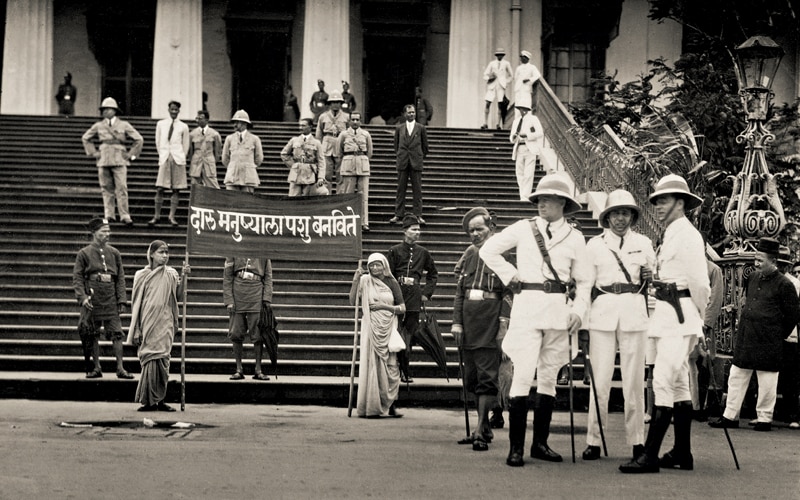 In these symbolically resonant images, the protesters, particularly women—whether general volunteers, desh sevikas or picketers from diverse communities politicized/mobilized by the nationalists—have literally turned their backs on the intimidating, hierarchical, exclusionary edifice of colonial privilege, power and oppression; instead, by addressing mass audiences in public spaces they are scripting and conducting a radically different mode of participatory dissent.
—By Preeti Chopra
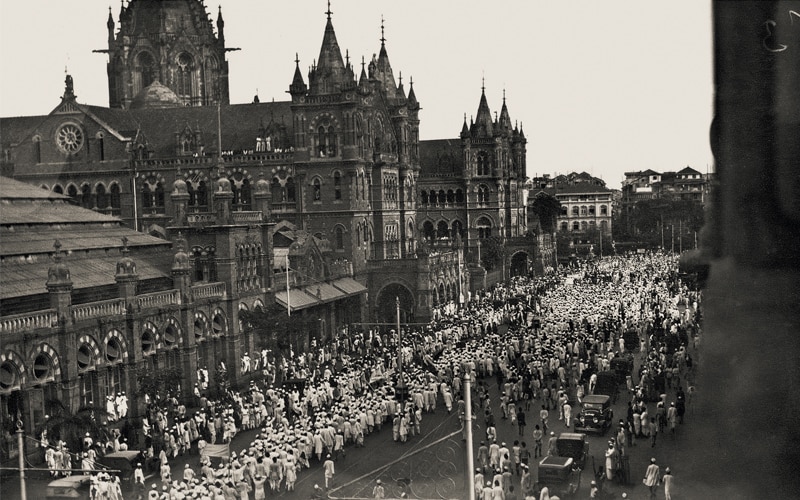 A procession organized by the Bullion Market, Bombay passing the Victoria Terminus, 1930-31. The extended diagonal of white-clad participants is accentuated by the dark diagonal of the station’s facade.
In order to maximize visibility while protesting outside edifices of colonial power, protesters took up positions at the entrance or just beyond. Such positioning makes us aware of the building’s threshold, a place of crossing from one realm to the other, reminding us of two ever antagonistic realms—the imperial and the nationalist—intimately bound in ferocious incompatibility.
—By Preeti Chopra
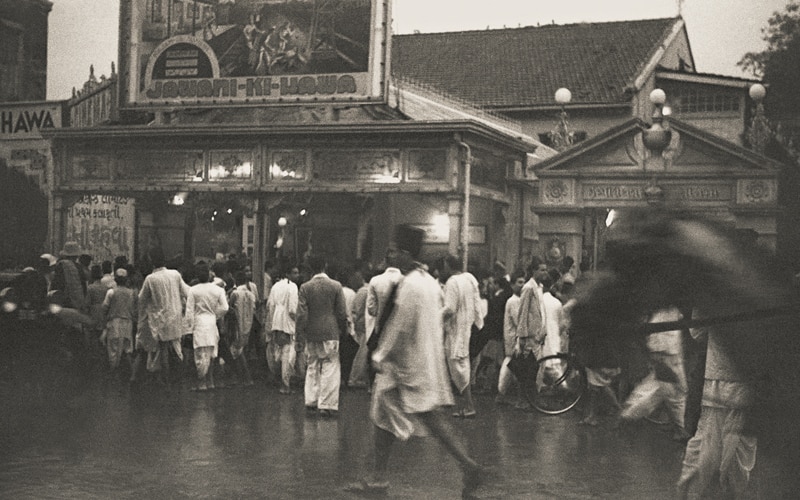 Crowds outside Imperial Cinema in Bombay being surveilled by police during the premiere of Bombay Talkies’ debut Hindi film Jawani Ki Hawa (1935).
It is in the early 1930s that cinema emerged as a conspicuous site for—and subject of—political debate, negotiation and contestation in colonial India. By the late 1930s, a robust anti-colonial cultural movement had sprung up against foreign films that displayed a patently racist or imperialist agenda in their depictions of India. Whether we examine the censor’s control of films considered unsuitable in a factory town, or the nationalist Indian’s outrage against racist representation, we are confronted by a widespread belief in the power of cinema to sway hearts and minds.
—By Debashree Mukherjee
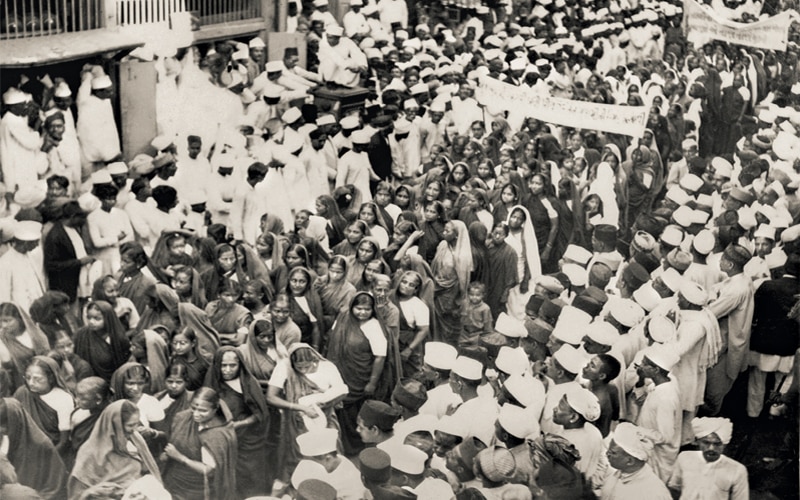
A takli procession organized by the Congress to encourage the art of hand spinning. c. 1930–1931.
When hundreds of women embarked upon a takli (traditional spindles used in hand spinning) procession through Bombay’s streets in the thick of the Civil Disobedience Movement, they did much more than simply demonstrate their fervour for khadi cloth and other domestically produced goods. Rather, they orchestrated a remarkable reversal of street politics in Bombay: one where women took centre stage and men were relegated to being mere onlookers, with many of them sequestered under the eaves of nearby houses.
—By Dinyar Patel
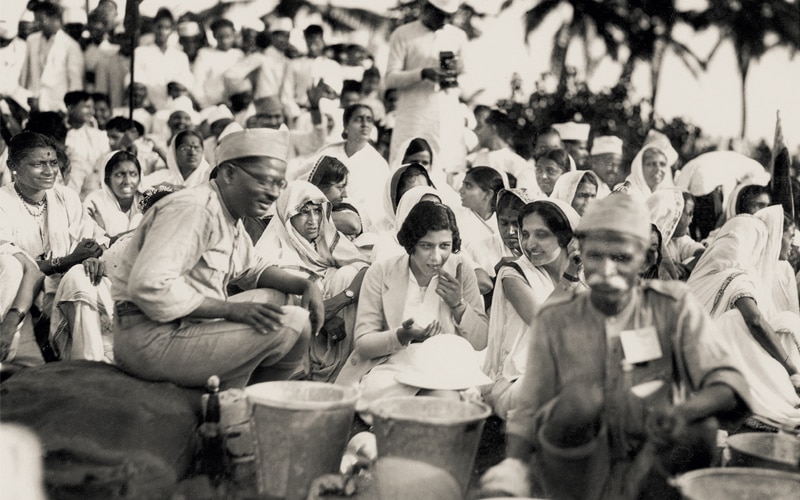
“Some prominent people (sic)” tasting the salt prepared in Worli, 1930.
When M. K. Gandhi broke the salt laws in Dandi, it was Bombay that scaled up the campaign of civil disobedience into a mass movement. Bombay’s disobedient residents not only had to learn how to forge a new relationship with the sea, but also had to be taught how to make it yield the precious mineral whose illicit extraction and possession enabled them to challenge the might of an empire. Manufacturing, selling and consuming contraband salt were all punishable offences under existing laws, but clearly these ‘prominent’ women—one of them quite stylish in appearance—did not care. They posed for the camera, delicately tasting the fruit of their patriotic labours, however crude and unpalatable it might have been.
—By Sumathi Ramaswamy
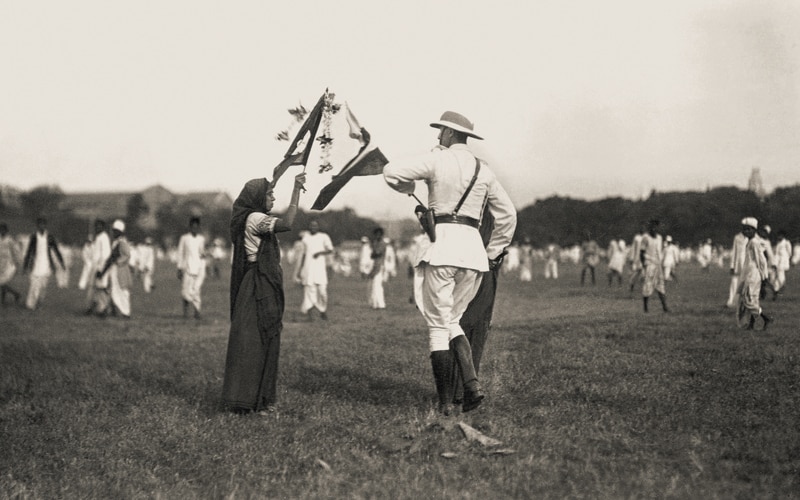 A police officer snatching the Congress flag from a desh sevika, c. 1930-31.
On 26 October 1930, when the Civil Disobedience Movement was at its crescendo, the Bombay War Council, attempted to hold a flag salutation ceremony at the Azad (‘Free’) Maidan, formerly a part of the Esplanade of Bombay, renamed so by the nationalists. After a group of male demonstrators were arrested, a group of women activists from the Desh Sevika Sangh entered the fray. A few women were arrested, but the rest were bundled into a police van, and dropped off in the Bombay Suburban District. Suburban Bombay had significant sites of nationalist protest, but did not seem to catch the attention of photographers. As a result, suburban Congress-women and their protest sites have suffered varying degrees of erasure from the larger historical narrative.
—By Murali Ranganathan
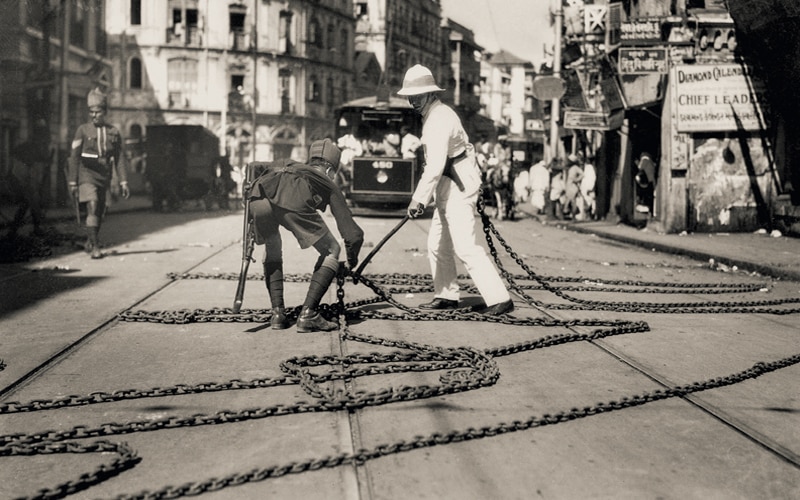 A hartal (strike) organized by the Congress, with chains strewn on the road at Dhobi Talao to stop trams.
Locals devised creative ways to deter the police from carrying out their regular duties. In one instance they brought the city to a halt by hindering the flow of traffic and public transport. In a deeply symbolic and aesthetically poignant photograph captured from a low angle, the foreground is dominated by cumbersome metal chains strewn across a cordoned-off section of the street, the loose arcs and ellipses of the chains offset by the rigid parallels of the tram tracks. Isolated, the two figures of colonial authority, interlinked, interdependent and mutually bound within their profession, are engaged in removing the chains—the constable, bending low, with his hand; the white officer, upright, with a lathi.
—By Avrati Bhatnagar
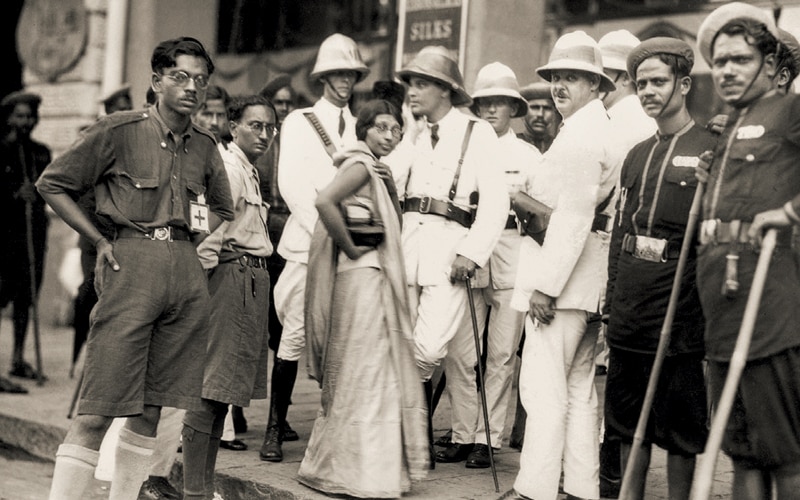 Congress leader Lilavati Munshi with a police posse in front of the Whiteaway Laidlaw store in the Fort area, likely in June 1930.
For all we have been told that women were at the heart of boycott movements, early images of boycott events at key stores do not feature women as central players. Instead, in these photographs, boycott appears to be a male experience. The one exception here is a set of two images in front of Whiteaway featuring local Congress leader Lilavati Munshi. But in these photographs she is interestingly positioned, appearing not as a picketer prepared for arrest herself, but instead as a negotiator, coordinating the details of mass action.
—By Abigail McGowan
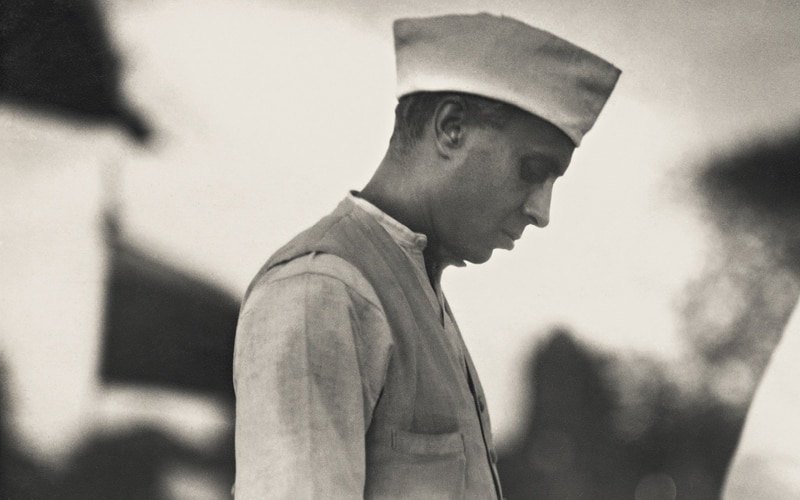 “Nehru addressing a meeting.” c. 1930–1931.
A handsome profile study of Jawaharlal Nehru “addressing a meeting”, reading from a prepared text—the background is out of focus, but it appears to indicate a flag and the silhouette of a crowd. Jawaharlal’s reliance on a text to read his speech indicates a level of nationalist organization and planning not evident in the later parts of the movement.
—By Kama Maclean
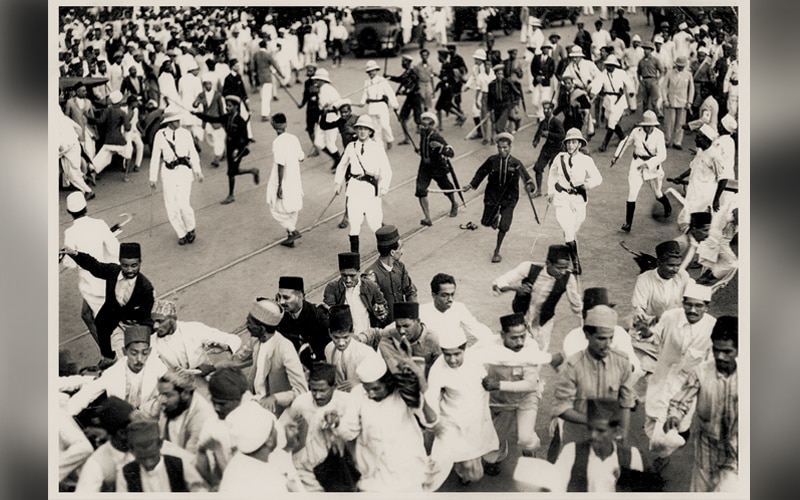 “The city police dispersing the huge crowds that had assembled to witness the proceedings on Garhwali day” (1930). This photograph was also published in The Times of India, 14 July 1930.
Demonstrations such as ‘Garhwal Day’, organized to celebrate the defiance of the Garhwal regiment of the British army, and ‘Tilak Day’ to commemorate the popular western Indian political (and Congress) leader, made headlines for how civil demonstrators showed up on the occasion and were met with brutal police violence.
—By Avrati Bhatnagar
All photos and edited excerpts from the book Photographing Civil Disobedience, Bombay 1930-31, edited by Avrati Bhatnagar and Sumathi Ramaswamy. Published by Mapin Publishing, along with the Alkazi Collection of Photography, in conjunction with the exhibition Disobedient Subjects: Bombay, 1930-1931 at CSMVS (in partnership with Alkazi Foundation), showing till 31 March 2026. The book is available on www.mapinpub.com