The Noida Entrepreneur who Devised a Fix for Cigarette Waste
Cigarette butts may be tiny, but their environmental impact is vast. Naman Gupta is tackling the problem
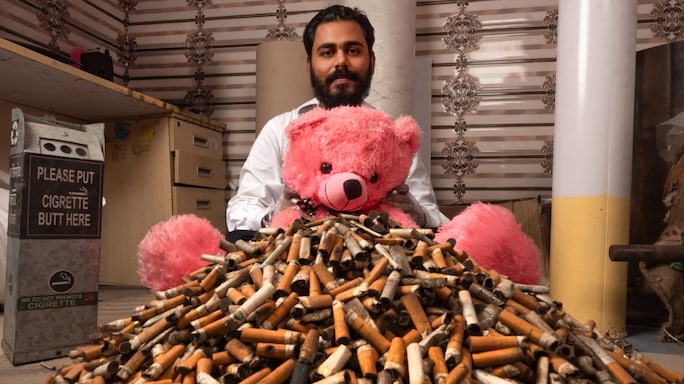 Naman Gupta devised a way to turn discarded cigarette butts into household items. Photo: Atul Kumar Yadav
On a cold January afternoon, inside a house in Noida’s Nangli village, 36-year-old Poonam and three other women sit huddled on the floor around a pile of fruit-shaped woollen plushies they have just made.
The scene feels rather unremarkable. These soft, colourful curios could easily pass for decorative objects found in any ordinary drawing room. But there’s one unexpected detail: they are stuffed with fibres recycled from discarded cigarette butts. Turning an everyday pollutant into something useful is the idea behind the work of 31-year-old entrepreneur Naman Gupta.
Growing up in Noida, Gupta was troubled by the sight of cigarette butts strewn across nearly every street and public area—and by the absence of any system to deal with the waste.
The scale of the problem remains staggering. Around 28.6 per cent of Indian adults (nearly 267 million people) use tobacco in some form, including cigarettes and bidis, according to the World Health Organization. It also reports that approximately 4.5 trillion cigarette butts are discarded globally every year, with India accounting for nearly 100 billion of them.
Cigarette butts are not just unsightly litter; they are a serious environmental hazard. The filters are made of cellulose acetate, a type of plastic that can take many years—or even up to a decade—to break down completely in the environment. As they linger in soil, waterways, and on streets, these butts slowly leach a cocktail of toxic chemicals—including nicotine, arsenic, lead, cadmium, and polycyclic aromatic hydrocarbons—into the ground and water, where they can harm plants, fish, and other wildlife. These toxins can persist long after the butt’s surface appears to have faded, contaminating ecosystems and posing risks to organisms that mistake them for food or absorb their runoff. This is why cigarette butts are considered one of the most pervasive forms of plastic pollution and hazardous litter worldwide.
“Countries like Singapore, Malayasia, New Zealand and the U.S. have bins specially installed by the government to properly dispose cigarette waste. India, however, has a massive regulatory and infrastructural gap in tackling the issue,” Gupta says. To address that gap, he launched Code (Conserving Our Depleting Environment) Enterprises in 2016, while still a third-year student at Delhi University.
For months, Gupta and his brother experimented with different methods to recycle cigarette waste. “We tested multiple chemical compositions. It took us four to five months to find the right one that recycled the waste,” Gupta recalls, adding, “Only after testing the recycled material in government-approved labs and getting their approval, did we form the company.” In 2018, the brothers rebranded the venture as CodeEffort Pvt. Ltd. and began collecting cigarette waste at scale.
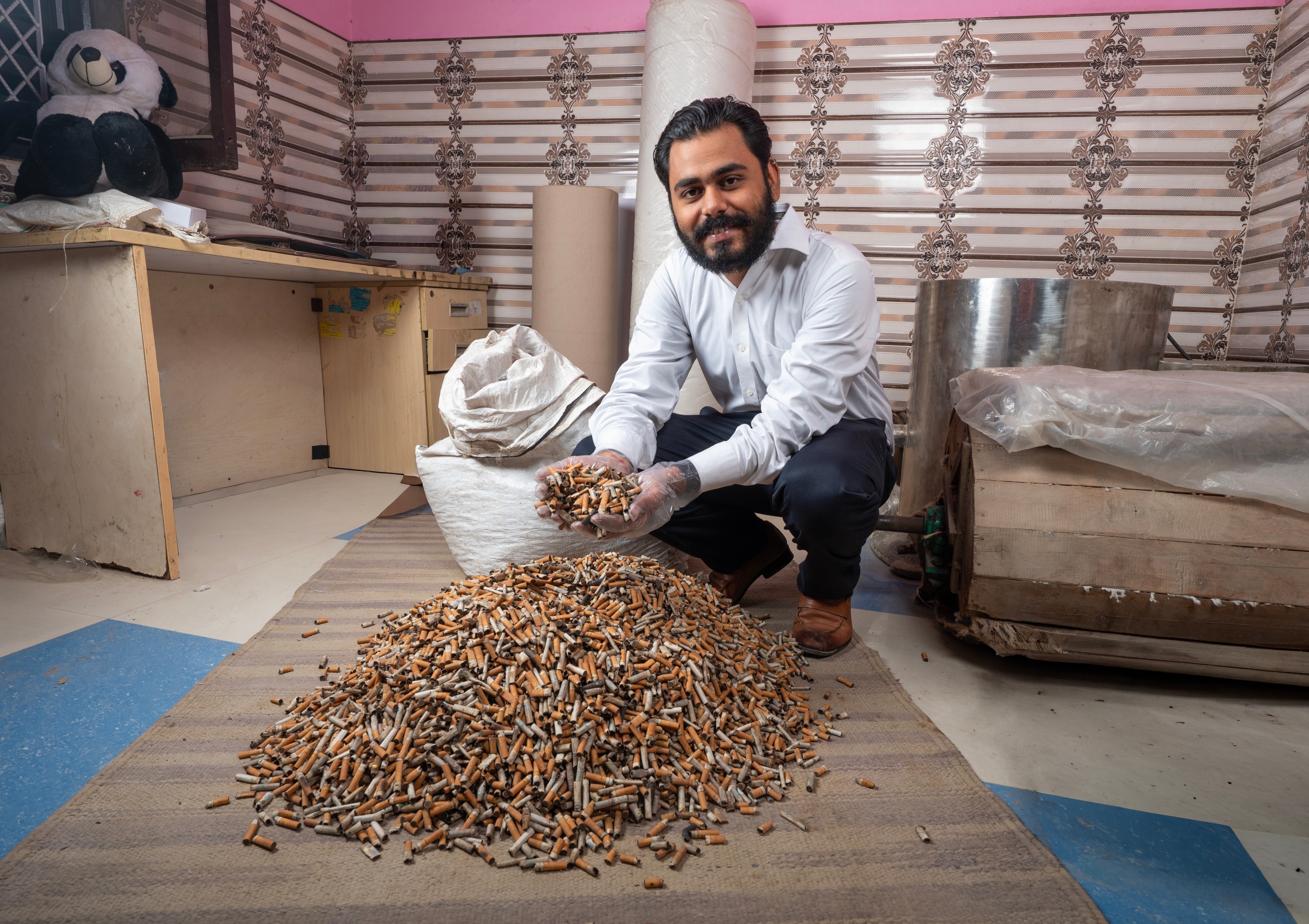
In 2019, the brothers set up a facility in Nangli to convert the collected waste into usable products. Each cigarette butt is manually separated into three components—tobacco, paper waste, and the cigarette filter. The tobacco is treated with bacteria and fungi in a compost pit for 28–30 days and turned into organic manure, which is sold to local nurseries and gardens. The paper waste is sent to a mill and recycled into paper. “This paper is used to manufacture carry bags, envelopes, handmade wrapping paper and A4 sheets, creating a commercially viable, recurring product line,” Gupta says.
The company’s most significant innovation lies in how it treats cigarette filters. The cellulose acetate that makes up the filters are cut into fibrous pieces using a specially fabricated cutting machine. These fibres are then soaked for 24 hours in a drum containing a biodegradable two-chemical solution—one removes trapped toxins and effluents, and the other restores the fibre’s natural white colour. After washing, the fibres are dried in a centrifuge. The process, Gupta explains, is designed to be sustainable. “Even waste water is treated and reused to wash the fibres.”
Once dried, the fibre is softened using a carding machine. It is then used as stuffing for plush toys and cushions, or repurposed into textiles, paper, bags, and mannequins, which are sold to other businesses. “Initially, we did not have the knowledge or network to create commercially viable products. So we just used the fibres as stuffing for toys and cushions. As we gained more experience, we expanded into paper and textile. These vectors have higher demand and greater use, which helped us scale as a business-to-business enterprise,” Gupta explains.
Gathering discarded butts was another big challenge. To streamline collection, the company designed and distributed special bins with narrow inlets, called ‘V-Bins’ to cigarette shops and commercial spaces with designated smoking zones. “These bins provide a continuous supply of raw materials for cigarette recycling and function as good branding tools,” Gupta says. From around 200 bins set up in Noida, CodeEffort has since installed over 3,00,000 bins across India in the past eight years, with collection centres in over 250 districts. “When we started, we barely collected 300 to 400 cigarette butts a day. Today, we collect 60 to 70 lakh butts a day, weighing close to two tonnes,” he adds. The company also operates through an association model, appointing individuals, groups, and small- or medium-scale enterprises as associates across towns and districts. These associates gather cigarette waste collected by networks of ragpickers and send it to the company.
On product safety, he is unequivocal. “We test every batch of the fibre at government-approved labs to comply with standards and maintain our ISO certifications. If any batch shows issues, we reprocess and test it again. We are committed to producing products that are completely safe for use.”
Beyond environmental impact, CodeEffort has created livelihoods. The company employs over 100 women in Nangli, for whom the initiative offers training and income opportunities that can be accessed from their homes and neighbourhoods. As she crochets an orange plushie, Poonam says, “We work around our chores and the targets set by the company. Depending on the volume of work, on a good month, I earn around ₹10,000 to ₹12,000, sometimes more. The work is good—we are helping reduce pollution and making something useful out of it.”
For more stories like these, click here