- HOME
- /
- Features
- /
- Cover Story
- /
Extraordinary Indians: Bertha Gyndykes Dkhar Lights the Way for Meghalaya's Visually Challenged
Her efforts have educated Meghalaya and much of Northeast India on disability, inclusion, and the value of human potential
 Bertha Gyndykes Dkhar developed Braille for Khasi speakers. Photo: Nilotpal Baruah
Bertha Gyndykes Dkhar still remembers the sting. It was the mid-1980s, and she sat across from a woman interviewing her for a central government job, freshly armed with a Master’s in Social Work. The job should have been hers. Then the interviewer placed a book in front of her. “Read this,” she said.
Bertha’s vision had been failing for years. By then, her world had narrowed to shadows and shapes. “I can’t see,” she said quietly.
“Yes, we just wanted to make sure,” came the reply. “You cannot take this job.”
That rejection could have ended her story. Instead, it became a turning point in a journey that would reshape how Meghalaya—and much of Northeast India—understands disability, inclusion, and human potential.
Today, at 66, Bertha is the Executive Director of Bethany Society, one of India’s most respected organisations working on inclusive education and disability rights. She is a Padma Shri awardee, the creator of Khasi Braille, and the architect of educational models now studied across the country. But the story of how she got here is less about accolades and more about a stubborn refusal to let the world tell her what she couldn’t do.
Bertha grew up in a family of educators and writers in Shillong. Her mother was the principal of the city’s first girls’ school. Five uncles were authors and academics. Books and spirited debate filled the house. But by age three, something was wrong. She fell constantly, collecting scars that would last a lifetime. At four, thick spectacles arrived. Classmates called her “bottle-bottom.” Then came night blindness, colour blindness, and the discovery that her left eye had stopped working. Her parents took her across India searching for answers. Doctors missed the real culprit: Retinitis Pigmentosa, a hereditary condition that would eventually claim her sight completely. Her younger brother developed it too.
People with RP walk in zigzag patterns. In Shillong’s close-knit community, concerned neighbours would tell her: “See, when you’re drunk, you don’t go out on your own.” It was meant as a joke. It didn’t feel like one.
Yet academically, Bertha soared. She skipped two grades, played piano, sang in church. But as she grew older, the weight of her difference pressed harder.
“I went through a big emotional turmoil,” she recalls. “I became very angry.” At 33, Bertha lost her vision completely. Back in Shillong after her MSW in Bangalore, she sold homemade jams and pickles, taught English to neighbourhood children. The central government job rejection stung. Another government position dissolved into politics. Then in 1992, a door opened. The very ophthalmologist who had diagnosed her RP was starting a school for the blind. “I don’t want this talent to get wasted,” she told Bertha’s mother.
The school that would become Jyoti Sroat was established in 1993 with eight students. Public opinion was harsh. A blind Khasi woman teaching blind children? “What foolish work is she doing?” people asked. But Bethany Society, which took over the school, saw capacity, not limitation. They sponsored Bertha’s training at the National Institute for the Visually Handicapped in Dehradun. There, she mastered Braille—it felt like solving a puzzle. When she returned, her principal gave her a challenge: “You have to develop Khasi Braille.”
Within a year, consulting with teachers and students, Bertha created both Grade 1 and Grade 2 Khasi Braille. The state’s Principal Secretary of Education endorsed it on the spot as Meghalaya’s official Braille code. By 2005, a question haunted Bertha: Why should blind children study in isolation? How would they survive if they never shared space with the world? She went to Carmo Noronha, Bethany’s Secretary. “Sir, let us make Bethany inclusive.”
They approached the government. Senior officials were blunt: “We do not want to promote this. It will lower the standard of education.”
Devastated but determined, Bertha said, “Sir, then let us do it ourselves,” and walked out.
In 2006, Jyoti Sroat became fully inclusive, admitting children with and without disabilities into the same classrooms. Ironically, when Sarva Shiksha Abhiyan rolled out, the same Education Department that had refused them came back, recognising Jyoti Sroat as a model school for inclusive education. It remains so today.
Bertha rejects euphemisms like divyang or differently-abled. “Disability is not shameful,” she says. “And it is not the person’s fault.” The problem, she insists, lies in barriers—buildings without ramps, classrooms without sign language, systems built for an imaginary “normal”. “We reject that word,” she says. “Normal applies to systems, not people.”
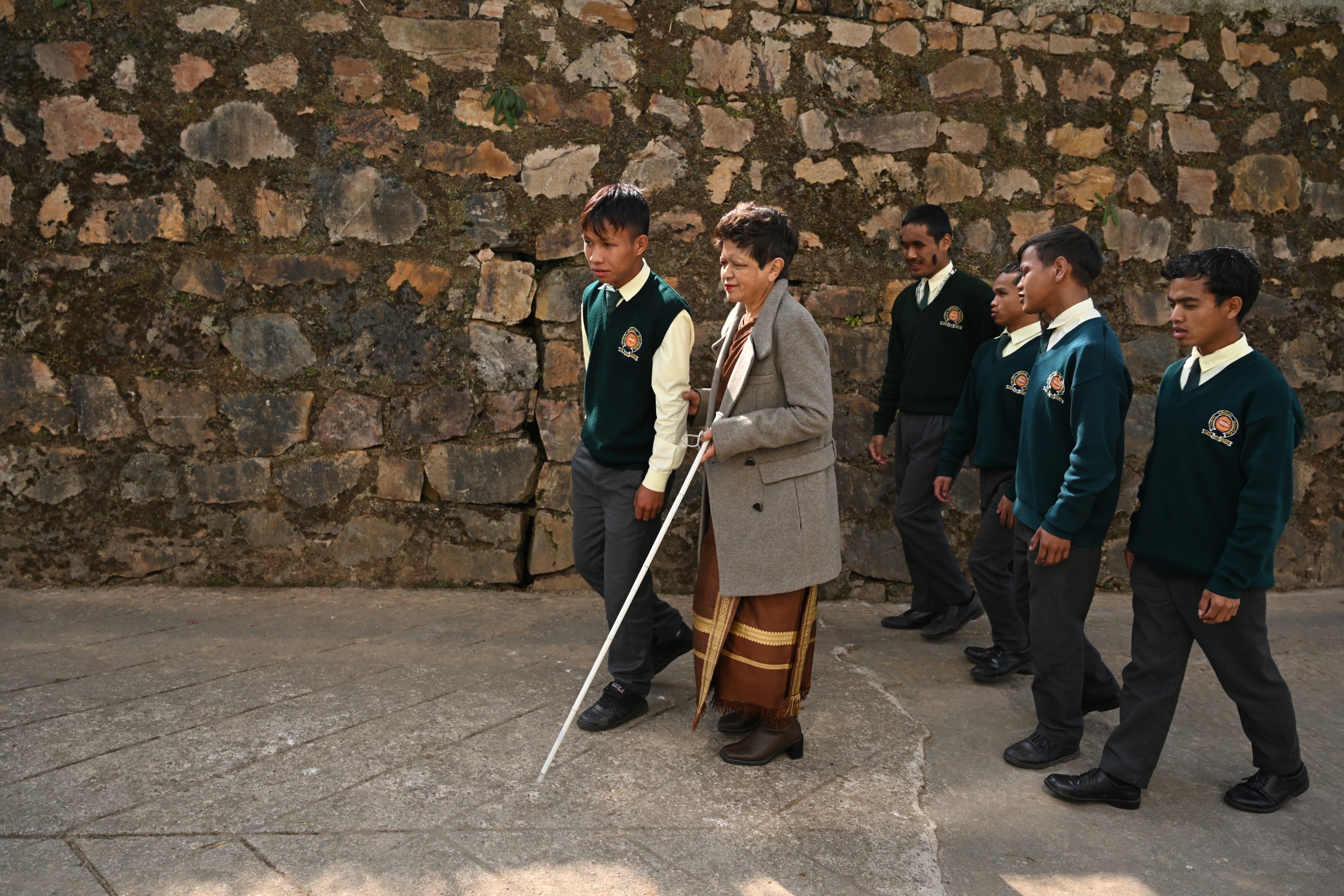
This understanding came from lived experience. When blindness came, barriers fell through simple solutions. Audio books replaced novels. A white cane replaced sight. “Even my own family had problems with me using a white cane,” she admits. “But I just did it. I commuted by public transport, changing taxis twice. They saw I could manage.”
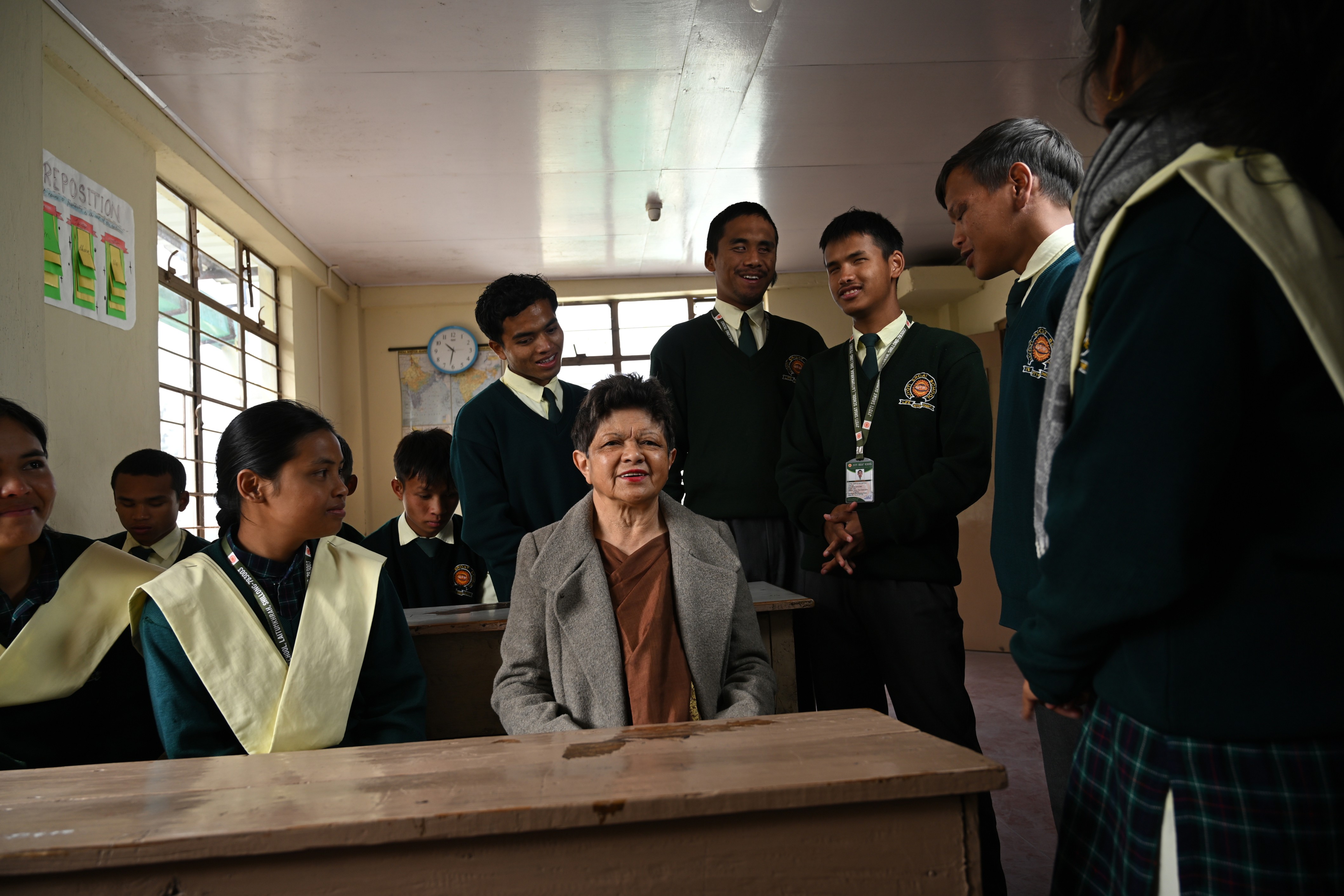
Through her involvement with national disability rights movements, Bertha became part of a growing voice demanding change. Public opinion shifted. Ten years after Jyoti Sroat opened, when students began passing board exams, the same communities that had mocked the school acknowledged its value. Attitudes slowly changed at the policy level, even if implementation lagged.
The recognition came gradually. In 2000, Bertha received the National Child Welfare Award. In 2008, the District Teacher Award from the Government of Meghalaya, followed by the State Teacher Award in 2009. Then came the Padma Shri in 2010, and so on.
“I didn’t do it for that,” she says simply. “It was my duty. This is part of life. We are here to contribute.”
What mattered more was the ripple effect. As a member of the Braille Council of India for over a decade, she travelled across the northeast, developing Braille codes for different dialects. In 1999, she became principal of Jyoti Sroat. In 2013, she stepped down to focus on broader education programmes. In 2023, she became Executive Director of Bethany Society.
Today, challenges remain. Data is outdated. Teacher training doesn’t address classroom variability. “Attitude is the biggest barrier,” Bertha says. “I discovered that in my own life. When I overcame the attitude of thinking ‘I am nothing,’ that changed everything.”
Asked what she would say to a young person facing the kind of rejection she once did, Bertha does not soften her answer. “Humiliation will come. Rejection will come,” she says. “But don’t blame society. Work with it. That is how the world changes.”
For more stories like these, click here