- HOME
- /
- Features
- /
- Classic Reads
- /
The Unforgettable Sam Manekshaw: The First Soldier Of India
Meet this famous warrior and jovial man of peace. An RD Classic from 1973

“An armed escort?” scoffed the dashing figure in Gurkha side-cap, his uniform ablaze with battle-ribbons. “I don’t need an armed escort in my own country.”
Protected by nothing more lethal than his swagger stick, Indian Army commander Sam Manekshaw strode into the encampment of 5,000 sullen Pakistani prisoners of war.
For the next hour, General Manekshaw chatted genially to the captives in their own tongues of Urdu and Punjabi, asking what units they were from, inviting complaints, urging them to write home. Noting the ease with which the general raised the morale of men who had good reason for disliking him, one grizzled Pakistani soldier confided, “Now I understand why your side did so well in the war.”
In December 1971, Manekshaw, as Chairman of the Chiefs of Staff Committee, led all three Indian armed services in a devastating victory over Pakistan. His forces held off a fierce attack along the western border from Rajasthan to Kashmir, and in a blistering 12-day campaign, liberated the 75 million people of East Pakistan—now Bangladesh.
In doing so, Manekshaw restored the fighting reputation of the Indian Army after their humiliating defeat by the Chinese in 1962. Moreover, he brought a better chance of peace and stability to the sub-continent than at any time since its 1947 partition into India and Pakistan. Last January [1973], the Indian Cabinet, service and government officials cheered themselves hoarse in the glittering, chandelier-lit Ashoka Hall of the President’s Delhi residence when Sam Hormuzji Framji Jamshedji Manekshaw became the first Indian to rise to the rank of field marshal. Known throughout India as Sam—not an abbreviation, but a name common in the 1,00,000-strong Parsi religious community—Manekshaw will stay on the active list for life “in recognition of his outstanding services.”
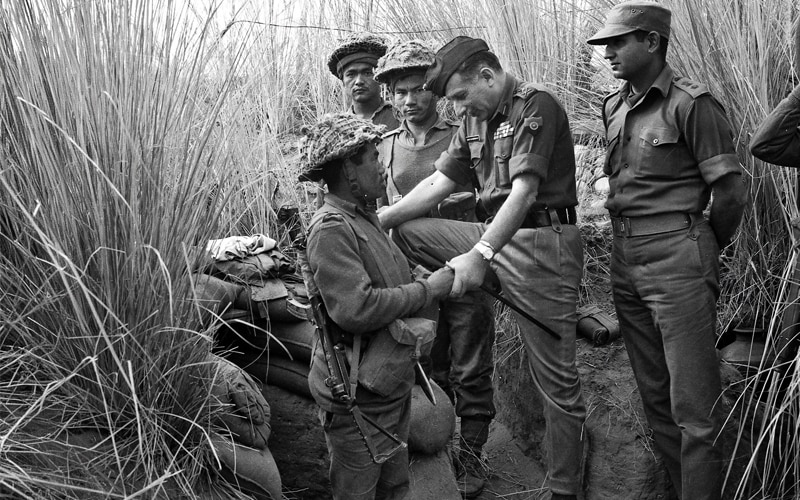 Manekshaw was never happier than when visiting his troops. Photo: PTI
No man, in fact, has been more suited to lead the polyglot, heterogeneous, 8,28,000-strong Indian Army. In addition to the official languages of Hindi and English, Manekshaw is fluent in Gujarati, Punjabi, Gurkhali and Urdu. Nicknamed ‘Sam Bahadur’—Hindi for ‘Sam the Brave,’ he has a fighting record that impresses even the Gurkhas, Sikhs, Dogras, Jats, Rajputs, Marathas and other legendary warriors of an army that has been volunteer since its foundation in 1895.
Above all, Manekshaw displays the gaiety and spirit that wins over a soldier of any land. Major-General James Lunt, a former defence adviser to the British High Commissioner in India, who first met Manekshaw in Burma in the dark days of 1942, told me, “Immediately, I recognized that extremely rare capacity to keep troops’ morale at a peak—however badly things might be going.”
Manekshaw is never happier than when visiting troops. In the past five years, he has travelled 48,000 kilometres a year to the remotest outposts—from the sweltering Rajasthan desert in the west, across icy northern Himalayan ranges, to the dense jungles of Assam in the east. Within minutes of arrival, he jokes with his men, swigging rum or tea from a standard-issue enamel mug. At night-time campfires, he leads traditional dances.
In the emotional months leading up to December 1971, Manekshaw toured virtually all his forward units, preparing them for the possibility of war. India, he pointed out, could not bear indefinitely the financial and social strain of 10 million refugees from East Pakistan.
Strict Resolve
While many Pakistani commanders fired their exclusively Muslim troops with talk of a “1,000-year holy war,” Manekshaw quietly reminded his Hindus, Muslims, Sikhs, Buddhists, Parsees, Christians and Jews of his uncompromising standards of discipline and restraint.
By the time Pakistani jets struck at eight Indian airbases at 5.47 p.m. on 3 December, 1971, Manekshaw was ready, having devised what Brigadier Kenneth Hunt, of the International Institute for Strategic Studies, calls one of “the most minutely detailed counter-offensives in recent military history.”
Keynotes of Manekshaw’s strategy in the east were speed, surprise and flexibility. While the Pakistanis were expecting lengthy pitched battles at certain key access points, the Indians unobligingly bypassed them, avoiding main roads and advancing along country tracks, through paddy fields and marsh.
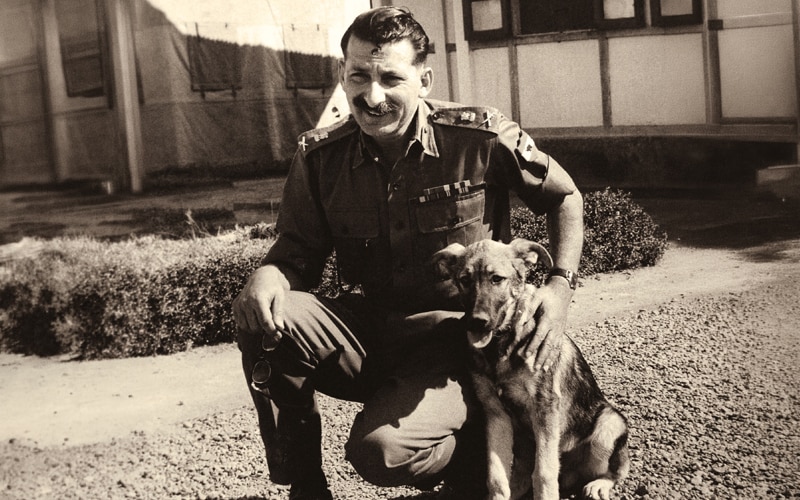 Manekshaw with his dog Piffer.
One night, to attack the enemy from the rear, lndian sappers laid a 32-km carpet of 90,000 duckboards. Leaving behind just enough troops to encircle Pakistani garrisons, Manekshaw closed in on Dhaka, capital of East Pakistan. He broadcast to the Pakistanis on All India Radio, detailing the hopelessness of their situation and appealing to them to lay down their arms: “We will give you the treatment befitting a soldier.”
At 4.31 p.m. on 16 December, Pakistani General Abdullah Niazi signed the instrument of surrender. As a Pakistani commander who had served with Manekshaw before Partition admitted: “We knew Sam would keep his word.”
Bangladesh exploded with joy and relief, giving the Indian Army of Liberation a tempestuous reception. Tough-looking Gurkhas stalked into Dhaka, bush hats weighed down with marigolds and water lilies. But Manekshaw was keenly aware how quickly the mood could turn to rancour and revenge. In less than nine months, the Pakistani Army and its collaborators had murdered an estimated 15 million, raped some 2,00,000 women and razed hundreds of villages. When 200 mutilated bodies of Bangladesh’s elite—politicians, doctors, professors, engineers, writers—were uncovered in a Dhaka brick-kiln compound after liberation, the stage was set for a bloodbath.
Wild-eyed guerrilla leaders spoke openly of avenging the deaths of their compatriots. One group rounded up five alleged collaborators and bayoneted four of them in front of a howling mob. Immediately, Manekshaw warned the guerillas that if they attempted similar atrocities, they would find themselves fighting the Indian Army.
For weeks, Bangladesh remained a seething cauldron of hatred. Manekshaw was so fearful for the safety of his 90,000 Pakistani prisoners that he allowed many to keep sidearms. Yet by the time Indian troops pulled out on 13 March 1972—having repaired roads, railways, bridges, airfields, and cleared more than 40,000 mines—the new nation had settled into relative calm.
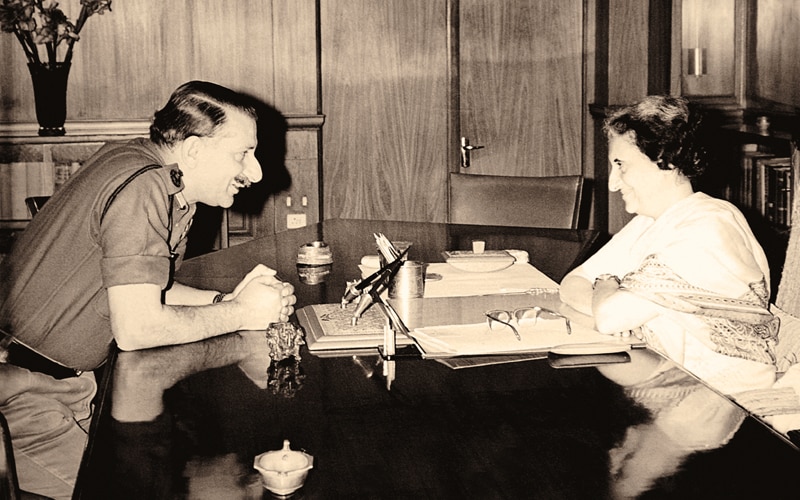 Manekshaw with Prime Minister Indira Gandhi. Their partnership saw India through to victory in the 1971 war with Pakistan, which led to the creation of Bangladesh.
Manekshaw’s diplomatic skill in preventing a massacre was the triumphant culmination of a hectic, 40-year career. Born in Amritsar in 1914, Sam Manekshaw graduated with the first batch of officers from the Indian Military Academy in Dehradun in 1934, and was posted to the Lahore-based Second Battalion of the Royal Scots. These Glaswegians taught the young sub-altern what he regards as his most valuable military lesson: “If you don’t take yourself too seriously and can prove yourself even tougher than your men, you can get them to do anything.”
Posted to the elite Frontier Force Regiment, Manekshaw led frequent actions against marauding Pathans in the mountains of the North-West Frontier. Then in 1941, his battalion was rushed to defend Burma against the Japanese attack. “We arrived in Rangoon,” Manekshaw recalls cheerfully, “just in time to receive the thrashing of our lives.”
The retreat through the Burma jungle ended abruptly for Manekshaw on 22 February 1942, when seven bullets from a Japanese machine gun whipped through his body. The young captain, who had just led two companies in the courageous capture of a vital hill, was awarded the Military Cross.
“We made an immediate recommendation,” a senior officer explained, “because you can’t award a dead man the Military Cross.”
Comeback
But Manekshaw made a remarkable recovery. After six months in hospital and a spell at Quetta staff training college, he eagerly rejoined the Frontier Force Regiment. “It was much more fun that time,” he says, recalling his satisfaction at chasing the Japanese as far east as Indo-China.
After the war, Manekshaw was one of the first Indian officers to join the Gurkhas. A 34-year-old brigadier, he became Director of Military Operations at Army headquarters during the crucial period following Partition. General Sir Roy Bucher, then British Commander in-Chief of the Indian Army, describes Manekshaw as “the very best staff officer I ever had. He would stand up to full generals and fight for what he believed to be the best plan—rather than meekly suggest what was expedient.”
When the Chinese mauled Indian forces in the border war of 1962, Manekshaw was swiftly promoted to lieutenant-general. Striding briskly into the conference hall of corps headquarters at Tezpur, Manekshaw mounted the dais and announced: “Gentlemen, there will be no more withdrawals.”
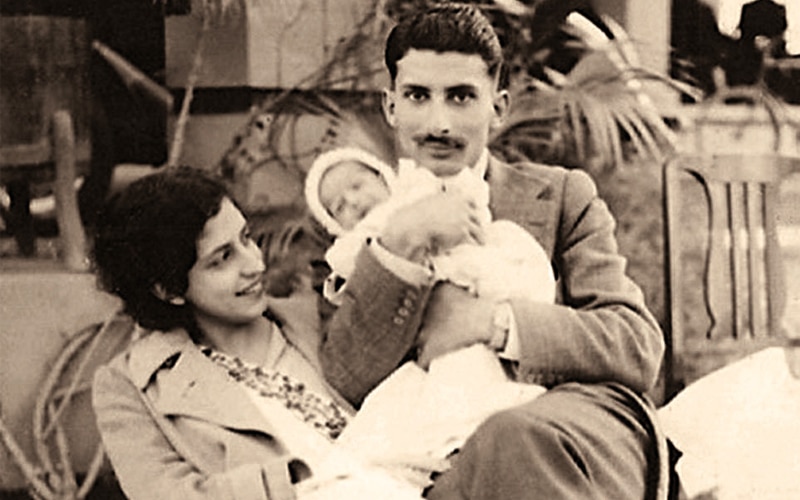 A young Manekshaw with wife Silloo and daughter Sherry
“Within 10 days,” Lt. General Sankaran Nair, now Adjutant General, told me, Manekshaw convinced every man that the corps could with stand attack from any quarter.”
On promotion to command of India’s entire eastern sector in 1964, Manekshaw had to deal with every type of internal disturbance. He is particularly proud that his troops quelled serious riots in Calcutta and West Bengal “without firing a single shot.”
When dealing with guerrillas in the Mizo Hills, his men came under constant ambush. Yet, even when guerrilla tactics were at their dirtiest. Manekshaw insisted on “doing things by the book.” One intelligence officer, who felt he might gain information by hanging a suspect upside down, quickly found himself facing a court martial.
Sam Manekshaw has always been swift to praise as well as punish. Within hours of the ceasefire in the 197I war, he set off on a 13,000-km tour to tell his frontline troops: “You have made the entire world sit up and take notice.”
Human Touch
With more than 10,000 Indians killed, wounded or missing, he stated: “I regard it as my personal responsibility see that none of the families of my fallen soldiers goes short.”
The General’s wife, Silloo (they have two married daughters and two grandchildren), at times spent I4 hours a day raising funds as President of the Army Wives’ Welfare Association. Manekshaw secured massive increases in army pensions and disablement benefits.
Recalling his own frustrating, pain-racked months in hospital, he tirelessly visited the wounded, distributed transistor radios and in the words of a staff officer “never left a hospital without speaking to every man in every ward.” Chatting to a wounded Pakistani colonel, he found that the Muslim had lost his Koran in the heat of battle. Next morning a copy of the sacred book arrived with the compliments of the Chief of the Indian Army.
Today, Sam Manekshaw is at last enjoying the cultivation of his own garden at his new home in the Nilgiri Hills of Southern India.
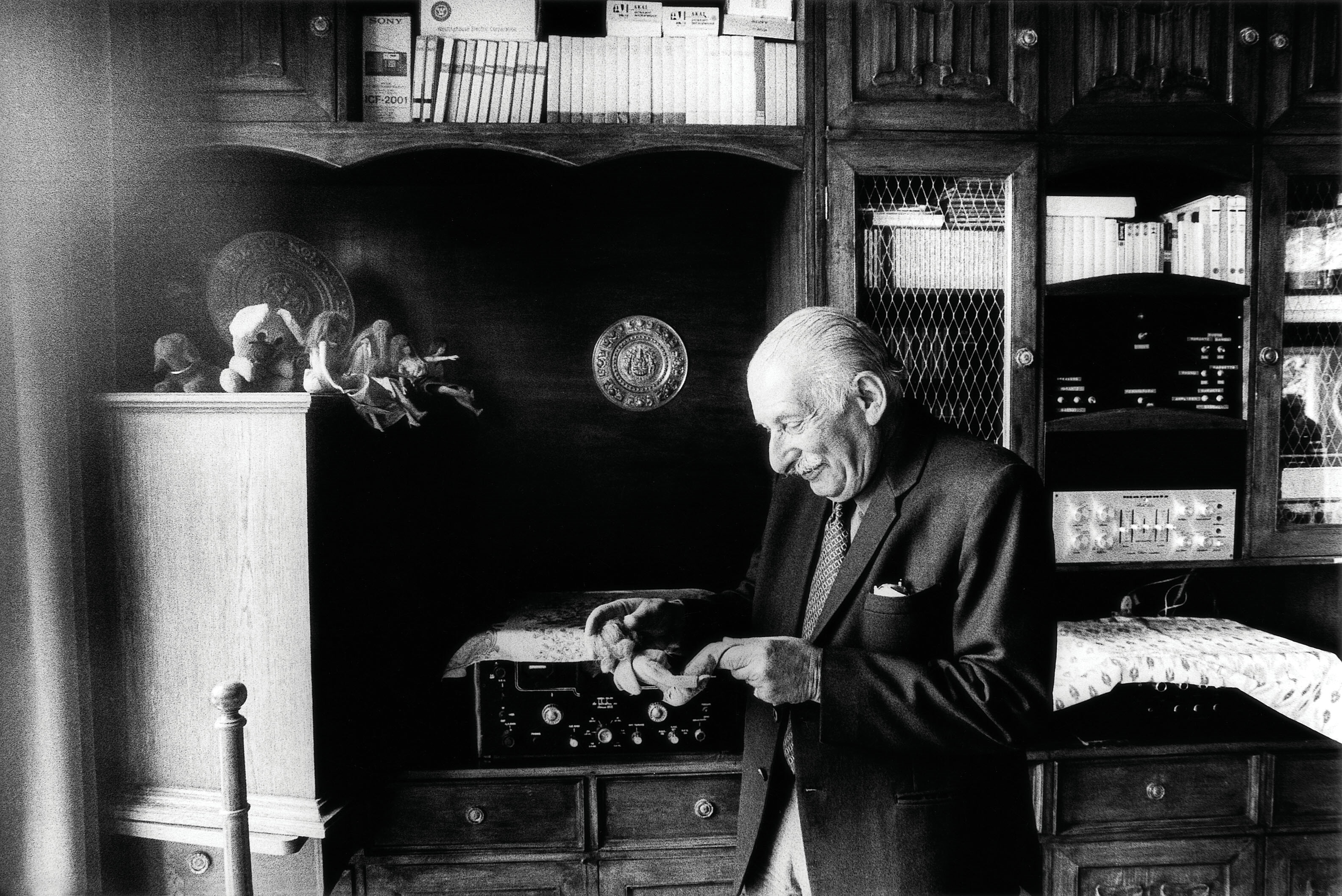
Dahlias and Decibels
Rising at 5.15 each morning, he raises prize flowers including dahlias, keeps poultry and bees. He enjoys tinkering with his mass of hi-fi equipment. Demonstrating its range to me, he enthusiastically thumped controls that seemed to produce every modulation and twice the power of a symphony orchestra.
Throughout India, he is a public hero. Babies, streets and railway junctions are named after him. The President of India gave him the coveted Padma Vibhushan award “for signal service to the nation.” And in Bangladesh, where Field Marshal Sam Manekshaw set a lead in humanity and chivalry when it was critically needed, the deeds of his Indian forces are, says Prime Minister Sheikh Mujibur Rahman, written in letters of gold.
Editor’s Note: Following his retirement from the Indian Army, Sam Manekshaw served as an independent director on the boards of several companies. He passed away of complications from pneumonia in Wellington, Tamil Nadu on 27 June 2008, aged 94. Gallant and cheerful to the end, reportedly his last words were, “I’m okay.”
From Reader's Digest, September 1973
For more stories from our archives, click here