The Enduring Art of Varanasi's Akhadas
On the banks of the Ganges, Varanasi’s centuries-old wrestling schools continue to nurture discipline, community and tradition in a rapidly changing world
 Photo: Alamy
Two wrestlers rub oil onto their shoulders and bow deeply to one another. Moments later, they are rolling across a sand-filled pit. Beads of sweat trace paths down their bronzed backs as the athletes trade holds and counters. At one point they lie in a tangled heap, but even amid the chaos, there is control and symmetry in their movements. The bout unfolds with the rhythm of a measured choreography. Then, in a flash, one wrestler lifts the other off the ground before bringing him down with a thump and grappling him into submission.
Silence, taut as a bowstring, settles over the arena There are no cries of pain, no triumphant roars. When it is over, the two combatants—48-year-old pehlwan Gauri Shankar, a national-level gold medallist, and 23-year-old amateur Golu—rise and shake hands.
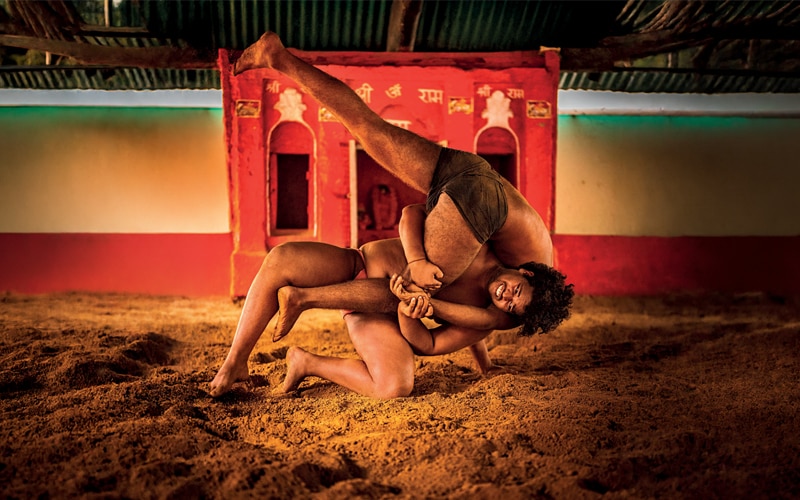 A kushti bout in progress. Photo: Alamy
We’re at the venerable Tulsi Ghat akhada, a traditional Indian gymnasium, in Varanasi, one of the oldest, continuously inhabited cities in the world. The wrestlers (or pehlwans, as they are known locally) train here in the traditional sport of kushti, and learn the ancient techniques of fluid movement and remarkable strength that defines this deeply respected, age-old regimen.
We soon find that here, bodybuilding and wrestling is about far more than physical prowess. The practice is intertwined with discipline, spirituality and reverence—for the teacher, for fellow wrestlers and for the tradition itself. Each session begins with a prayer. Incense sticks are placed before a small shrine dedicated to Lord Ram in one corner of the pitched-roof pavilion before training commences.
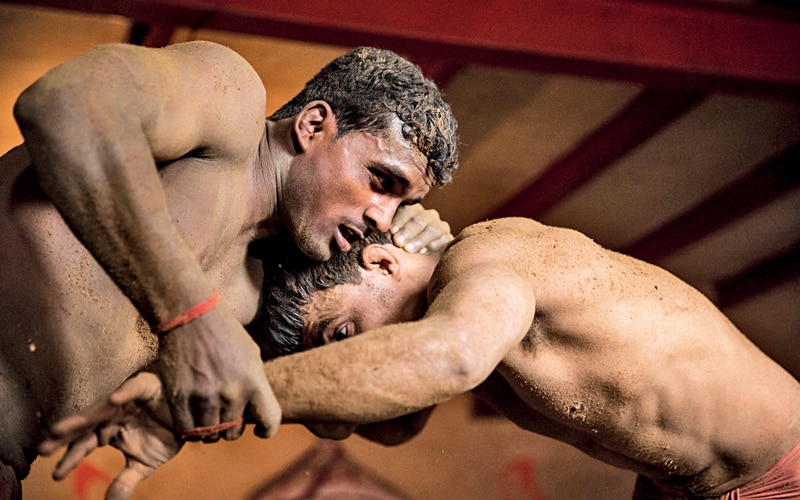 In Varanasi’s akhadas, wrestling requires strength but also discipline, spirituality and respect. Photo: Alamy
According to the book Kashi: The Valiant History of a Sacred Geography, Varanasi was once renowned not only for its temples but also for the strength and athleticism of its youth. Ancient Kashi was dotted with as many as 1,000 akhadas. Here, students developed muscular strength, physical endurance and mastery through kushti. Until the end of the last century, akhadas were woven into daily life, attracting young men from across the city, regardless of wealth or social standing.
Today, only a handful of akhadas remain, as youngsters prefer to limber up in modern gyms with state-of-the-art equipment, laments Daya Shankar Yadav, a 75-year-old coach at the Tulsi akhada who displays his agility by doing a couple of splits for us. “In modern gymnasiums, you merely get pumped up with new-age equipment; they tell you to take supplements,” he says. “In an akhada, you lose weight gradually and build strength slowly.” Buffeted by lack of funds and a dwindling number of students, coaches like Yadav are fighting to keep the kushti schools alive.
Indeed, their efforts are not for naught. Every morning, the akhada still draws a steady stream of students, who arrive by a steep flight of steps rising from the Ganges, swathed in early morning mist and tranquillity. Before warming up, the students touch Yadav’s feet in respect. He greets them with folded hands. Oil is applied on the joints. Exercises begin. Watching closely from the edge of the pit, Yadav corrects technique and keeps injuries at bay. His own lean, muscular frame reflects decades of discipline.
Like generations before them, the wrestlers wear langots (loincoths), sometimes beneath shorts for support and mobility. Some, as young as seven years old, join in on the calisthenics. Between bouts, they dust themselves with sand for traction. The pit itself is carefully maintained with soft earth brought from nearby fields and enriched with turmeric, curd, mustard oil and neem leaves. “This gives the sand therapeutic properties and ensures that wrestlers don’t catch an infection,” says Yadav.
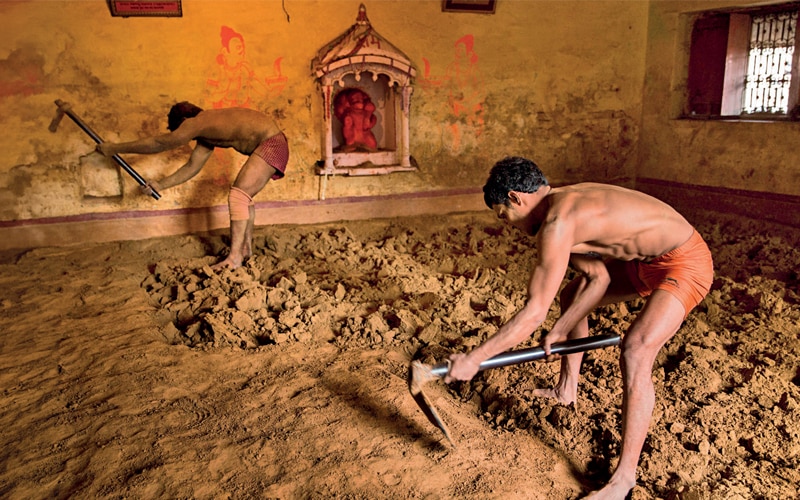 Pehlwans prepare the sand and mud arena where wrestlers train. Photo: Alamy
Their ‘uniform’ has a deeper reason too—a symbolic rejection of all markers of caste, creed or social status. All that remains is the purity of the pit and the practice. “Anyone can come to the akhada,” says Yadav, “All are equal.” This inclusive spirit crosses gender as well. In 2017, the akhada broke the glass ceiling and allowed girls to train, although their attendance is still minimal.
The institution itself is steeped in history. Said to be one of the oldest in Varanasi, some trace the origins of the Tulsi akhada to the 16th century, when, legend has it, the medieval poet-saint Tulsidas exercised here. His riverfront home—where he translated the Ramcharitmanas from Sanskrit to Awadhi, and penned the Hanuman Chalissa—is now a tourist attraction, located nearby.
Historians believe kushti has been practised in Varanasi in one form or another since at least the fifth century BCE. Malla yuddha, an ancient grappling tradition, appears in both the Mahabharata and the Ramayana. “Some of those heroes, including Hanuman and Bhima, were great wrestlers,” explains Yadav. Over time, indigenous traditions absorbed Persian influences brought by the Mughals, shaping the kushti practised today.
Not everyone training here dreams of competitive glory. Many come simply to build fitness and stamina. Outside the wrestling pit, students perform endless squats and push-ups, swing 30-kg gadas (clubs) and scale hanging ropes. One young man struts around with a heavy ring around his neck, weighing, as a venerable old timer whispers to me, “90 kilos!”
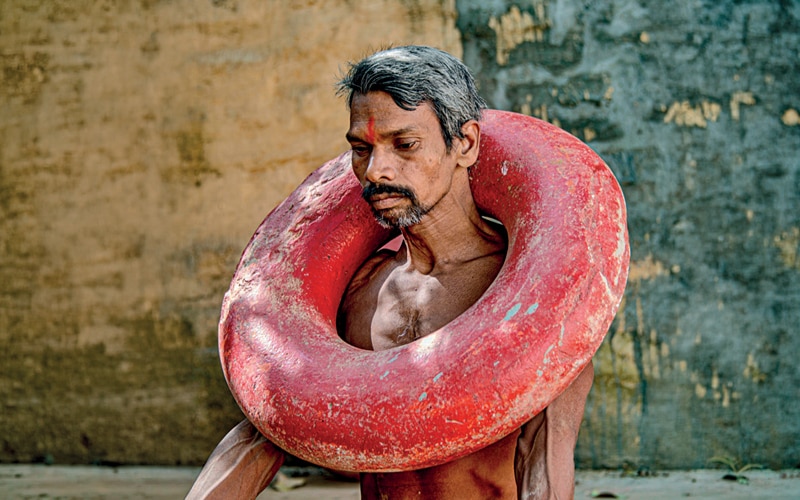 A pehlwan at the Tulsi akhada displays his strength by wearing a 90-kg concrete ring around his shoulders. Photo: Alamy
Yet another does a headstand and then proceeds to walk around on his hands! There is a great deal of camaraderie amongst the young students as they assist each other to limber up, raising one leg at a time and resting it on a companion’s shoulder.
To the bystander, the warm-ups and exercise routines appear back-breaking. But, training to become a professional pehlwan is a different ball game. The day starts with thousands of squats and stretches, running, swimming and subsisting on a protein-rich diet of milk and almonds. To be an undisputed champion in Indian and international wrestling—like Ghulam Mohammad Baksh Butt or the Great Gama—takes a stupendous amount of discipline. Born in undivided India in the early 20th century, Gama grew up in a wrestling family in Punjab, and spent much of his life in and around akhadas, according to Olympics.com. His daily regimen included 5,000 sit-ups, 3,000 push-ups and wrestling with over 40 wrestlers. He subsisted on a diet of 15 litres of milk, three kilos of butter and mutton, nine kilos of almonds, and three baskets of fruits daily. The Great Gama went on to have an unbroken record of being undefeated in over 5,000 bouts in the span of his five-decade-long career!
As the day’s training ends, the wrestlers drift back to classrooms, offices and everyday routines. We leave the akhada too, returning to the clang and clamour of a city that eats, prays and celebrates with equal enthusiasm. Yet the memory that lingers is not of the noise, but of the quiet discipline within the mud pit. In the shadow of temples and along the banks of the Ganges, Varanasi’s akhadas continue to shape strength, character, and community—much as they have for centuries.
For more stories like these, click here