- HOME
- /
- Culturescape
- /
Tyeb Mehta and the Art of Seeing a Fractured World
Tyeb Mehta’s paintings were spare, restrained and often unsettling, filled with fragmented figures, diagonals and a sense of human vulnerability. From the book, Tyeb Mehta: Bearing Weight with the Lightness of Being, published alongside the exhibition, this excerpt considers the artist whose restrained palette, fragmented forms and unmistakable diagonals became a powerful language for the fractured modern world
 Three Head Studies (Mahisasura), acrylic on canvas, 1998. Collection: Kiran Nadar Museum of Art
Tyeb Mehta was a courteous and cultured man whose interactions with others held warmth, curiosity and reciprocity. He was not crooked in any sense of the word. But as a painter, his vision was a bit askew. He perceived the twisted nature of reality. In this regard, he stood apart from his artist friends. Unlike Maqbool Fida Husain, he didn’t look upon everything with playful eyes. He wasn’t in search of peace and harmony in contradictions of all kinds, like Sayed Haider Raza was. He was also distinct from Vasudev Gaitonde, who liked to make unseen everything that could be seen. Unlike Ram Kumar, he did not consider this world a well-organized landscape. Nor was he beleaguered by the grotesque and the rugged, like Francis Newton Souza tended to be. Tyeb saw the fissures, cracks, divisions and displacements in reality: He was diagonal.
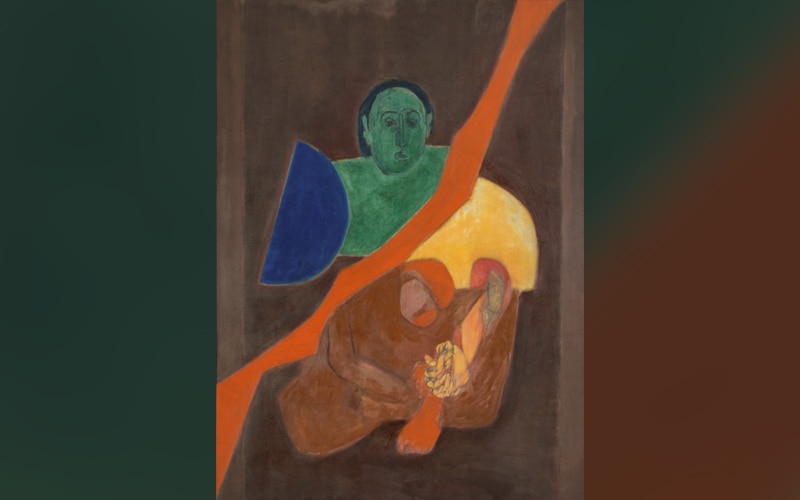 Diagonal (detail), oil on canvas, 1970. Collection: Kiran Nadar Museum of Art
Tyeb was a figurative painter, but his images neither emerged from nor constructed any narrative. They seemed to be surrealistic at times, and occasionally bordered on abstraction. Art critic Richard Bartholomew had said of Tyeb Mehta’s subject matter decades ago: "After the frenzy, neither from hope nor fear, neither accepting nor rejecting but being all that has been brought about."
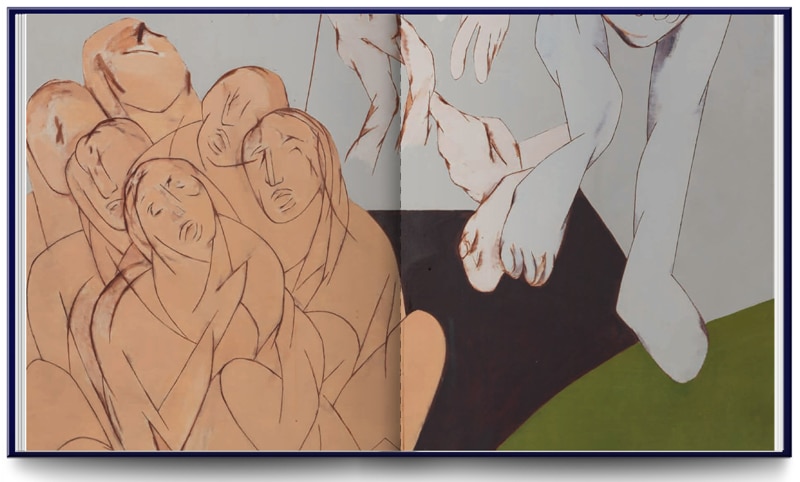 Study after Santiniketan Triptych, acrylic on canvas, 1989. Alkazi Collection of Art
Tyeb painted both human and animalistic figures, often those who had been abandoned and only had themselves to rely on. They seemed to float in a narrative void, not drifting, but unmoving. Tyeb said what he had to say through his paintings. His reticence was a manifestation of his humility. He was of the opinion that the content of a painting was independent of both the painter and the viewer. He breached the duality of narrative and form in his practice. As soon as he created the form, the narrative would emerge from it.
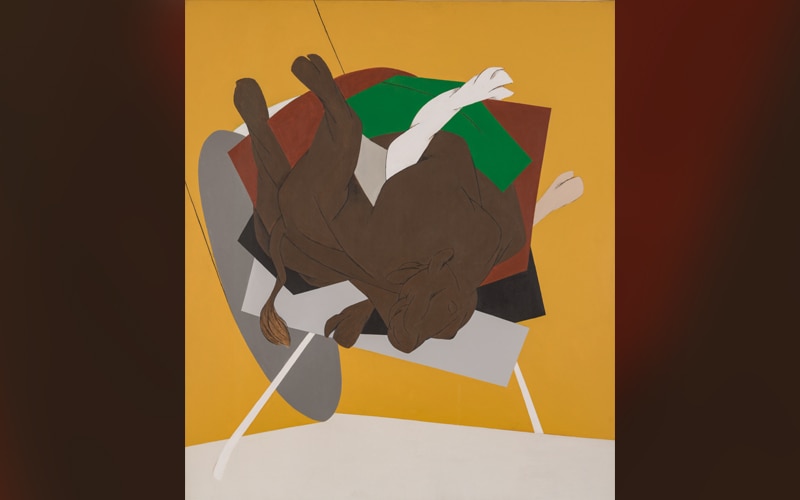 Bull on Rickshaw, acrylic on canvas, 1999. Collection: Kiran Nadar Museum of Art
It is widely known that Tyeb’s paintings highlight the modern human predicament through fragmentation, collapse and violence. In all his later works, the pictorial space is bisected by a diagonal. The images themselves are similarly broken and split. This has perhaps made him the most political painter of his time. Yet, his art is not overtly political. The dilemma that he hints at through fragmentation and collapse can be simultaneously read as historical and as political, eternal and contemporary.
While discussing tradition and art, Tyeb has written, "I have looked with equal enthusiasm at Amaravati, Egyptian art, Assyrian bas reliefs and sculptures, statues, African craft, Chinese paintings, Renaissance masters and contemporary paintings at home and abroad. I did not fully understand them then and even now I remember that conventions and rules are not an obligation—they coexist without discord."
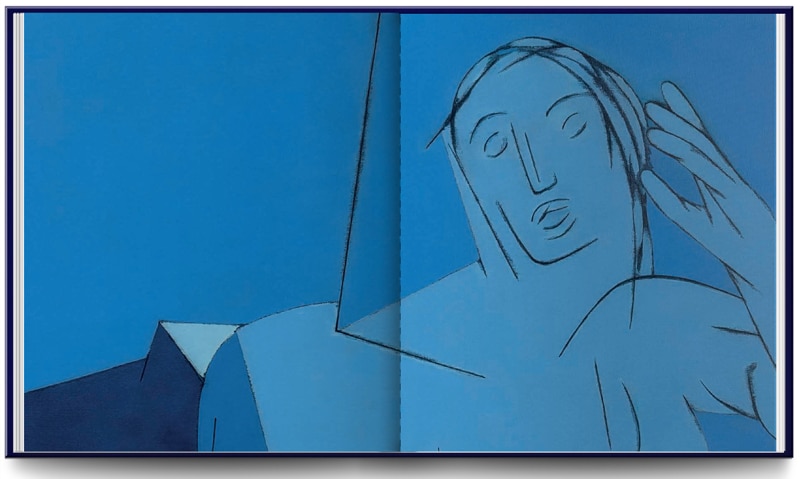 Blue Painting, oil on canvas, 1982. Collection: Kiran Nadar Museum of Art
In the Indian tradition—especially in sculpture—gods, animals and humans have all been integrated. We see that in Tyeb’s works as well. The bull, Kali, animals and man are all unified and in some state of descent. We can’t overlook the fact that there is no verbosity in his work. Tyeb doesn’t want to say much. There is no impatience of any kind either.
His modern art is a classic in how it remains dignified even within its own restlessness. As if by being painted, the fallen are uplifted. These artworks seem liberated from gravity and appear to depict a fragmented and ruptured modernity in a spiritual void. In most of his paintings, the background is simple and plain, often in one colour. Tyeb does not want to offer any context because he does not want to impose a narrative on you.
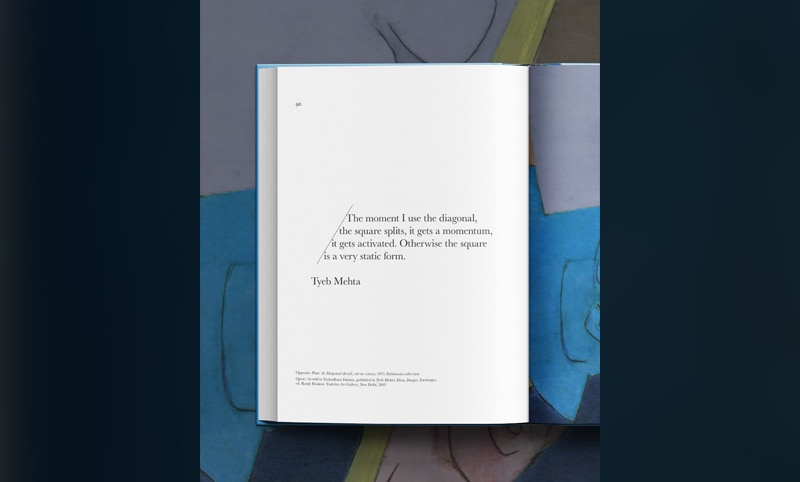 From the book Tyeb Mehta Bearing Weight with the lightness of being
Tyeb’s use of colour was very restrained. He created his fragmented forms on flat backgrounds in such a way that the dramatic tension between the plainness of the background and the deluge of colour in the foreground could be clearly felt. This dramatic tension brought his content—devoid of specific narratives—and his craft into a state of aesthetic harmony. His understanding of colour was based on thought and sensitivity, and it evinced subtlety and absolute control. You can only see what the painter thinks you should see.
There was no place for the material world or nature in most of his paintings. He seemed to unrelentingly explore and configure the human dilemmas of his time. As if he wished to focus all those dilemmas entirely on man. The truth is that unlike his contemporaries, Tyeb created a very small body of work—he said little, escaped saying much, and was never driven by the market. However, his art never moved away or became indifferent to the splintering and collapse of humanity.
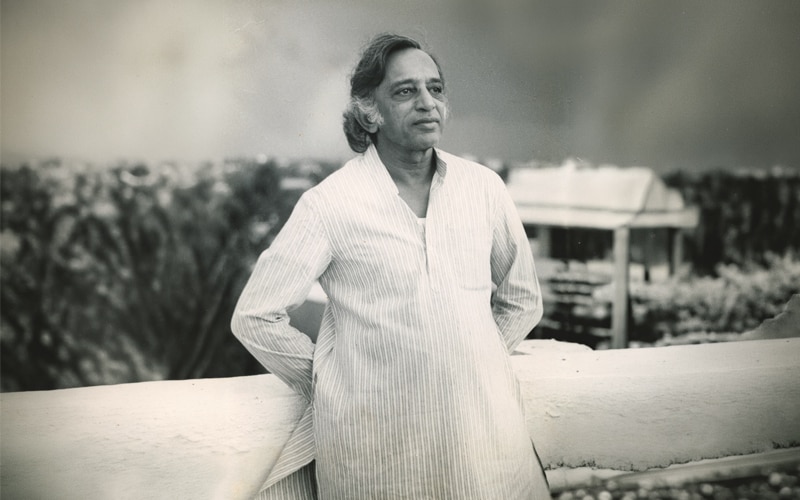 Tyeb Mehta (1925–2009)
About the Author: Ashok Vajpeyi is a poet, essayist and cultural critic. A former Indian Administrative Service officer, he has played a key role in establishing cultural institutions, including Bharat Bhavan, Bhopal. He currently serves as Managing Trustee of the Raza Foundation.
Edited Excerpt from Tyeb Mehta Bearing Weight (with the Lightness of Being), translated from the original text in Hindi by Priyanka Sarkar.
Published by Kiran Nadar Museum of Art and Mapin Publishing Pvt. Ltd. on the occasion of the exhibition Tyeb Mehta: Bearing Weight (with the lightness of being), curated by Roobina Karode. Presented by the Kiran Nadar Museum of Art in collaboration with the Tyeb Mehta Foundation and Saffronart Foundation