They Took Their Film to the Streets ... And Built an Audience From Scratch
In a film industry that rarely makes space for outsiders, Tanmaya Shekhar and Molshri rewrote the rules—taking their story to the streets, and finding an audience along the way.
 Molshri and director Tanmaya Shekhar, the minds behind the film Nukkad Naatak.
Cinema rarely affords the luxury of solitude. Unlike painting or writing, it demands collaboration, resources and, increasingly, the ability to compete for attention in a crowded, fast-scrolling world. Since the Covid pandemic, big-budget action spectacles have dominated Indian screens, leaving smaller independent films struggling to be seen. Yet some filmmakers are choosing not to wait for permission—but to create their own path.
Earlier this year, director Tanmaya Shekhar and actress Molshri did just that with Nukkad Naatak (Street Play), a film they made and financed independently, without studio backing. Ahead of its release on 27 February, they turned to social media—and the open road. Securing a theatrical release for a film made by newcomers without industry connections is no small feat, and to drum up publicity for it, Shekhar and Molshri embarked on a five-week cross-country trip in a caravan.
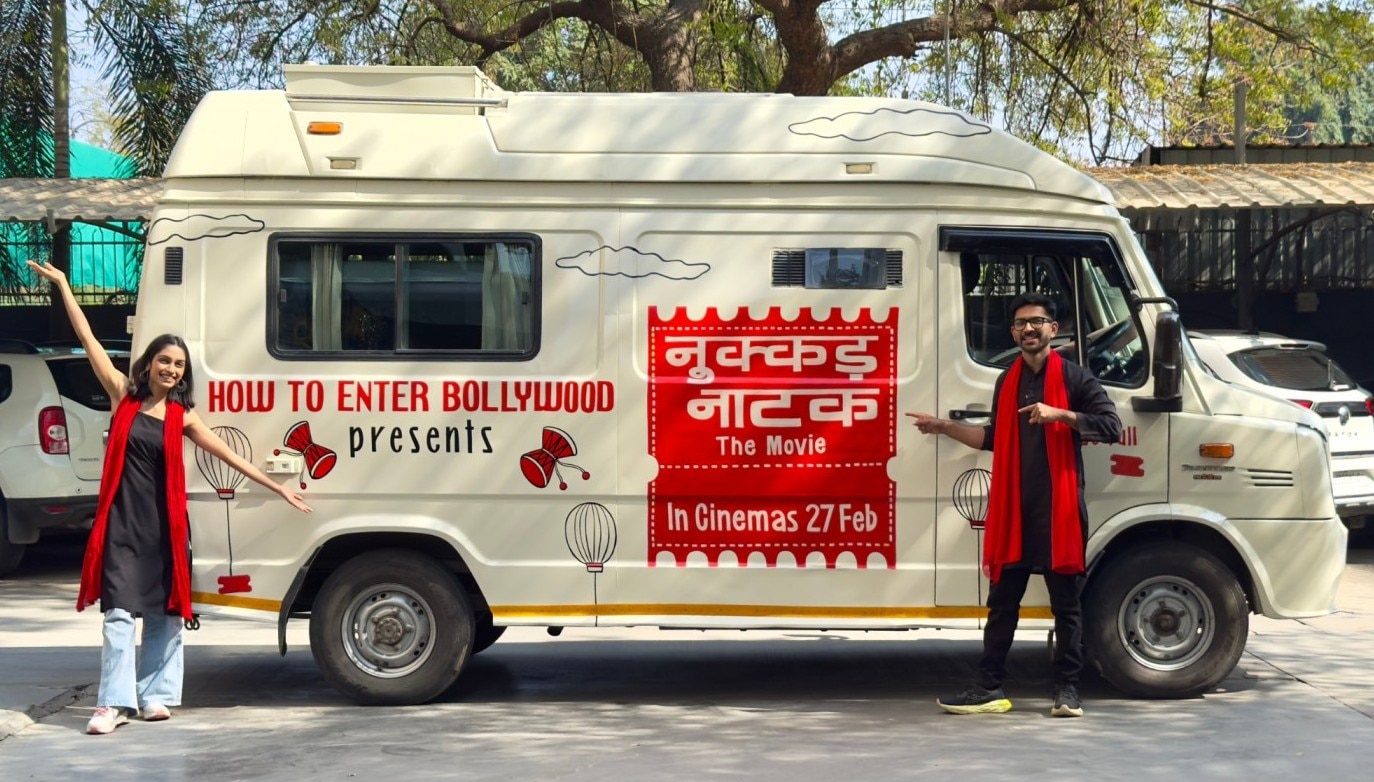 Molshri and Shekhar with the customized Nukkad Naatak caravan.
Their story begins far from the film sets they now inhabit. Hailing from Kanpur, Shekhar was expected to become an engineer. “My father was a professor of engineering at IIT-Kanpur. I studied engineering, and eventually moved to the U.S. in 2012 for a data science job,” he says. But something shifted there. “I met young people who were unapologetically pursuing creative paths like painting and sculpture … That exposure changed my perspective.”
Shekhar quit his job and began assisting on film sets, but the decision to leave that life behind was not easily understood at home. “It was like the ‘Then-versus-Now’ meme… Initially, they couldn’t understand why I left such a well-paying job,” he recalls. What they did recognise, eventually, was his persistence. “No one in my family came from a creative background,” Shekhar remembers. “But they also saw I was not giving up. Eventually, they supported me, and even helped me financially when I couldn’t make my rent.” By the time he returned to India during the pandemic, filmmaking was no longer an experiment, but a commitment.
Molshri’s journey unfolded differently, but arrived at a similar place. Growing up in Kota, she imagined a future in academia. “I studied English Literature at Delhi University… Acting was never on my radar,” she says. When she first began performing in street plays and stage shows, the experience was far from transformative. “I was terrible. I constantly fumbled. Acting felt like an invisible craft. I didn’t quite understand how it worked until I attended acting workshops.”
The two met at Mumbai’s Prithvi Theatre and from each other, they learnt an important lesson: find like-minded collaborators. “Nobody will come forward to fund your vision just because they think you are brilliant,” Shekhar advises. “Find people like yourself and create something together.” That’s how the duo made Scenes From A Pandemic (2022), an inventive short film about the travails of a young woman during the Covid pandemic. The experience gave them the confidence to embark on their first feature.
The idea for Nukkad Naatak emerged from a moment of dissonance, when Shekhar visited his parents in Dhanbad. His father had became the dean of IIT-Dhanbad, while his mother was teaching at a nearby basti (slum). Visiting the basti with her left a lasting impression: “I was living in an IIT campus that offered elite education, but just three kilometres away, children had no access to schooling,” Shekhar says. That proximity—of privilege and deprivation—became the film’s emotional core.
The story follows two engineering students and street theatre performers (played by Molshri and Shivang Rajpal) who are expelled from college after a misguided, though well-intentioned act of vigilantism. But they are offered a chance at redemption—they must persuade five children from a nearby basti to attend school. Along the way, their journey turns inward—Rajpal's character comes to terms with his own queer identity, while Molshri’s character forms an evolving bond with a young girl, Choti (Nirmala Hazra).
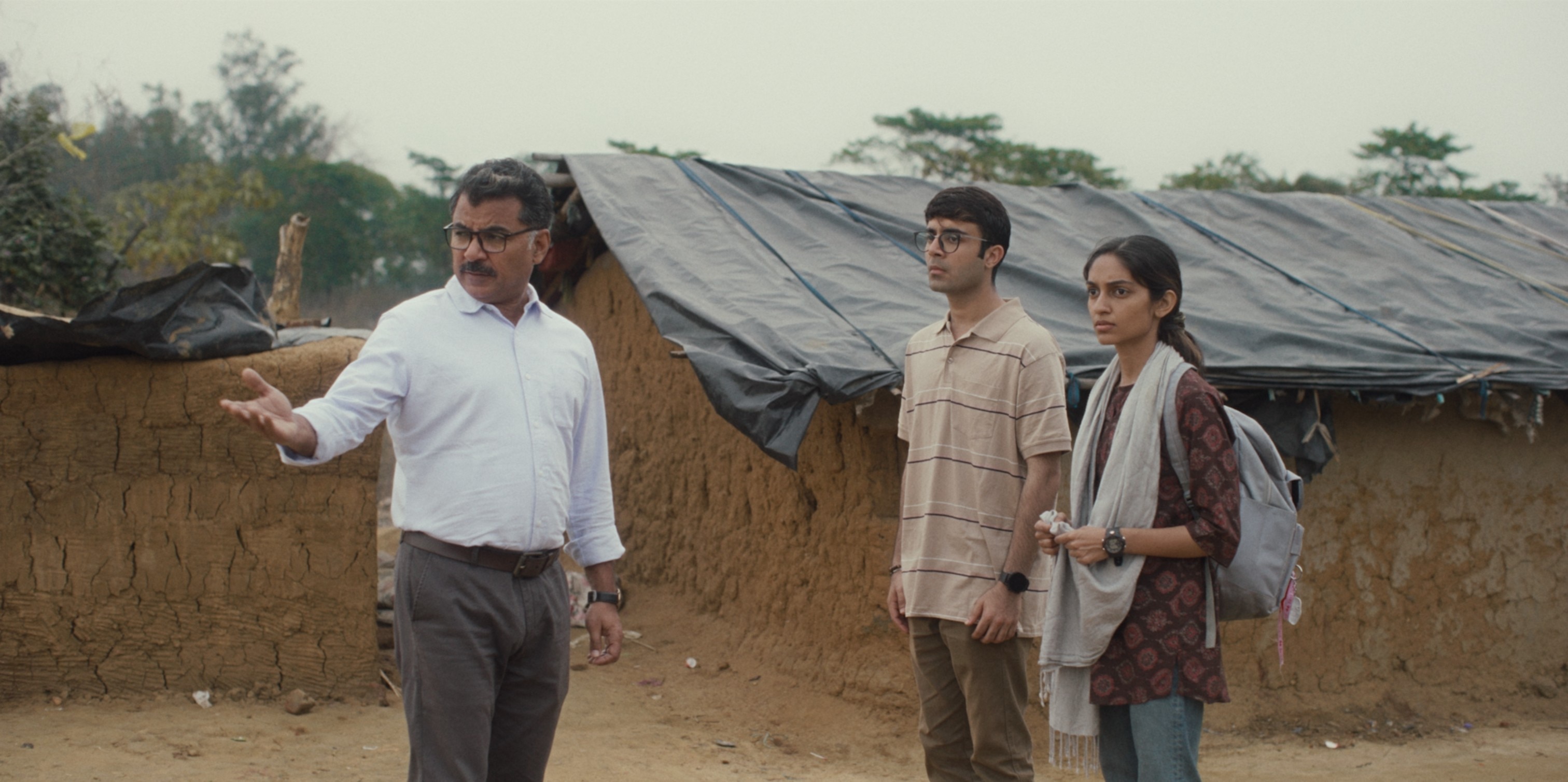 Danish Husain, Shivang Rajpal and Molshri in Nukkad Naatak.
Fittingly, the film was made in much the same spirit it portrays—a true DIY (Do It Yourself) project. Shekhar used IIT-Dhanbad as a primary location and filmed in the basti where his mother taught. The cast and crew lived together in his family home, where his mother and grandmother cooked daily meals. Funding, however, remained a challenge. Around ₹50 lakh was raised from 30 friends and family members, but post-production and marketing required more. “We often underestimate the strength of our connections. People will support you if they find your idea exciting,” Shekhar says. Mapping them—and asking for help—became part of the process. The total budget eventually reached two crores, with loans still to be repaid.
The shoot itself, completed over three weeks in March 2023, was a balancing act between creative work and logistics. “The good days were when we were focused on the script, rehearsals, or shot-listing,” Shekhar says. Molshri balanced performance with casting, sourcing local actors and working closely with the teenage Nirmala Hazra who plays Choti. “I ensured she would come to set daily with her parents, since she couldn’t travel alone. We arranged transport, explained locations, timings, costumes in detail,” Molshri reveals.
When reality fell short of requirements, creativity stepped in. “When we needed 200 people for a scene and only 20 or 30 people showed up, we created the illusion of a crowd with clever camera angles,” Shekhar recalls.
If finishing the film was tough, finding its audience proved harder. After premiering at the 2024 Kolkata International Film Festival and screening internationally in Berlin, London and Melbourne, months of outreach yielded no distribution deals. “There’s a lot of saturation now,” Shekhar says. “You cannot assume that if you make a film, people will automatically discover it.”
So they returned to what they understood best: storytelling. Their Instagram micro-drama series, How To Enter Bollywood, offered a fictionalised version of their struggles and struck a chord. It built a community—and even drew a cameo from director Imtiaz Ali. “People related to our struggles of being artists without connections,” Molshri says. “It helped turn the film into a movement.” But the visibility came with at a cost. “It can be exhausting,” Shekhar adds, "because as content creators, we are constantly online: responding to comments, posting updates. There’s also the negativity and trolling. While there’s immense value to it, it also requires intentional use like a tool.”
When a limited theatrical release finally materialised, they extended their approach into the physical world. Travelling across 13 cities in a customised caravan, they performed, sang and invited people to watch their film—turning promotion into participation. In Jaipur, a traffic jam near Hawa Mahal became an unexpected stage.
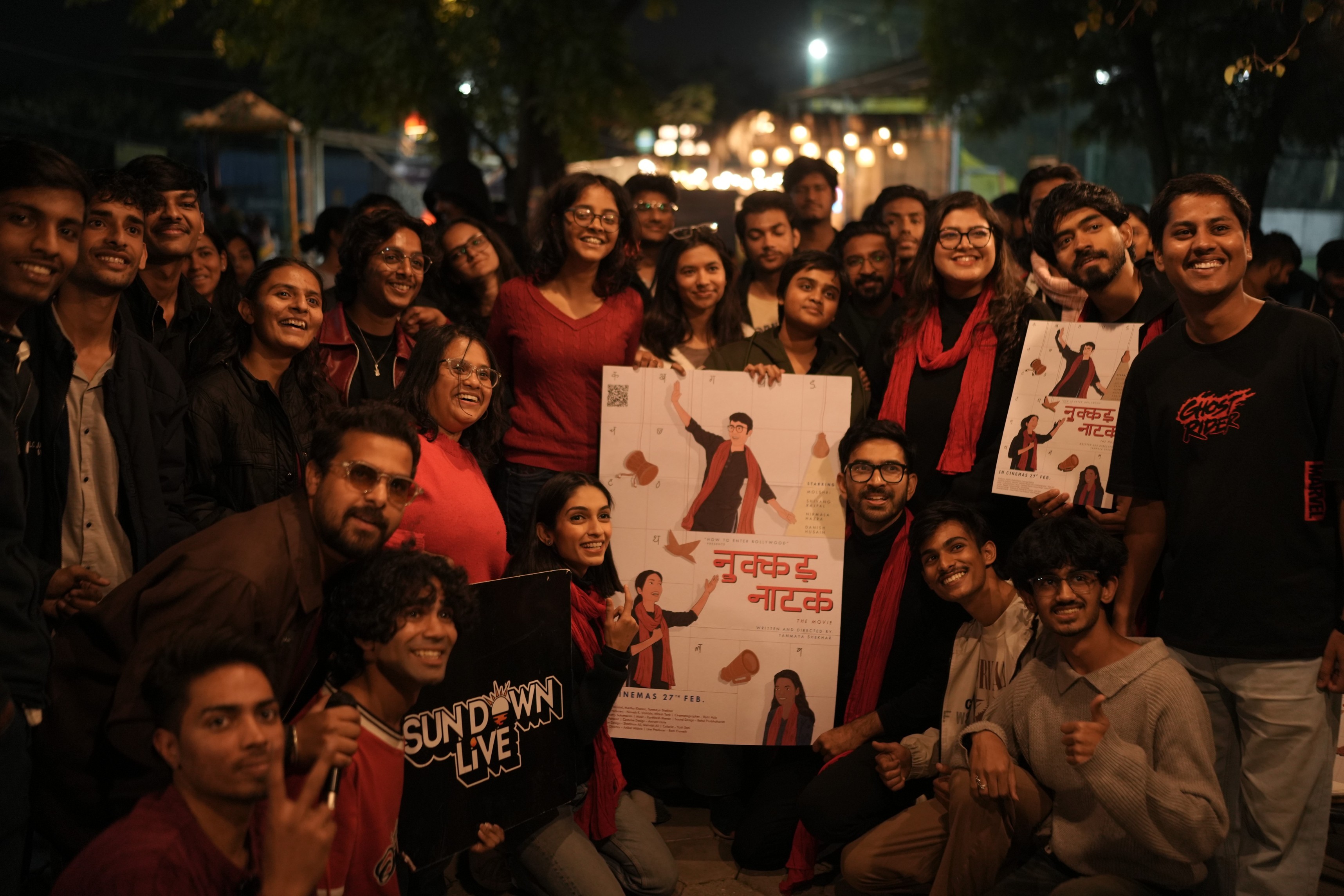 Team Nukkad Naatak at a meet-and-greet in Indore.
For Molshri, the journey circled back home. In Kota, she returned to her school with her parents, carrying with her a story that had begun in uncertainty. In Dhanbad, the team screened the film in the basti where it was shot. “We arranged for a projector and a screen, and showed the film to around 80–90 people,” Shekhar recalls. “It was very emotional.”
But the return to Dhanbad was also bittersweet. After making the film, Nirmala Hazra, who plays Choti, was married off and now has a child. “We called her to show the film. She sounded very excited about it, but the next day, she refused to come, saying she had responsibilities of her own,” Molshri recalls. This brings to light a very sad irony: though the film poetically shows a basti and its children being empowered by street theatre to seek education, the reality is cruelly the opposite, emphasizing that more needs to be done to save children from fates like child marriage.
Even as financial pressures mounted and their final crowdfunding push drew criticism, the film held its ground. It completed a three-week theatrical run, reaching around 50 shows—short of their ‘100 Housefull Shows’ goal, but enough to capture the public imagination. Support from filmmakers like Karan Johar and Anurag Kashyap amplified its reach. And on 24 April, Nukkad Naatak emerged from the corners of the Indian hinterland to make its global streaming debut on Netflix.
For Shekhar and Molshri, the journey has been life-changing. “It gave me a sense of ownership,” Molshri says. “You can’t wait for opportunities—you have to create them.” Shekhar adds: “It takes a village to make a film. You learn resilience. There is always a way—you just have to keep moving forward.”
For more stories like these, click here.