Rock Bottom
A hiker somehow survived being pinned in a creek under a 315-kilo boulder. Then the water started to rise
 Illustration by Frank Stockton
When Joanna Roop heard a deep rumble overlaid with thunderous crashes, a sick feeling invaded the pit of her stomach. The horrible clatter of rocks and boulders stampeding down the hillside was emanating from the spot where her husband, Kell Morris, had been standing a minute earlier.
The pair, both 61 years old, had been hiking along Godwin Creek in Seward, Alaska, looking for a place to cross the water en route to their intended destination, Godwin Glacier. They had split up, and Morris had scaled some rocky terrain against the cliff while Roop walked downstream a bit. She’d made a mental note earlier of a potential crossing and was making her way back there when she heard the landslide about 300 feet behind her.
She ran as fast as she could, but she felt as if she was moving in slow motion. And to an extent she was—each step had to be deliberate as she traversed the rocks.
“Kell!” she hollered. “Kell!” She heard no reply over the rushing water. Roop was all but certain that her husband was gone, buried beneath a pile of rocks.
But there he was, along the edge of the water, with his distinctive brown fedora and blue backpack. Thank God.
Then Roop realized she could only see him from the shoulder blades up. Most of the rest of his body was pinned under a massive boulder shaped like a half-moon. Morris lay on his stomach, fully conscious, his face just barely out of the creek water.
He’s gotta be crushed under there, Roop thought. But Morris was talking and did not seem to be in pain, even though his left boot pointed out from under the rock and up to the sky at a sickening angle. She assumed that his leg had been crushed.
Morris could move his right leg and his arms and could breathe fine. What he couldn’t do was turn his head and see the enormity of the boulder that had trapped him.
“Just move it, Jo!” he called out.
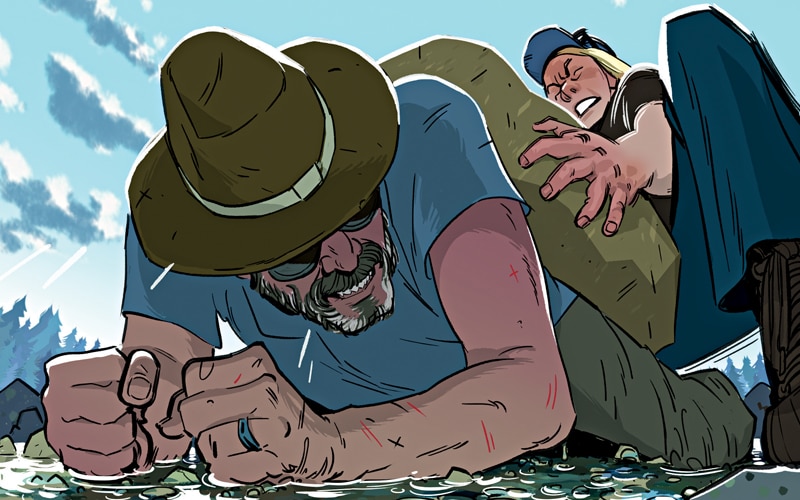 Illustration by Frank Stockton
The boulder, which was later determined to weigh about 315 kgs, was far too big for Roop to move on her own. Nevertheless, she squatted, reached under it from the side and tried to lift. The massive rock wouldn’t budge. Morris propped himself up on his elbows and brought his right knee up while Roop gripped the stone. Working in unison—him pushing up from underneath, her from the side—they managed to shift it ever so slightly. But that was the best they could do.
Roop took out her cellphone, but in this remote area, there was no signal at all. With no immediate way to get help, she searched the area for a long, skinny rock she could slide underneath the boulder and leverage it enough to give Morris room to crawl out. But she couldn’t find the tool she needed. She also worried that if the boulder shifted, it might crush him.
Morris began to shiver in the 1.6-degree water.
“Stop, Jo,” he said. “Go try to get help.” He reached into his pocket and pulled out his phone. “Here, now you’ve got two phones. Go as far as you have to go until you get a signal.”
Roop didn’t want to leave her husband, but she knew she had no choice. And somehow she kept her sense of humour.
“Don’t go anywhere,” she told Morris as she set off.
Kell Morris and Jo Roop met as middle-aged divorcees and had one of those Brady Bunch–like marriages—he had two grown daughters, she had two grown sons. A couple of years after they married, they were living in Kootenai, Idaho, a small city about 95 kms from the Canadian border, where they retired early and started building two houses with the intention of making rental income on them.
“But we both retired too early,” Morris says. “Our pensions were being eaten up by inflation. We got the first house about half built, then we started running out of money.”
In 2024, Roop, who had been an Alaska state trooper before she retired, was catching up with an old friend in Seward and lamenting that she needed to go back to work. The friend mentioned that the local police department needed people. Before they knew it, Roop and Morris moved to Alaska, where Roop joined the police department and Morris—who’d had an assortment of jobs over the years ranging from pipe fitter to ski instructor—found work as a foreman with a marine engineering company. The plan was to return to Idaho regularly to keep working on the houses until they could re-retire.
Morris and Roop had always loved hiking, and they couldn’t resist the lure of Alaska’s natural beauty. This past 24 May—Saturday of Memorial Day weekend—they wanted to avoid the holiday crowds on the Kenai Peninsula, an area containing part of Seward that juts out from the coast of southcentral Alaska. Instead, they decided to hike to the Godwin Glacier via an undeveloped, isolated trail. They would follow Fourth of July Creek up to Godwin Creek, which is lined with boulders deposited by the glacier. They loaded their backpacks with what they’d need for the day—snacks, water, dry clothes. The temperature was just under 10 degrees when they left home around 8 a.m. and was forecast to rise to 12—one of the warmest days of the year so far in Seward.
“If we make it to the glacier, great. But if we don’t, we don’t,” Morris said as they set out. “We’ll have a great day out either way.”
They walked for a couple of kilometres, followed some fresh moose and bear tracks, then took a break a little before 11 a.m. to watch a newborn mountain goat and its mama.
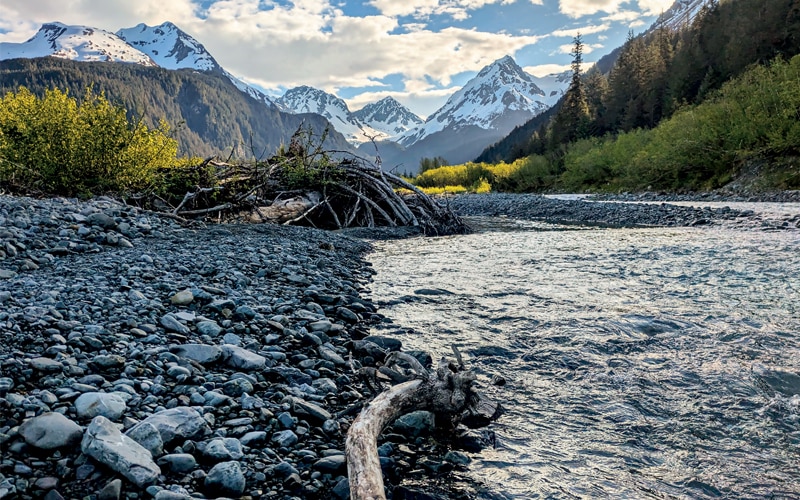 Photo Credit: Joanna Roop
“It’s not even up and walking yet,” Roop whispered.
When they got moving again, the creek narrowed and the current became faster. Morris and Roop went in separate directions in search of a safe place to cross. Morris didn’t want to walk below some unstable-looking boulders, so he made his way up the steep canyon, getting high enough to walk above them.
Just as he feared, the boulders were loose. Morris was directly above them when they started to slide down the slope. The smaller rocks he was walking on gave way as well.
“I didn’t see anything,” he recalls. “I have no visual memory at all. But the sound will probably be with me forever.”
It all happened in an instant. Morris tumbled about 20 feet and landed face down in the water. The boulder that came down behind him surely would have crushed him if not for the fact that several other large rocks had landed right beside him and absorbed most of the impact of that big daddy.
Lying in the creek, Morris did a quick self-assessment. Yes, I’m alive. Yes, I have feeling in my limbs. But I’m stuck. I can’t move my left leg at all, and I’m pinned down under something.
“Help! Help!” he yelled.
Minutes later, Roop found him.
Now, fearing that her husband didn’t have long to live, Roop didn’t want to leave him alone. But she was desperate to call for help.
She walked about 250 metres to the first curve in the creek, where she had a decent line of sight down the valley. She tried her phone. To her amazement, the 911 call went through. Roop knew the dispatcher who answered.
“Evan, it’s Officer Roop. Kell is stuck in the river under a big boulder with his leg crushed. I need a helicopter, and I need it now!”
While Roop made her way back to her husband, 22-year-old Sam Paperman was driving home from a morning shift leading dogsled tours across the local glaciers for Turning Heads Kennel. His employers—Iditarod veterans Sarah Stokey and Travis Beals—also own Seward Helicopter Tours, and Paperman is a volunteer with the neighbouring Bear Creek Fire Department. He was the right person in the right place at the right time when the dispatch notification from the Seward Fire Department hit his phone: “Please respond to a search-and-rescue on a male individual who is trapped under a boulder in the creek.”
Paperman had hiked the rugged Godwin Creek plenty of times and knew that it was nearly impossible to access by truck or even all-terrain vehicle. So he called the airport manager at Seward Helicopter Tours and got approval to turn one of their choppers into a rescue vehicle for the day. Then he called the Seward Fire Department.
“We have two helicopters,” Paperman said. “We can push all of our tours to one of them, and the other one is ready to go.” A few minutes later, Paperman and pilot Neo Martinson were airborne.
Kell Morris had never feared death, but as he lay there alone he wondered how painful it would be to meet his end through hypothermia. The water wasn’t just freezing. It was also rapidly rising—on this relatively warm, cloudless day, the glacier was melting at a higher rate than normal. Morris began shivering harder. But he kept calm, placed his hands on the creek floor and pushed up, keeping his bearded face out of the water until Roop returned.
“They’re coming,” she told Morris. “I told ’em we need a helicopter. They’re on their way.”
At 12:09 p.m., 12 minutes after the call was dispatched, Seward Fire Department Chief Clinton Crites set up an incident command post at the Seward Marine Industrial Center quarry, about three kilometres downstream from Morris and Roop. That was the closest the rescue trucks could get. Crites sent rescue workers by ATV, but on this extremely rocky terrain, it would be slow going.
The Seward Helicopter Tours chopper arrived when the ATVs were still at least 45 minutes out. Paperman saw Roop down below, waving her arms. There was no level surface to set the helicopter down, so Martinson brought one skid to rest on the ground, the other hovering over the water, and Paperman climbed out.
The chopper headed back to the command post to pick up more men and supplies. In the meantime, Roop and Paperman, who had no medical gear or equipment, did what they could—which wasn’t much.
“Let’s wedge a piece of driftwood under the boulder to try to relieve a bit of pressure,” Paperman said.
Working together, they tipped the 315-kg stone ever so slightly, causing it to reposition on Morris’s left thigh. It was the most pain he’d ever felt. He was sure his femur was about to snap.
Paperman and Roop were in some pain of their own as they strained to stop the boulder from shifting any more. The frigid water was soaking through their boots. Roop’s fingers ached from trying to hold the boulder steady. All they could do was wait for reinforcements.
Jason Harrington, a 27-year-old full-timer with the Seward Fire Department, was enjoying hamburgers on the grill with several other firefighters that picture-perfect late spring day when the call came in that a man was trapped under a boulder in Godwin Creek.
The barbecue was put on hold. Harrington and his fellow rescue workers rushed to the incident command post.
The tour helicopter could fit three rescuers at a time. Harrington was in the first group that Martinson flew to Morris, Roop and Paperman. About 15 minutes after Paperman had arrived on the scene, the chopper hovered again with one skid on the ground, and Harrington and two other firefighters hopped out. Harrington took charge as the incident commander.
“OK, we have a few guys here now, let’s get this thing off of Kell,” Roop said. But Harrington’s training and experience led him to a different approach: He saw a conscious, stable victim in a boulder field where everything had the potential to shift as the water rose.
“We’re going to need more manpower,” he said. If they tried to lift the rock and failed, they risked setting it down on Morris, particularly if the smaller rocks underneath it shifted. One wrong move and he could be crushed to death.
Harrington assessed Morris. Hypothermia was clearly setting in. The fallen hiker was conscious, but his verbal responses were getting slower and his speech was becoming slurred. They were racing against the clock, but Harrington believed they had time for the helicopter to bring in another three rescuers and more equipment.
While they waited, one of the rescuers examined Morris’s twisted boot.
“Can you wiggle the toes on your left foot?” he asked as he squeezed the toe of the boot.
“Yeah, I’m wiggling them right now,” Morris responded.
The boot wasn’t moving. The rescue workers shook their heads. This guy’s gonna lose his leg.
By the time the helicopter returned, Morris had been in the creek for nearly three hours. He slipped in and out of consciousness as hypothermia set in.
“Stay with me,” Roop urged her husband as she held his head above the rushing water. His dropping body temperature was a greater threat than drowning, but all the factors were adding up.
“We’re running out of time,” Harrington told his crew. “We have to hurry up and get him out of here.” The rescuers wedged two pneumatic air bags, often used to dislodge heavy objects in car crashes, under the boulder and inflated them, helping stabilize everything and protect Morris if the boulder slipped.
The time had come to apply some brute force. Four men gripped the edges of the 315-kg boulder and, on the count of three, lifted it as high as they could on one side—not much, just a centimetre or so in the air.
“Hold it, steady!” Harrington yelled. Three smaller rocks pinned down Morris’s left leg, so two rescuers reached in and moved them.
Roop’s job was to pull Morris out, but when the moment arrived, she was too exhausted to drag him against the flow of the creek. She moved him a bit—but now, if the rescuers lost their grip on the boulder, it would probably cut his legs off at the thigh.
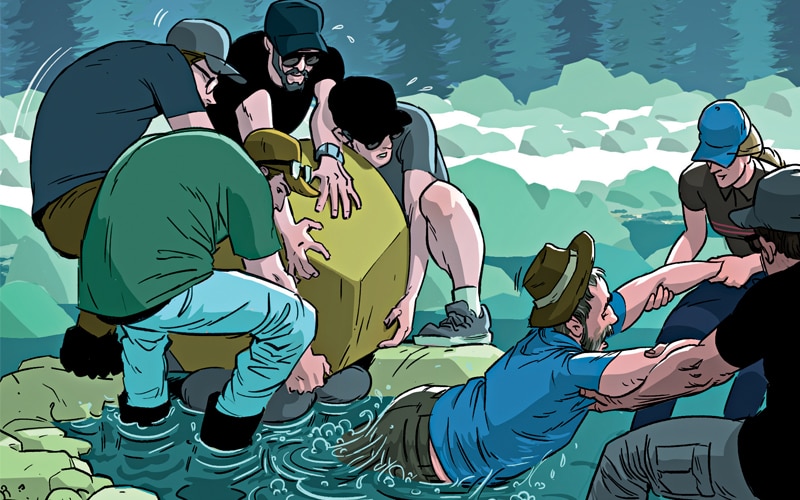 Illustration by Frank Stockton
“I need help!” Roop called out. One of the firefighters moving the smaller rocks grabbed Morris under the armpits and, while the other men kept the giant boulder elevated, pulled him out.
After three hours trapped under the rock, Morris was free.
The Rescuers thought they needed to tend to his mangled left leg, but quickly realized that his boot hadn’t been on his foot. It had come off in the fall, twisted around and filled with water—which had made it feel as if there was a foot inside it. Far from being horribly twisted and mangled, Morris’s leg had suffered only a few scratches.
He wasn’t out of danger yet, though—the team had to warm him up. The first step was getting him out of his wet clothes. Much to Morris’s dismay, they cut him out of one of his better pairs of hiking pants.
“I have his long johns and dry clothes in my bag,” Roop said. They put them on him, then added thermal blankets, a sleeping bag and a full-body vacuum splint, which wrapped around Morris’s body and immobilized him. As his temperature rose, he became more alert, and his pulse and heart rate improved.
It took about another hour before a 176th Wing Alaska Air National Guard pararescue squadron helicopter, which was equipped to airlift Morris, arrived. He was then carried in a basket across Resurrection Bay to Providence Seward Medical Center, where he spent two nights.
The hospital stay was purely a precaution. Morris was, somehow, largely unscathed. He had a nasty bruise on one shoulder and minor scratches all over, but that was about it.
“For him to have no significant injuries,” Harrington says, “that was shocking—in a good way.”
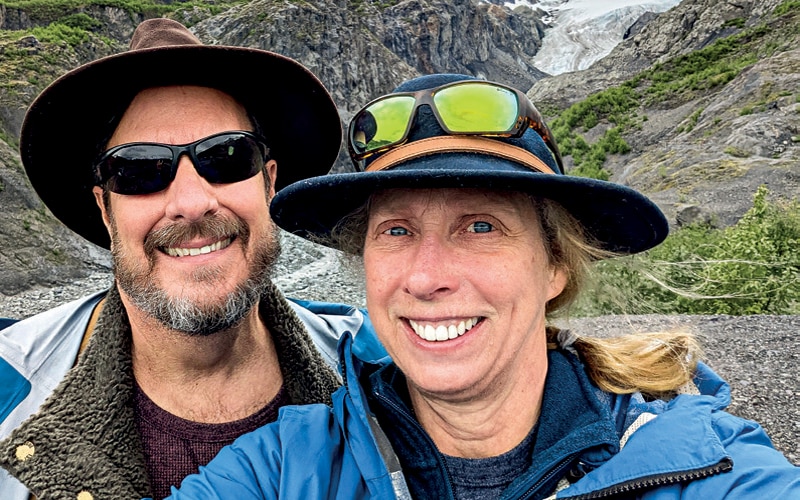 Kell Morris and Joanna Roop plan to keep exploring Alaska’s wilderness. Photo Credit: Joanna Roop
You wouldn’t normally think of a man who gets caught in a rock slide, falls 20 feet, and lands face down in a creek under a boulder as lucky, but in a number of ways, Kell Morris was. If he’d banged his head on a hard surface on the way down, if the boulder hadn’t landed just so on a scattering of other rocks, if Roop hadn’t been able to get a cell signal so quickly, if Sam Paperman and his helicopter hadn’t been available to ferry the firefighters quickly to the scene …
“Every star aligned in this case,” Fire Chief Crites reflects.
Morris and Roop believe it was more than that. “I don’t feel like luck had anything to do with it,” Roop says. “I feel like God’s plan had everything to do with it.”
Morris was back to work three days after the accident, and he and Roop plan to keep up their busy schedule of hiking, backcountry skiing and other outdoor adventures.
“We are definitely going to get to that glacier,” Morris says. “There’s no way that thing’s going to get the best of us. But probably we won’t go up the creek—we know some folks who can get us there by helicopter.”
For more stories like these, click here.