- HOME
- /
- True Stories
- /
- Good News
- /
The Storm-Proof Homes in the Sundarbans That Survived Every Cyclone Since Amphan
A non-profit and a team of architects are turning to local materials, traditional wisdom and community collaboration to rethink what climate resilience could look like in one of India’s most vulnerable regions.
 Photo Courtesy Mukti
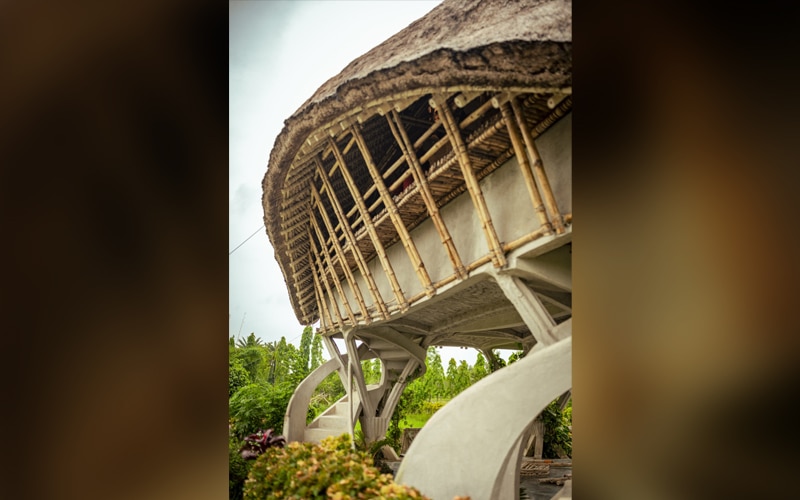
At the Purba Sridharpur village in the Sundarbans, West Bengal, stands an eccentric structure straight out of The Hobbit: a guest house with a domed roof, raised on stilts. But this is the result of careful the planning, not whimsy, of the non-profit MUKTI, in collaboration with architects Udit Mittal and Laurent Fournier.
In 2020, Cyclone Amphan caused widespread destruction of life and property, exposing how vulnerable housing in the Sundarbans had become in the face of strong winds, torrential rain and floods. “Most homes were built with low-cost materials like mud, bamboo, jute and thatch. These houses were usually low-lying, lightly anchored to the ground, and lacked strong structural connections between the roof, walls and foundation,” says Sankar Halder, founder and president of MUKTI. In many cases, residents’ aspirations to build city-like houses also proved to be their undoing. “These houses were built using brick and RCC, but in a sub-standard manner,” says Mittal, founder and principal architect of the QX Design, based in Kolkata.
Being low-lying, houses in the area were especially vulnerable to sweeping cyclonic floods. But a bigger red flag was the widespread use of asbestos-sheet roofing with poor anchoring. “When high-speed winds and storm surges hit, roofs were often the first to be blown away. Once that happened, the mud walls quickly collapsed under pressure from wind and water,” explains Halder. “The sheets frequently blew off and caused severe damage, sometimes even destroying brick walls. Even where thatch roofs were used, they were often poorly detailed, with incorrect pitch and construction leading to leakages. The vulnerability in these houses came from misuse of materials, flawed roof geometry, weak anchoring and declining construction practices,” Mittal adds.
Halder, Mittal and Fournier, a senior architect from France, began rethinking how homes could built in anticipation of storms rather than repeatedly collapse and be rebuilt. As a test, they built Aronnyok, MUKTI’s guest house, as a prototype designed to resist cyclones. At first glance, one immediately notices that the structure is raised on stilts, resembling a spaceship hovering in the air. “Floodwaters during cyclonic events can rise several feet above ground level, often inundating conventional single-storey houses. Therefore, the guest house is elevated well above known flood levels using a stilted structure, allowing floodwater to pass beneath the building without damaging living spaces, while also improving ventilation and safety in extreme weather,” Halder says. Elevation is achieved through shallow brick dome floor slabs, a low-cost technique that uses locally handmade bricks, requires less concrete and steel than RCC slabs, and can span longer distances.
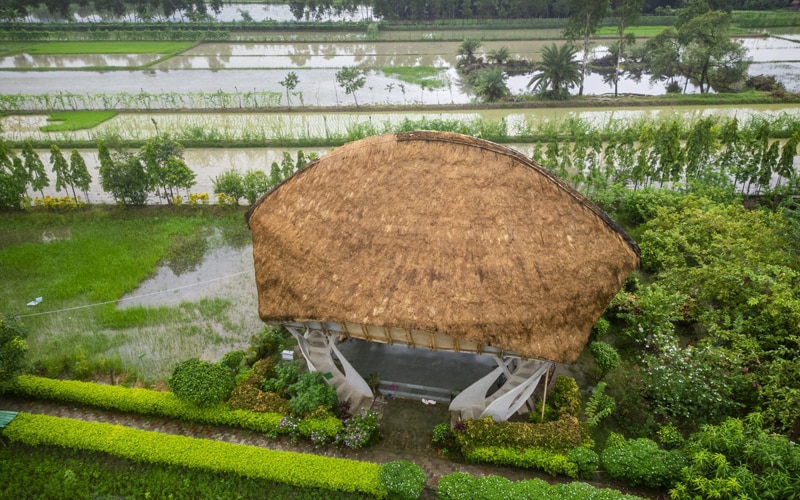
The domed roof certainly elevates the aesthetics of the guest house, but it also serves a crucial structural function. Derived from the traditional do-chala form, the roof is made from locally sourced bamboo, treated and lashed to allow flexibility during high winds, along with thick prefabricated thatch panels made from native rice varieties. About 1.5 feet thick, the panels add durability without industrial waterproofing. The aerodynamic form allows strong winds to pass over the roof rather than tear it apart. The roof, walls and foundation are firmly tied together so the house behaves as one strong unit during storms.
Local involvement was central to both design and construction. “Design decisions evolved through continuous dialogue instead of us being fixated on drawings. Boat makers led the bamboo work, farmers supported the sourcing and preparation of thatch, and women from the village produced prefabricated thatch panels on the ground. Local masons were trained in techniques such as shallow brick dome slabs. This process created strong ownership and mutual learning throughout the project,” says Mittal.
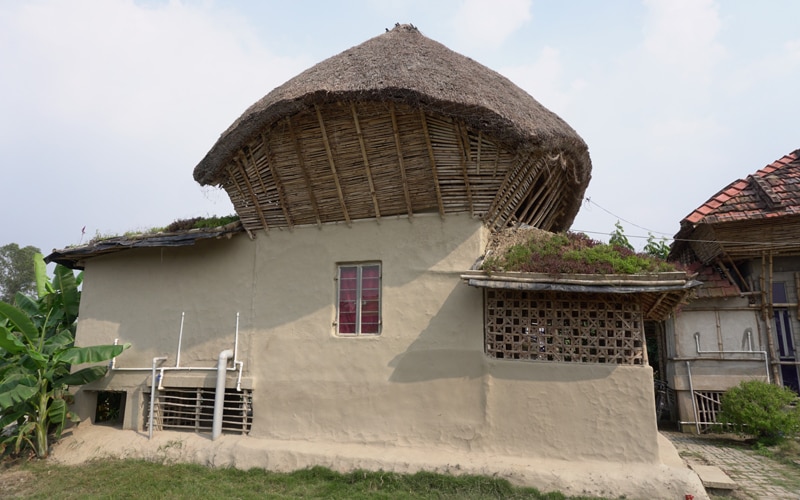
The litmus test for Aronnyok came soon after Amphan, when Cyclone Yaas battered the region in 2021. To the team’s delight, the structure reported no damage or leakage through the thatch roof. It has since weathered multiple cyclonic events, including Cyclone Sitrang (2022), Mocha (2023), and Remal and Dana (2024). Encouraged by this, the team has helped build over 100 cyclone- and flood-resilient houses across vulnerable villages in the Sundarbans. The programme continues to expand in phases. “Several of the construction techniques have already been adopted by local families in surrounding villages. There are ongoing discussions and plans to adapt and scale these ideas to other vulnerable regions, always with sensitivity to local context, materials and skills,” Halder says.
Halder and Mittal hope the project goes beyond innovation. “The focus is on anticipation and resilience—building homes that can face future storms in a sustainable manner,” Halder notes. “Creating an environment where people feel confident to try, adapt and even make mistakes—with guidance and shared learning—is a key part of the ethos. Ultimately, the aim is to build not just resilient structures, but a culture of resilience, curiosity and self-belief,” Mittal adds.
For more stories like this click here