Adrift On An Endless Sea
When the current swept Nathan and Kim Maker far from their dive boat, all they had was each other.
 Illustration by Pete Lloyd
From his perch at the edge of the dive boat, about 50 km off the Texas coast, all Nathan Maker could see was a grey expanse of water. Clouds hung heavy over the gulf, and waves swelled against the hull.
It wasn’t a great day for a dive. But for Nathan and his wife, Kim Maker, any day spent in the water was a good one. The couple from Edmond, Oklahoma, had discovered the wonders of the ocean on their honeymoon in Cozumel, Mexico, 12 years earlier and had become instantly hooked. Since then, they’d spent every vacation that they could scuba diving.
That morning, 24 July 2024, the final dive of their excursion was at a site where coral gardens had formed around an abandoned oil rig, bringing parrotfish, turtles, manta rays and sharks. An earlier dive had been slightly underwhelming, with few signs of marine life, but the Makers were eager to give it another try with the rest of their dive group. At about 10:30, they entered the water with a splash.
A thin cord, or down line, stretched from the boat to the site, guiding divers to about 80 feet below the surface. As Nathan and Kim descended, however, they could see another group of divers from their boat making their way back up the line. Suddenly, one of the women lost her grip and began drifting away. Kim gestured to her husband—a silent “go help her”—and Nathan swam over to the woman. But as he helped her back, making sure she had a grip on the down line, he couldn’t quite reach the line himself, struggling against the current. Kim reached out to him with one hand. But at nearly the same instant, another diver from the ascending group reached her and accidentally grabbed her arm, pulling her hand off the line. Suddenly Kim, too, was drifting.
The Makers were being pulled away from the dive boat, caught in an unusually strong current. They were just below the surface, 10 or 15 feet down, and Nathan gestured for the two of them to dive lower, where the current is often weaker. They swam down, but even at about 40 feet below the surface they could feel the water pulling them away. Trying to swim back to the down line would be exhausting and would burn through their air supply. It was a shame to quit on their final dive of the trip, but there was nothing they could do. They decided to call it a day.
The couple surfaced and inflated their buoyancy control devices, or BCDs, the vests that help divers ascend and descend. Then they inflated their surface marker buoys—long tubes that stick out of the water and make divers visible.
Nathan looked at the dive computer on his wrist. They had been underwater for only six minutes. “Can you believe this?” he said.
In these situations, the rule is to stay put. Don’t struggle against the current. Just stay calm and wait for those on board to send a dinghy. The boat was still in sight, maybe 90 metres away. They could see divers on the deck. But no one seemed to be coming for them. As the current pulled them farther away, they had to wonder: Could anyone see them?
A knot grew in Nathan’s stomach. This wasn’t good. His mind flashed to the stories he’d heard about scuba divers who’d been left behind by their boats. The stories almost always ended badly.
Over the next 30 minutes, the boat got smaller and smaller. Then it disappeared over the horizon. And just like that, Kim and Nathan Maker were alone—miles from shore with nothing but water as far as they could see in every direction.
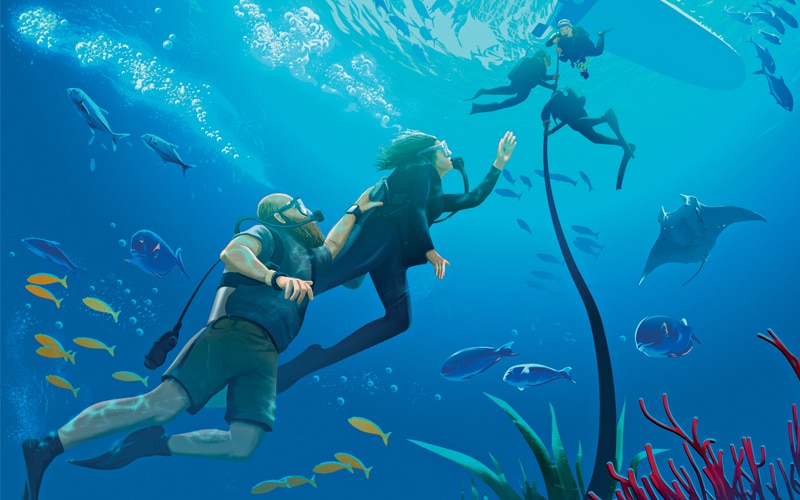 Illustration by Pete Lloyd
Nathan needed to make sure he and Kim stayed together. That had been his impulse from just about the moment he’d met her. A former firefighter, Nathan is a big man with a bushy beard and a gift for talking to strangers and turning them into friends. When he met Kim, he was 37 and living in Edmond. She lived more than four hours away, in Fort Worth, Texas—a big-hearted, 32-year-old special-education teacher who was quick to joke but had the practical know-how of someone who had grown up in a military family. They met online, and after their first date they immediately knew: This was it. They got married five months later, in July 2012.
Nathan had often heard couples talk about how marriage was hard work. He’d nod along, but the truth was he couldn’t relate. Sometimes he and Kim would look at each other in wonder and ask themselves: How is this so easy? It was a cliche to call your wife your best friend, but for Nathan it was just a fact.
In the ocean that day, his first move was to try to jury-rig a tether between them. Using the nylon rope from his surface marker buoy, he attached one end to the crotch strap holding his scuba harness in place and affixed the other end to a split ring attached to Kim’s oxygen tank. Whatever came next, they would be together.
As they bobbed in the water, they talked out next steps. “Shouldn’t we be going back toward the boat?” said Kim.
Nathan didn’t think so. “We don’t even know where the boat’s at,” he said.
Trying to swim back would mean fighting the waves, and the current was pulling them north, toward land. The better course of action was to just go with the current, he said. Once the boat crew realized they were gone, they would alert the Coast Guard. People would be out searching for them.
They had their surface marker buoys, dive computers, flashlights and scuba gear. The water was warm, about 29 degrees, and they were used to being in the ocean. They just had to survive.
That first day, Nathan and Kim tried to stay positive. They invented elaborate drinks, describing the cocktails they would have once they’d been rescued. They compared Sunday school experiences, the different songs they’d sung. Despite the circumstances, they still took pleasure in discovering new things about each other.
Even in warm water, you can get dangerously cold if you’re submerged for too long, especially without a wet suit. To avoid hypothermia, they began doing swim sprints to get their blood pumping. Nathan suggested making it a game: 30 hard leg kicks, then rest for two minutes, always tethered together.
After a few hours, they heard the faint whir of a plane. It was a two or three kilometres to the west, but even from that distance they could see the blaze of orange on its tail and nose—the markings of a Coast Guard aircraft. Nathan’s heart leaped. But as the plane crisscrossed the sky, it quickly became apparent that there was no chance a pilot could spot them from such a distance.
Throughout the afternoon, the plane made intermittent appearances. The couple waved their hands and flashed their flashlights in a desperate attempt to make themselves seen. As evening came, they could see a storm gathering force far off on the horizon to the west, the wind picking up and lightning piercing the sky. Nathan knew the Coast Guard wouldn’t fly in that weather.
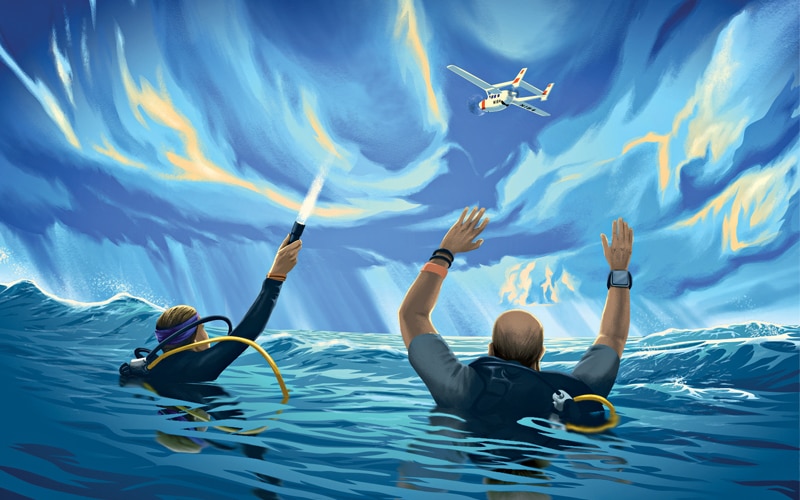 Illustration by Pete Lloyd
“How are you doing mentally?” he asked Kim. “We’re still fighting, right?”
“Yeah, we’ve got this, no problem.”
“We can be in the water all night; it’s not a big deal,” said Nathan, trying to reassure himself as much as his wife. As the light faded, the realization settled on them both uneasily: It would be a long night alone in the ocean.
After the dive boat searched for the couple, the crew had contacted the authorities. “The Coast Guard is searching for two missing divers 24 km offshore from Matagorda,” the rescue service said in a press release. “The divers were last seen surfacing in unfavourable weather conditions and were not seen after conditions cleared.”
Aircraft from Station Corpus Christi were deployed, along with search-and-rescue boats. As the news spread across the country, the couple’s family members prayed for their safety.
Nathan and Kim’s world was reduced to the water they floated in and the sound of each other’s voice. The night was overcast, with thick clouds snuffing out the stars.
Around 8:30 p.m., a glimmering light appeared on the horizon to the north. It vanished, then reappeared a moment later. It was a light mounted on some kind of structure, they realized, possibly an oil rig, and it was popping into view whenever they were at the crest of a wave. It was far away. But not so far that they couldn’t swim to it.
Nathan took their bearings with his dive computer. And then they set off.
By now they were exhausted, but the light gave them something to push toward. Kim had always been goal oriented. This was the ultimate goal—survival—and she swam with energy she hadn’t known she had. All night they swam, taking breaks frequently, but always moving toward the light. After nearly nine hours, they could see the faint outline of the structure—safety and survival, finally within reach.
And then the storm that they had spotted the previous evening hit.
Eighty-kilometre-an-hour winds whipped the ocean into 10-foot swells. Rain came down in torrents. The couple was tossed this way and that, the spray lashing their faces. At first, they leaned back and opened their mouths to try to catch the rain, desperate for any fresh water. But after getting hit by wave after salty wave, they put their regulators in their mouths so they could breath, then clung to each other and tried to endure, grateful for the thin strip of cord holding them together.
The storm subsided just as the sun came up at around 6:30 a.m., revealing an infinite panorama of ocean. There was no sign of the light. There was nothing on the horizon but waves.
Now, almost 24 hours into their ordeal, Nathan could see that Kim had been badly sunburned the day before. And he was noticeably weaker. The couple resumed their conversation—checking in with each other, trying to keep things light. “We’re still good; we still got this; we still have energy,” said Nathan. “We’re OK.” But they both knew the situation was getting dire.
Throughout the day, the Coast Guard plane would appear, always far to the west. At one point, they drifted into a school of jellyfish, which left awful stings across their bodies. In the afternoon, Nathan started vomiting uncontrollably. They were severely dehydrated. A human body can generally go about three days without water, and with the way they were feeling, Nathan didn’t think they were going to set any records.
“Let’s try to rest,” he said. Nathan put in his regulator so he could float with his face in the water, then lay his forehead on his surface buoy marker, using it as a pillow, and closed his eyes as Kim watched over him.
After 10 minutes, they switched. As soon as Kim put her face underwater, however, she popped back up again. “Dolphins!” she yelled. “Dolphins!”
Just beneath them, about a dozen spotted dolphins circled, suddenly leaping out of the water and flipping in the air, putting on a show. Kim and Nathan looked at each other in amazement. Then they started laughing. They were fighting for their lives, but the sight of those dolphins gave them a jolt of energy.
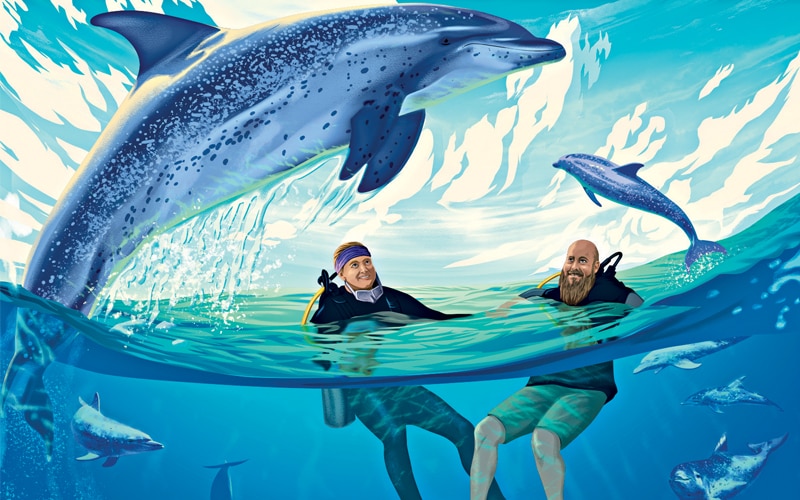 Illustration by Pete Lloyd
By 7 pm, as the second evening approached, it was harder than ever to avoid facing the seriousness of their situation. They were weak with hunger, severely dehydrated and exhausted. Nathan could feel his body falling apart. He was older than Kim and had type 2 diabetes. When they resumed their swim sprints, they just went in circles, with Nathan dragging behind.
At one point, he suddenly saw his father, who had died a few years earlier, standing there in the waves. “Here you go, son,” he said, handing Nathan a set of keys. Then he disappeared.
“Did you just see my dad?” Nathan asked. Kim looked at him with growing concern. If her husband was hallucinating, how long could he keep going?
As the sun set, Kim’s lips and tongue were badly swollen, her throat so constricted and dry she could barely talk. Her feet were so swollen that every kick sent a shock of pain through her body. We’re not going to make it to morning, she thought.
In the darkness, they could see more lights in the distance. Kim wanted to swim to them, but Nathan couldn’t kick his legs anymore. He could feel her straining against the cord as she tried to swim. It was obvious to him—he was weighing her down.
They stopped. “Listen, I’m fighting to my last breath,” Nathan told his wife. “But if I pass before you, you’ve got to cut that tether and just let me go. You’ve got to get home.”
Kim didn’t want to hear it. Over the last few hours, she had been making her own plan. If Nathan died, she had decided, she would take the weights from her BCD vest, stuff them into her rash guard, and sink to the bottom of the ocean. She didn’t want to go on without Nathan. It was almost a relief to know she had a plan.
By now, the Coast Guard had been searching for about 36 hours. The couple had drifted miles from where they’d initially gone missing. Ships and planes and helicopters had all been searching fruitlessly, covering 4,289 sq. km.
Just before midnight, the Coast Guard plane that had been making occasional appearances to the west curved toward them. Nathan and Kim looked up, hardly daring to hope. The plane kept coming. Kim remembered the Morse code for SOS, and they pointed their flashlights at the plane. Short, short, short. Long, long, long. Short, short, short. Clicking the button was almost too much for Nathan’s exhausted body. The plane kept coming, flying directly overhead. Do they see us? It was impossible to tell.
About 10 minutes later, they heard the roar of a boat coming toward them. Oh my God, thought Nathan. We’re gonna be saved. The boat pulled right up to them and three Coast Guard officers in blue uniforms peered down into the water. “They were literally the best-looking people I’ve seen in my life,” says Nathan.
“Do you have any major injuries?” one of the men asked.
“No, no, no, we’re good,” said Nathan.
“We’re gonna pull you up,” they told him. Nathan looked up at them. I’m 6-foot-4, 115 kilos, with 18 kilos of gear on, he thought. There’s no way they’re just gonna pick me up. But the next thing he knew, their hands were on him, briefly pushing him down into the water and then using his buoyancy to help them pull him over the side of the boat. Kim followed.
For the next five minutes, they just lay there on the deck—exhausted, injured, but together and very much alive.
The rest of the rescue was almost like a dream. Is this real? thought Kim. Are we going to be OK? The small boat delivered the couple to the Coast Guard Cutter Edgar Culbertson, where the crew seemed almost as excited to rescue the couple as Kim and Nathan were to be rescued. The crew members took their vitals and gave them Pedialyte to hydrate them. They cooked for them, insisted they each take a shower and gave them clothes out of their lockers. Nathan was already cracking jokes and making new friends.
The couple was taken to St. Luke’s Health–Brazosport Hospital in Lake Jackson, Texas. Both were badly sunburned and dehydrated, and Kim was diagnosed with rhabdomyolysis, a condition in which her muscles were breaking down. But despite their ordeal, they were both amazingly intact. A few days later, they were released.
In the months since then, Kim and Nathan have tried to process the event, at times struggling to make sense of it all. For Nathan, the world became extra vivid. “Everything changed from that point forward,” he says. “Everything smells better. Everything is sweeter.”
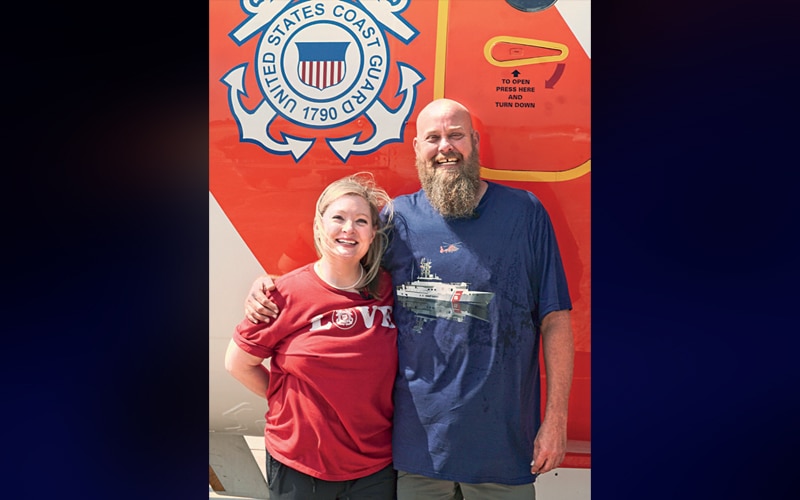 Kim and Nathan Maker haven’t lost their love of diving. Photo Courtesy: Nathan Maker
The trauma of their time in the water hasn’t left them either, sometimes returning when they least expect it. A few weeks after their ordeal, they invited their Coast Guard rescuers to the American Legion post near their town for a thank-you party. Some of them arrived in their airplane, and the specific sound of the engine immediately sent Kim and Nathan back to the ocean. “For a split second, I thought I was floating in the water again,” says Nathan.
One thing that hasn’t changed is the couple’s strong relationship. When they talk about the time they spent on the ocean, they rush to give the other credit for their survival. “She’s the toughest woman I’ve ever met,” says Nathan. “If it wouldn’t have been for her, I wouldn’t have lived.”
Kim insists Nathan was the one who tied them together and made swimming into a game. “It was absolutely him that kept us alive out there.”
But they both agree that they wouldn’t have made it without the other.
Last August, a month to the day after the dive that nearly killed them, the Makers were in Jupiter, Florida, for another scuba diving trip. If they didn’t get back on the horse right away, Nathan reasoned, maybe they never would. As the boat made its way to the dive site, both of them felt incredibly nervous. Being out on the ocean was nerve-racking.
Luckily, they didn’t have to do it alone. They took a giant stride off the boat and entered the water, together.
To read more thrilling tales of survival, click here.