- HOME
- /
- True Stories
- /
- Heroes
- /
How Dr. Abraham George is Building a World Of Second Chances
After a near-death moment granted him a new lease on life, Dr. Abraham George chose to turn his blessings outward, creating opportunities so at-risk children can begin again
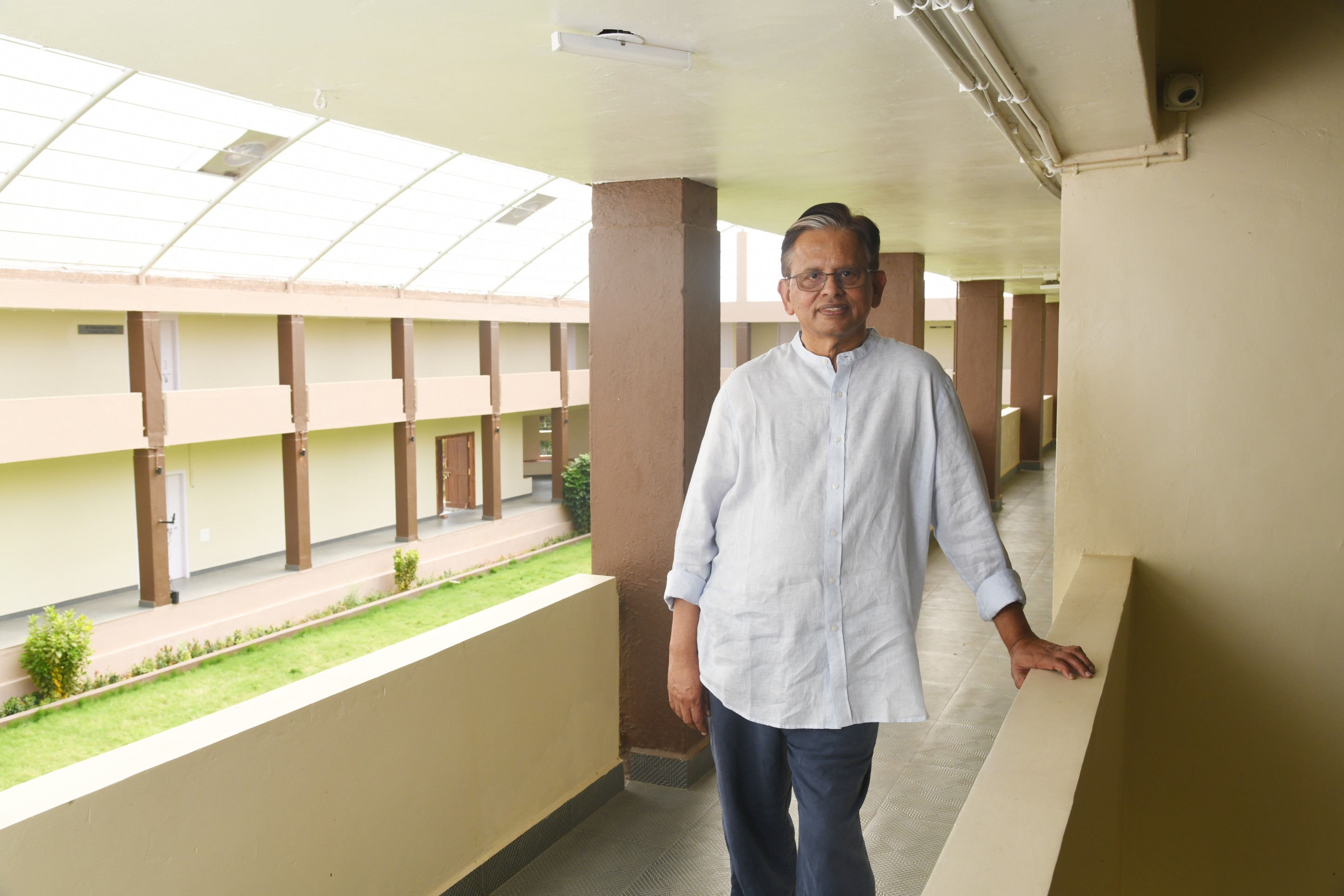
 Dr. Abraham George sold his successful U.S.-based business to focus full-time on philanthropy. Photo: Ratheesh Sundaram
In 1965, three years after the Indo-China war, Dr. Abraham George—then a young captain in the Indian Army’s artillery division—came close to death. His regiment was stationed in the Himalayas at 14,000 feet, battling extreme cold and low oxygen.
“I was leading 300–400 soldiers in a no-man’s-land near the Chinese border. We were digging bunkers by blasting through rocks, preparing for possible conflict,” he recalls. One explosion went horribly wrong, leaving him severely injured.
In the aftermath, as he lay recovering, a new resolve took shape: to build a life that would matter—and to use it in service of others.
As a child, he had watched soldiers train near his grandfather’s home in Thiruvananthapuram. “I was fascinated by it all—the discipline, the uniform. I was a mischievous kid, but I wanted to join the military.
My parents didn’t know much about it, but they supported me. I joined the National Defence Academy at the age of 14,” he says.
In his memoir, Mountains to Cross, Finding Life’s Purpose in Service, released last April, Dr. George recounts the moment of the accident as a fateful crossroads. In an interview with the Reader’s Digest India, the social entrepreneur, philanthropist and the founder of Shanti Bhavan Children’s project says it made him pause and think about what he was doing. “The [injury] was the breaking point,” Dr. George says. “But it changed my life.”
After being discharged from his duties on sick leave, he spent time with his family and pored over books. He was deeply influenced by Reverence for Life written by Albert Schweitzer. “It’s about the how we all have an obligation to help those who are suffering, and the sanctity of life itself,” he says. He was also moved by British philosopher, Bertrand Russel, a leading anti-war activist, who is known to have famously said, “War does not determine who is right—only who is left."
“I realized that I didn’t want a life built around conflict. I do agree that somebody has to do that job, but I couldn’t see myself doing it for the rest of my life,” he says.
In December 1968, he arrived in the United States for a new chapter and found himself amid the civil-rights unrest and political upheaval. “I knew I was witnessing history unfold,” he says. After earning a business degree and a PhD in international finance and development, he eventually founded Multinational Computer Models, a company that, by 1990, served 200 Fortune 500 clients—giving him the means and clarity to pursue sustainable philanthropy.
By 1995, Dr. George was back in India and ready to launch the non-profit through which he would route his social work—the George Foundation, whose aim was to improve the lives of marginalized people, focusing on poverty alleviation, environmental health and gender equality. However, its most notable accomplishments over the years are Project Lead-Free and the establishment of Shanti Bhavan.
Project Lead-Free was the most extensive blood-lead screening study ever conducted in India. Between 1997 and 1999, the foundation screened over 22,000 people, of which 15,000 were children in seven major Indian cities. The results were astonishing. More than half under the age of 12 in urban areas had alarming blood lead levels, far exceeding 10 mcg/dl. Before this study, the Indian government had not recognized lead poisoning as a serious health threat. Confronted with the data, India’s three major oil-refining companies committed to phasing out leaded petrol. Unleaded petrol in cars became law by 2000.
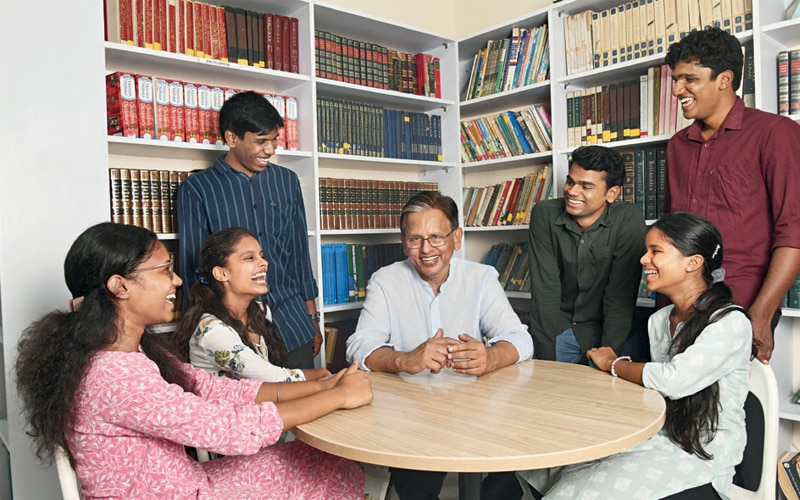 Dr. George with students at Shanti Bhavan school. Photo: Ratheesh Sundaram
Dr. George also set his sights on creating a pioneering model for education. A residential school near Hosur, straddling the border of Tamil Nadu and Karnataka, Shanti Bhavan is a radical experiment, designed to break the cycle of intergenerational poverty. “We take in children, one from each family, from age four, and provide full-time lodging, education, meals, and a comprehensive upbringing,” he says. The students hail from the most marginalized communities, including Dalits. Many have contended with abject poverty, violence, broken homes, parental fights and severe caste discrimination. Removing them from this toxic environment and creating opportunities for them was important.
But it wasn’t easy. In the early days, when Shanti Bhavan’s volunteers were sent to rural areas around the school, they were regarded with suspicion. People were convinced it was a scam. With patience and persistence, they gained the community’s trust and formed its first batch of students.
When Shanti Bhavan Residential School officially opened in 1997, it welcomed its first cohort of 48 students—24 girls and 24 boys. Their commitment to these children and their families went beyond schooling: the institution supports its students through college and into their first jobs. Today, its graduates have gained entry to universities in India and abroad, transforming not only their own futures but those of their families. In 2024, a second Shanti Bhavan school opened in Chikkahosahalli, a village near Bangalore. A total of 400 students study across both schools, with an equal number having already graduated.
The cost of educating one child is a little over 2,200 USD [₹2.09 lakh] a year, says Dr. George. All facilities for the children are offered for free. After the 2008 financial crisis, in which he was hit hard, Shanti Bhavan depended on external donors for the first time. One of the biggest donors was Dr. George’s own mother, herself an accomplished NASA scientist and one of the first Indian women to earn a PhD in physics. “She gave away all her life savings to Shanti Bhavan,” he says. “None of us siblings inherited anything. She was so proud of the school and the children.”
Despite the significant challenges, Dr. George claims to be the happiest of men. His legacy is not measured in wealth or recognition, but in the children in whom he invested over the years. “Transforming society—that’s what we aim for. Only that can create lasting change.”
For more inspirational stories like these, click here