- HOME
- /
- True Stories
- /
- My Story
- /
Could He Avoid AI for Two Whole Days?
Spoiler alert: It was harder than you might think!
 Photo: Amir Hamja/The New York Times
When I decided to live without artificial intelligence for 48 hours, I figured it would affect some parts of my routine. I knew I wouldn’t be able to watch Netflix algorithm–recommended documentaries or read marketing emails written by bots, for instance. That I could deal with. What I didn’t expect was that my attempt to avoid AI would affect nearly every part of my life—what I ate, what I wore, how I got around.
I undertook this experiment with the goal of seeing firsthand just how prevalent AI is in our everyday lives. I wanted to identify all the AI hiding in plain sight, and to find out what life would be like without it. I would spend two days as the No-AI Guy.
“Good luck with that!” said Jeff Wilser, the host of a podcast called AI-Curious. “I used to say that if you want to avoid AI, you should go be a goat herder in the mountains. Now I can’t even say that, because goat herders probably use it too, wittingly or not. For starters, they check the weather, and nowadays almost every weather prediction is made with AI.”
While researching my subject, I encountered wildly conflicting opinions. Is AI overhyped, merely a glorified spell-check, as some people insist? Or is it the biggest discovery since fire, as others claim? Is it taking away our freedom of choice by forcing us to obey biased algorithms? Or is it making our lives better in a thousand small ways, as Garrett Winther, the chief product officer of the venture capital firm Newlab, argued.
“People think AI is scary,” Winther told me, “but, really, it’s improving our lives in ways we don’t even notice, allowing us to breathe easier. Literally.” He cited a recent New York State AI programme that used the technology to monitor the air for abnormalities such as methane leaks.
Before I started my experiment on a random Monday in October, I had to answer a fundamental question: How should I define AI?
Many people associate the term with generative AI, which burst onto the scene in 2022. It’s the technology that churns out college English papers and concocts images of smiling customers for soft-drink ads. But the AI umbrella also covers other types of programmes capable of learning and evolving—including machine learning, which has been widespread since the 2000s. A machine-learning program updates itself or its predictions based on new data. When the Waze [traffic] app finds a shortcut, you can thank machine learning.
To be AI-free, I decided, I would avoid both generative AI and machine learning. I would be a purist.
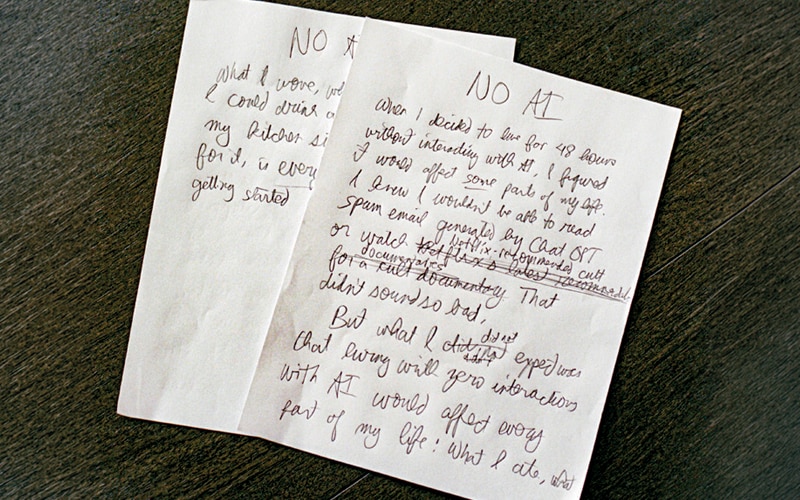 Photo: Amir Hamja/ The New York Times.
It Begins
Still in bed in my New York City apartment, I reflexively grabbed my iPhone so that I could hold it in front of my face and unlock the screen. But no. Facial recognition runs on AI. I typed in my passcode like it was 2017.
What could I do with my phone now that it was open? Not much. No Facebook, no Instagram: Social media feeds are determined by AI and littered with AI-generated ads. How about a podcast? Nope. Many podcasts use AI editing programmes to remove the ‘ums’ and awkward silences.
Should I check the news? According to a 2024 Associated Press report, 70 per cent of journalists reported that their organizations used generative AI tools for research or other purposes. I would be cut off from current events—which could be a nice bonus.
Checking my email was also a no-no. Gmail uses machine learning to weed out spam. I put my iPhone in a drawer.
In the kitchen, my wife, Julie, flicked on the lights. I flicked them off.
“Are you kidding me?” she asked.
“The energy grid uses machine learning to predict where the demand will be,” I explained.
 Photo: Amir Hamja/ The New York Times.
I told Julie there was no reason to worry, though: I had prepared for this eventuality by purchasing a portable solar power generator. I plugged a lamp into it and lit up the kitchen with pride.
Brushing my teeth was more of a challenge, at least if I wanted to use water. The New York City reservoir system has a tool that takes data from a network of sensors, which it combines with historic data. Scientists and engineers use those findings to help anticipate demand and make decisions about infrastructure repair.
But I was ready for my self-imposed drought. Like a doomsday prepper, I had been collecting rainwater in a bowl. I know—a bit ridiculous. But the absurdity helped me see the world with new eyes. I was spotting AI everywhere, as if I had an ultraviolet flashlight revealing all the germs we can’t see.
The fact is, almost every object in our lives is affected by generative AI and machine learning—whether in its design, manufacturing, marketing or shipping. The question is no longer whether these new technologies touch something, but to what degree.
I decided to rate everything in my life on a scale of one to 10. If something owes its existence almost entirely to AI or machine learning, like the spam emails that clog my inbox, it gets a 10.
What about the tree outside my window? The New York Department of Parks and Recreation uses cars equipped with visual scanners to conduct an AI-powered tree census, which tracks the health of the city’s more than 6,00,000 sidewalk trees. So my neighbourhood maple has been touched by AI, but only tangentially. It scores a mere one out of 10. I can rest in its shade with just a little guilt.
Bartering for Food
My business meetings are often conducted over Zoom, which uses AI for noise suppression, among other things. So I was glad to have received an invitation to meet three other non-fiction authors at a restaurant downtown.
What to wear? Certainly not my H&M chinos, which scored a four on my ranking. Like many big clothing retailers, H&M uses machine learning to optimize shipping routes, and its designers have experimented with AI-powered tools. To be safe, I dug out an outfit from the pre-AI era: a bright floral shirt and a pair of checkered pants I had inherited from my grandfather, who had an Austin Powers phase back in the 1970s. It wasn’t my usual nondescript outfit, and it made me nervous.
“It’s actually the coolest outfit you’ve worn since we’ve been married,” Julie said.
I usually check the weather on my phone before I leave the apartment. But weather apps use machine-learning data. So I resorted to an old-style app—sticking my hand out the window. About 23 degrees—no need for a jacket, though I did take an umbrella, since I didn’t know if it would rain.
“If you’re leaving, could you take out the garbage?” Julie asked.
Sadly, I could not. To be safe, I had to avoid contact with the sanitation system, which uses machine learning to optimize the garbage truck routes and AI robots to sort recycling.
How would I get to the restaurant? Uber and Lyft were verboten, since they use AI for pricing, demand and scheduling. What about hailing a taxi? Still no. Automakers use AI to design parts, and more than half of modern cars come loaded with machine-learning features, such as the sensors that alert you when you have drifted into another lane.
I considered the subway. The Metropolitan Transportation Authority uses AI-enabled software to monitor fare-evasion patterns. So the subway received a two on my scale.
Not bad. But a safer option might be a bicycle—not a Citi Bike rental, which uses machine learning to predict demand and determine the placement of its bicycles. Instead, I borrowed my son’s bike.
Alas, I was likely to incur a number of violations on my ride. The New York City Department of Transportation uses machine learning to analyze traffic and pedestrian flow. I pedalled downtown nonetheless, pausing on a corner to examine a folding Rand McNally city map. Yes, you can still buy paper maps! Which was a good thing, since I couldn’t check Waze or Google Maps, which use machine learning to pinpoint your location and update your route.
I unfolded the map, battling gusts of wind while trying to figure out which avenues had bike lanes. I reflexively used my thumb and forefinger to enlarge Sixth Avenue. Well, almost. I caught myself at the last moment. Regardless, the map didn’t have that info. Utterly failing to refold it properly, I ended up stuffing the bulky paper accordion back in my bag.
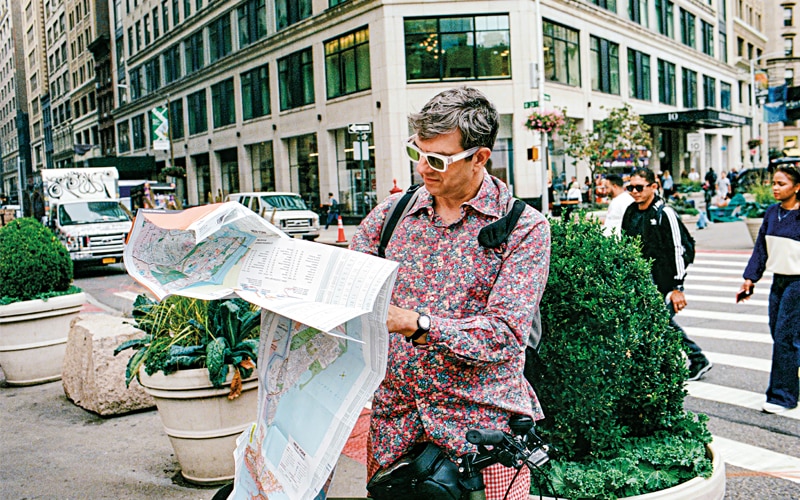 Photo: Amir Hamja/ The New York Times.
Finally, I arrived at my destination, the Hole in the Wall restaurant.
“Thanks for organizing lunch,” I whispered to author Jonathan Goodman.
“Why are you whispering?” he asked.
I explained that I was trying to avoid interacting with AI and had noted the presence of a man nearby who was wearing AirPods. The new Apple AirPods Pro 3 include an AI feature that translates languages in real time.
Over lunch, we talked about the use of AI in publishing, including its impressive editing abilities. I gave up whispering and hoped for the best.
How to pay for my food? That was a head-scratcher. Credit card companies use AI to detect fraudulent activity, as does the ATM where I get my cash.
“Do you accept gold?” I asked the manager.
“I’m sorry, no,” he said. “I don’t know the rates of gold.”
That was a shame, because I had brought some with me. My mother, a jewellery maker, had given me three tiny 20-carat golden horses left over from a necklace she had made.
I figured cash was lower on the AI scale than credit cards, so I paid with $20 bills.
 Photo: Amir Hamja/ The New York Times.
“Let’s get a selfie before we leave,” Goodman said.
“I don’t think I should,” I said.
Smartphone cameras use AI to figure out where to focus and how to adjust for lighting. But I had come prepared, with a vintage Kodak folding camera in my bag. I held it aloft.
“Everybody stay still for 20 minutes,” Goodman joked.
I snapped a photo. Or tried to. The shutter was stuck.
Truth be told, the restaurant meal had earned me several violations. The food service industry has AI aplenty. Some industrial farms use it to predict water and fertilizer needs. And my lunch ingredients had been trucked and shipped along AI-optimized routes. (I’d ordered scrambled eggs, figuring a one-ingredient meal required less AI.)
There was also the fact that my lunch mates had reserved our table with the machine learning–equipped Resy app. Further, the Parched Hospitality Group, which operates Hole in the Wall, uses AI-enhanced software for invoicing, payroll and food orders, according to Tom Rowse, the company’s chief strategy officer.
To atone for my restaurant sins, I decided to forage for my next meal in Central Park. I’d watched a video by Steve Brill, a forager known as Wildman, who has gathered foodstuffs in New York City parks since the 1980s. I plucked up several plantain weeds (not to be confused with the much more delicious banana relatives called plantains). At dinner, I tried them. They tasted like the dirt they had come from. I erased the flavour with some red peppers that a friend had gotten at an organic farm.
That night, I collapsed into bed. Luckily, my mattress was not one of those ‘smart mattresses’ that adjust the firmness and temperature with AI.
Leaving the Algorithm
Not long after waking up on Day two, I decided it was movie time.
A big downside of AI is that it can force us into cultural silos. Streaming services nudge us toward the types of entertainment we’re already familiar with. You liked Notting Hill? Here are two more Julia Roberts rom-coms!
I replaced the Netflix recommendation algorithm with my high school English teacher, a film buff. Before my experiment, I had emailed him for a suggestion. He responded: “Currently reexploring Robert Altman—Brewster McCloud … whoa.”
I had ordered this 1970 movie on DVD, and now I watched it on a portable DVD player we had neglected for two decades. Brewster McCloud was bizarre and whoa-worthy, and I was glad to be out of my Netflix bubble.
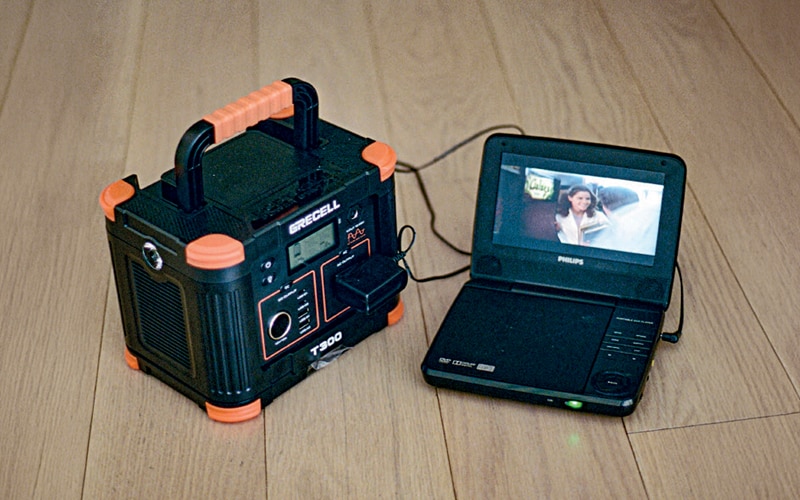 Photo: Amir Hamja/ The New York Times.
My next errand was walking our dog. Before leaving the apartment, I put on my anti–facial recognition sunglasses. The streets of Manhattan are monitored by thousands of security cameras, some operated by the police department, others by businesses. After a suspected crime, the NYPD can search the footage using AI-powered facial recognition software. So just by strolling outside, I risked interacting with AI.
Hence, my Ghost sunglasses. I had bought them from Reflectacles, a privacy protection company. The white frames and yellow-tinted lenses defy facial recognition cameras by blocking the infrared light they use to map our features. I relished the feeling of slipping under the radar.
“Hey, Elton!” one of my neighbours greeted me.
Back home, I had to make a phone call, a tricky undertaking, since the iPhone uses machine learning for noise suppression and energy efficiency.
Julie retrieved a landline telephone, curly cord and all, from a storage locker in the basement. It wasn’t a perfect solution, as Verizon uses AI to predict damage to its fibre lines. But it ranked lower on my AI scale than a smartphone.
My plan was to attempt a Herculean feat: to find an actual human being at eBay customer support who would talk to me. I’d paid for a vintage 1990s bike, which had failed to arrive. That’s why I had settled for riding my son’s 2022 bike on day one.
First, I needed the number for eBay headquarters. I called 411.
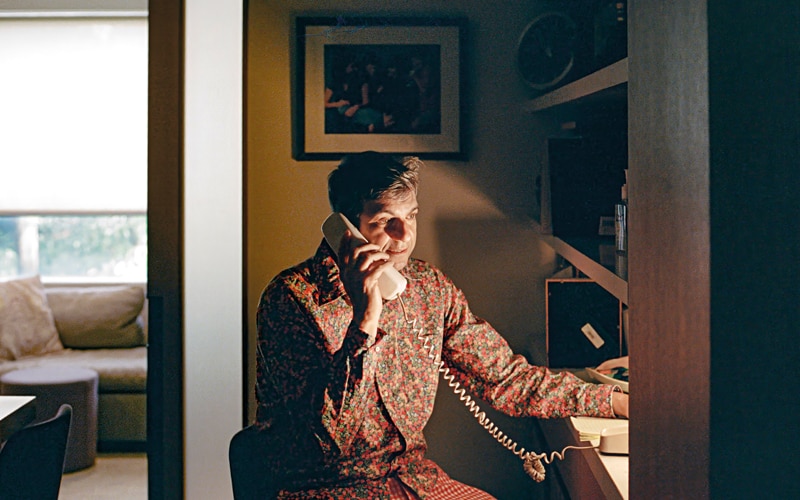 Photo by Amir Hamja/ The New York Times.
“City and state, please,” said a robotic voice.
“Can I talk to a human being, please?”
Voice-recognition programmes rated an eight on my scale—they run on AI programmes trained on millions of spoken words.
Moments later, a different voice said: “City and state, please.”
“Are you a human being?” I asked.
“Yes, I am.”
“Me too!”
Silence. I requested the number for eBay. While the operator was looking it up, I asked, “By the way, what kind of people still call 411?” Silence. Then a robotic voice gave me eBay’s number.
Things went downhill from there. The eBay phone tree flat-out refused to connect me to a non-robot.
I spent the final hours of my experiment trying to draft this article. I couldn’t use my MacBook Pro, as it’s loaded with machine-learning features. I began working on a typewriter I bought days earlier. I loved the clackety-clack sound, but the ribbon was low on ink.
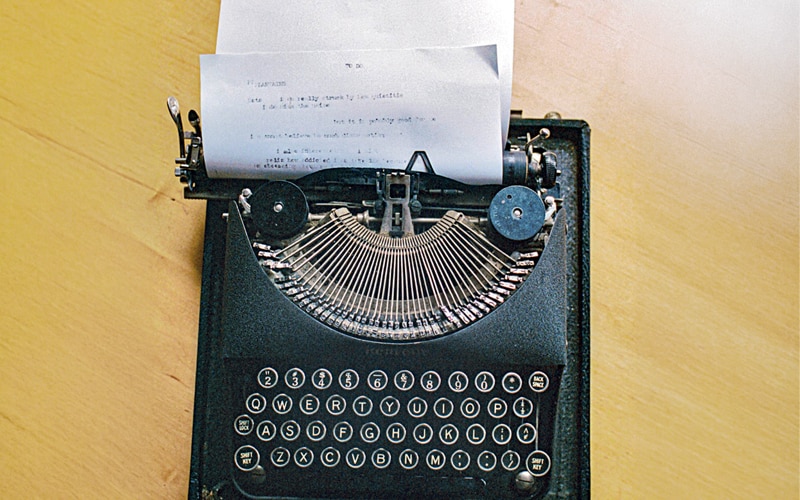 Photo: Amir Hamja/ The New York Times.
I switched to pencil and paper, despite my worry that the manufacturers of those simple writing tools were among the more than 50 per cent of companies that use AI in hiring, according to a survey by Resume Builders. Since my solar power box had run out of juice, I wrote by candlelight. It was kind of soothing.
So how am I feeling in these last few hours? A little unsettled by just how prevalent AI is. I’d like more transparency. It seems important to know when an image or email is AI generated. And I’d like more control over the algorithms that influence my life.
I’m also less sure about how the world will look in five years, but more certain that AI will be increasingly involved. “We’re just at the beginning of the AI era,” said Wilser, the host of the AI-Curious podcast. On the spectrum of AI-is-glorified-spell-check to AI-is-bigger-than-fire, the project has moved me slightly in the bigger-than-fire direction.
If I were to write a sequel to this story in five years, I would have an even more difficult time. Or, as Jeff Crume, an IBM cybersecurity expert who makes popular AI explainer videos, put it: “You mean when ChatGPT writes a sequel to this article in five years?”
Good point.
The New York Times (28 October 2025), Copyright © 2025 by The New York Times Company.
For more stories like these, click here