- HOME
- /
- True Stories
- /
- Heroes
- /
Rescue from An Infernal Trail
A retired firefighter knew that a delirious hiker was close to death in the 37-degree heat. Could he coax the much larger man down the mountain and save both their lives?
 Zeto hiking in the Superstition Mountains. Photo: Marion Rhoades Photography
On a Wednesday morning in May 2024, Colt Johnson, a 26-year old electrician on vacation in central Arizona, set out to hike a remote trail in the Superstition Mountains by himself. Accustomed to hiking the shaded, cooler trails near his home in Blackfoot, Idaho, Johnson was undone by the brutal 37-degree heat of Arizona’s naked sun. After five hours, he found himself lost and out of water. Lightheaded and dizzy, he texted his wife, “I need help.”
But his text didn’t go through; his phone had no service. Johnson nibbled some gummy worms, fearing they would be his last meal. He thought of his wife, Malia Johnson, five months pregnant, and their three-year-old daughter, Della, hoping that he would get to see them again.
Desperate, he fired a distress signal from the 10 mm handgun he carried to fend off bears—a last-ditch call for help.
The sound carried across the rocks and mesas to John Zeto Jr., a 57-year-old retired firefighter from Tampa, Florida, enjoying his new hobby—hiking mountain trails in Arizona. He’d passed a sign banning target practice, so he thought the pair of shots might be someone shooting at an animal. But when he heard another pair about half an hour later, his instincts, honed over 30 years responding to calls for help, told him the repeated shots must be a distress signal.
On previous hikes, Zeto had come across other hikers in need. There was a man who fell and bloodied his head, a woman who broke her leg. As a result, he’d started carrying extra supplies in case others needed help. He hiked in the direction of the shots, and about 45 minutes later, cresting a ridge, he spotted gear scattered off the trail. Soon he came across Johnson, lying on his side.
He could tell that Johnson was confused, disoriented and in rough shape. Zeto gave him some of the extra water he’d packed along with an electrolyte gel. In his delirious state, Johnson rambled on about Malia and Della.
“Where's your car parked?” Zeto asked.
Johnson mumbled something about a lake. Must be Canyon Lake, Zeto figured, looking at a photo of the map on his phone. It was about five kilometres away. “Let’s go,” Zeto said firmly. “We’re wasting time.”
It was around two p.m. when they got moving. Johnson was woozy but could put one foot ahead of the other. Zeto knew the situation was urgent and wanted to take advantage of what strength the younger man had while it lasted.
Within half an hour, Johnson had finished off Zeto’s three litres of water. But still, he grew weaker. Shivers shook him, likely brought on by an elevated body temperature. Soon, Zeto had to support Johnson so he wouldn’t stumble and fall. Zeto, five foot seven and 70 kilograms, draped Johnson’s arm over his shoulder to help support the sagging man’s six-foot-five, 95-kilogramframe. “If he’d fallen, my job then would have been to run and get cell service so I could call for help,” Zeto says. “I can’t lift him.”
It made for slow going. When they’d reach a boulder, Zeto would push Johnson up from behind, then scramble around to help guide him down the other side.
They took several short breaks in the shade of the rocks. Zeto was tiring from the effort but remained standing. “If I sat down, it would mean it was over for both of us,” Zeto says.
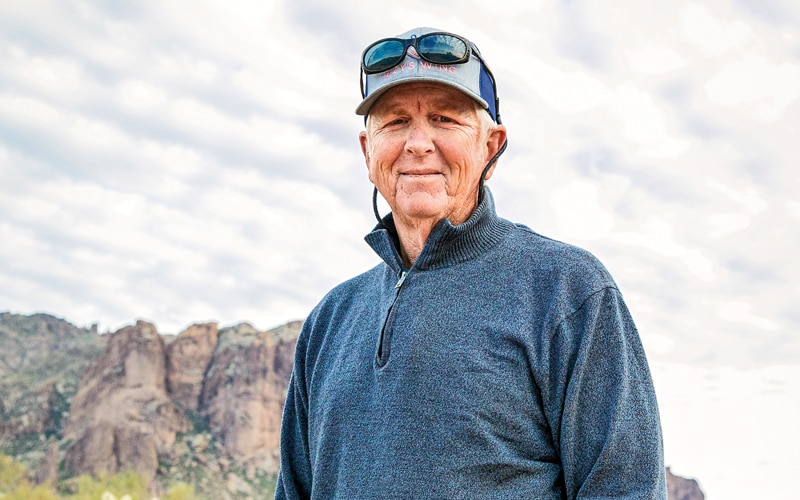 John Zeto Jr.’s lifesaving skills kicked in on a dangerous trail. Photo: Marion Rhodes Photography
But during one break, Johnson sat, closed his eyes and refused to move.
If they didn’t get off the mountain, Zeto figured Johnson could probably make it through that day but not the next, not in that heat with his core temperature already dangerously high. Zeto’s experience rescuing people in Florida’s heat told him that Johnson’s symptoms—the wooziness, the chills, the mumbling—meant he was heading toward a stroke unless he got help soon. And even though he’d hydrated in advance, Zeto, parched, was also in need of liquids.
He had to keep Johnson going. He got in his face: “You got a daughter? Want to see her again? Then get off your butt! You’re putting us both in danger.”
That got Johnson moving. But next time they took a break, he again didn’t want to get up. “C’mon!” Zeto barked.
This scene played out several times. Slowly, they made their way down, carefully picking their way along the switchbacks that cut through the steep terrain, taking care not to slip on the sharp shell rock that lined the trail. Zeto knew that a twisted ankle could sideline them both.
The more Johnson slumped against Zeto, the heavier he became. Tired as he was, though, Zeto was determined to get them both to safety. “The hills weren’t easy for me either, but I was able to muscle over them,” he said.
At around four-thirty p.m.—after almost three tedious hours of trekking and climbing and stopping—Zeto and Johnson finally made it to Johnson’s Toyota Highlander, parked by a trailhead near Canyon Lake .
As Johnson slipped in and out of consciousness, Zeto found his car keys, shovelled him inside the Highlander and drove the half hour to Apache Junction, the closest town.
Zeto then helped Johnson out of the car and into an air-conditioned souvenir shop. They sat down and poured Gatorade down their throats. After a spell, Johnson began to feel more like himself. Zeto could tell: His voice was more distinct, his words no longer gibberish.
Eventually, the two drove back to the trailhead. Johnson assured Zeto he was well enough to drive back to his family in Casa Grande, Arizona, roughly an hour and a half away. After they parted ways in their respective cars, Zeto checked in periodically by phone to make sure Johnson arrived safely.
It wasn’t the last time the two men spoke. In fact, they’ve stayed in touch ever since, with Zeto spending five days in Idaho with Johnson and his family, which now includes another daughter, Scottie, about one and a half years old.
Like a lot of heroes, Zeto downplays his role in the rescue. “I was on a hike; this guy needed help,” he says. “I got him down the hill. Now we’re friends.”
Johnson sees things differently, saying: “He definitely saved my life on that mountain.”
For more heroic stories like these, click here