- HOME
- /
- True Stories
- /
- My Story
- /
A Valuable Lesson, Courtesy the Azalea
The beauty of a wild, unpruned, punk-rock shrub
 Illustration by Lila Poppins
Left untouched, the azalea beside our house in Morehead City, North Carolina, would take over the entire yard, and it wouldn’t stop there. Already, it’s seven-feet tall and fat enough to house six of Snow White’s seven dwarfs. If Black & Decker and I didn’t keep it in check, it would engulf the yard, consume the house, annex the block and begin to shade the entire planet, turning day into night and ending photosynthesis on a global scale. Forget climate change. Fear my azalea instead.
This was my mindset last spring as I approached my vernal nemesis, pruning shears in one hand like a six-shooter, hedge trimmers in the other like a sawed-off shotgun. The azalea’s purple-pink blooms lay on the ground, wilted and spent. This was our annual date with destiny.
I’d made good progress on half the bush and was teetering on a stepladder, about to attack the top, when suddenly a bird flushed from the interior of the shrub and streaked off toward the backyard. It was a brown thrasher, and I’d been watching it, or its mate, in the backyard for weeks.
Uh-oh. That could be a problem, I thought. I pulled a few branches apart, peering deep into the dark heart of the azalea from hell, and spotted the bird’s nest. Tucked into a slightly ramshackle bowl of twigs and leaves—thrashers aren’t known for their tidy habits—were three downy chicks.
And I had a decision to make.
It’s a sad folly of modern life that we think we’re somehow separated from the natural fabric in which we live. It’s a perspective built on a calculus of artifice—brick by brick by technological advance, we’ve convinced ourselves that we live apart from the bird and the turtle and the fox. But it’s a perspective that diminishes the lives of both humans and wild creatures.
“In a world older and more complete than ours,” wrote Henry Beston in his book The Outermost House, “[animals] move finished and complete, gifted with extensions of the senses we have lost or never attained, living by voices we shall never hear. They are not brethren, they are not underlings; they are other nations, caught with ourselves in the net of life and time, fellow prisoners of the splendour and travail of the earth.”
In a lot of ways, how we live our lives is a matter of choosing how we wish to impact those ‘other nations.’ A bird flushing from a side-yard azalea is proof that those other nations ‘aren’t out there’ in some abstract fashion: They live among us and with us and alongside us. Whether it’s a drive to the grocery store or an approach to lawn care, the act of everyday living has real-world impacts on our furred, feathered, scaled and exoskeletoned fellow travellers. We either choose to ignore our impacts on those other nations, or we choose to be as neighbourly as possible.
I’ll be honest: Brown thrashers aren’t the prettiest birds. Where they aren’t solid brown, they’re spotted with brown. They have startlingly yellow eyes that make them look like they’re mad at somebody, and that somebody might be you. They’re scroungers that use a stout bill to thrash through leaf litter to ferret out bugs and seeds. They are exuberant singers, I’ll give them that, but even that talent is underappreciated. Like the mockingbird—their taxonomic kin, along with the grey catbird—they sing in repetitive phrases and mimic other birds, sort of an ornithological cover band. None of them would win the wild kingdom’s version of American Idol.
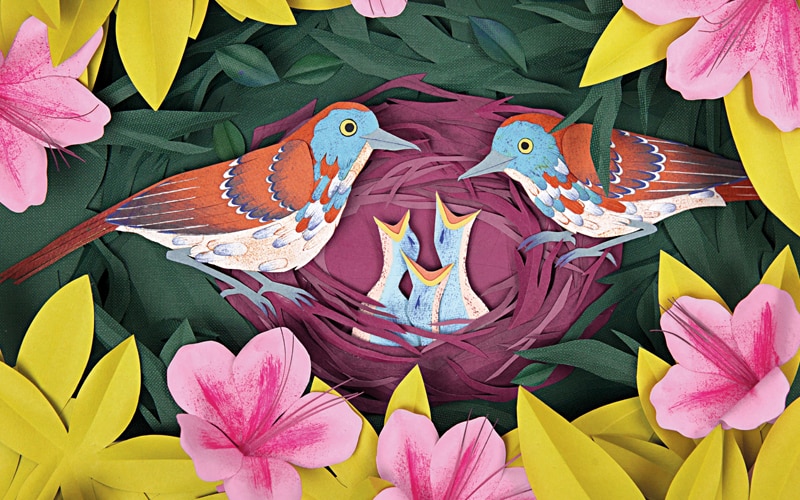 Illustration by Lila Poppins
But we were all in our little corner of Morehead City, trying to make a living. Raise a few babies. Build a home among the splendour and travail of life on earth.
The brown thrashers likely chose my azalea for the attributes I was there to prune away. The bush’s wild growth was a refuge in a tidy neighbourhood.
Its dishevelled demeanour helped them keep their family hidden from hawks and crows and other predators. From the azalea, the thrasher parents could dart out to glean a bug or berry from my butterfly garden and zip back to the nest with a treat for the babies.
I’d already flushed a parent from the nest, and I knew those fragile chicks couldn’t last long exposed to the elements. The longer it took me to prune, the longer the parents would stay away, and the greater the chance the nest would fail. Even if I made quick work of the azalea’s haircut, removing more of the foliage than I already had would sink those chicks’ chances even lower.
So I gingerly retreated down the stepladder, gathered my clippers and trimmers, and walked away with the azalea only halfway pruned. Its lower two-thirds were sheared as neat as a Marine’s new haircut, but the plant’s topknot was wild and gangly and headed toward eight feet tall. I’d given the azalea an impressive Mohawk. I wondered for a moment if the sight might cause a few car wrecks on the corner. I felt sure the neighbours would talk.
But on the other hand, my punk-rock shrub seemed, to me, an expression of a certain understanding. An obligation that comes with living on the only planet we have. My azalea was not mine alone. Nor was my little corner lot. Nor anywhere I’ll ever plant a footprint in this life. The other nations are everywhere ... and more reliant on harmony and benevolence than ever before.
What would the neighbours think? I hoped they’d think that I was just the sort of neighbour they’d like to have.
Originally published in Our State Magazine, ourstate.com (18 March 2025), Copyright © Our State and T. Edward Nickens.
For more stories like these, click here.