- HOME
- /
- Health & Wellness
- /
- Health
- /
How AI Cures Diseases and Saves Lives
Artificial intelligence can find new uses for existing drugs, helping to treat rare diseases, including the one that almost killed Joseph Coates
 Joseph Coates (left) owes his life to the AI model created by Dr. David Fajgenbaum (right) and his team. Photo: Hannah Yoon/ The New York Times.
A little over two years ago, Joseph Coates was told there was only one thing left to decide. Did he want to die at home, or in the hospital?
Coates, then 37 and living in Renton, Washington, was barely conscious. For months, he’d been battling a rare blood disorder called POEMS syndrome, which had left him with numb hands and feet, an enlarged heart and failing kidneys. Every few days, doctors needed to drain litres of fluid from his abdomen. He became too sick to receive a stem-cell transplant—one of the only treatments that could have put him into remission.
“I gave up,” Coates says. “I just thought the end was inevitable.”
But his girlfriend, Tara Theobald, wasn’t ready to quit. She sent an email begging for help to David Fajgenbaum, MD, an immunology researcher in Philadelphia whom the couple had met a year earlier at a rare-disease summit.
By the next morning, Dr. Fajgenbaum suggested an unconventional combination of chemotherapy, immunotherapy and steroids previously untested as a treatment for Coates’s disorder.
Within a week, Coates was responding to the treatment. In four months, he was healthy enough for a stem-cell transplant. Today, he’s in remission.
The life-saving drug regimen wasn’t thought up by the doctor, or any person. It had been spit out by an artificial intelligence model. In labs around the world, scientists are using AI to search among existing medicines for treatments that might work for rare diseases.
Drug repurposing, as it’s called, is not new, but the use of machine learning is speeding up the process—and could expand the treatment possibilities for people with rare diseases and few options.
Thanks to versions of the technology developed by Dr. Fajgenbaum’s team at the University of Pennsylvania and elsewhere, drugs are being quickly repurposed for conditions including rare and aggressive cancers, fatal inflammatory disorders and complex neurological conditions. And often, they’re working.
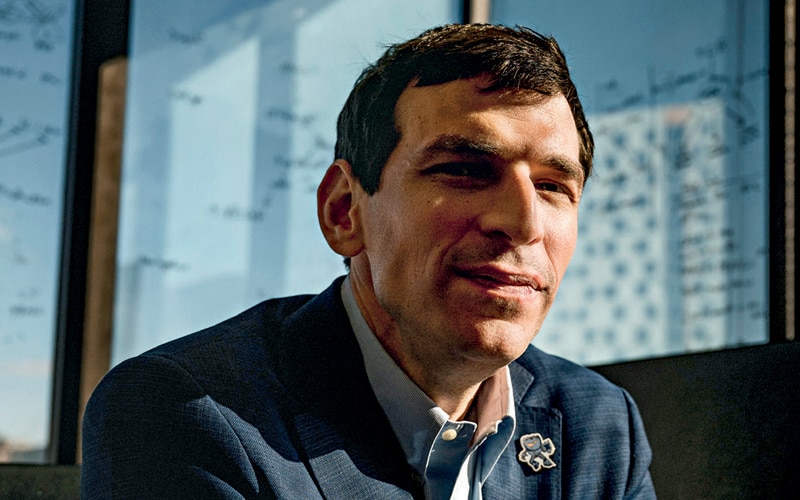 Dr. Fajgenbaum was inspired to find other existing drugs that can treat rare diseases. Photo: Hannah Yoon/ The New York Times.
The handful of success stories so far led researchers to ask the question: How many other cures are hiding in plain sight?
There’s a “treasure trove of medicine that could be used for so many other diseases. We just didn’t have a systematic way of looking at it,” says Donald C. Lo, PhD, scientific lead at Remedi4All, a group focused on drug repurposing. “It’s essentially almost silly not to try this, because these drugs are already approved. You can already buy them at the pharmacy.”
The National Institutes of Health defines rare diseases as those affecting fewer than 2,00,000 people in the United States. But there are thousands of rare diseases, which altogether affect tens of millions of Americans and hundreds of millions of people around the world.
And yet, more than 90 per cent of rare diseases have no approved treatments, and pharmaceutical giants don’t commit many resources to try to find them. There isn’t typically much money to be made developing a new drug for a small number of patients, says Christine Colvis, PhD, who heads drug development partnership programmes at the National Center for Advancing Translational Sciences.
That’s what makes drug repurposing such an enticing alternative route for finding treatments for rare diseases, says Marinka Zitnik, PhD, an associate professor at Harvard Medical School who studies computer science applications in medical research. Zitnik’s Harvard lab has built another AI model for drug repurposing.
“Other laboratory discovery techniques have already put drug repurposing on the map,” Lo says. “AI just puts rocket boosters on that.”
Finding Clues in Old Research
Repurposing is fairly common in pharmaceuticals. Minoxidil, developed as a blood-pressure medication, has been repurposed to treat hair loss. Viagra, originally developed to treat a cardiac condition, is now used as an erectile dysfunction drug. Semaglutide, a diabetes drug, has become best known for its ability to help people lose weight.
The first time Dr. Fajgenbaum repurposed a drug was in an attempt to save his own life. At 25, while in medical school, he was diagnosed with a rare subtype of a disorder called Castleman disease, which led to an immune system reaction that landed him in the ICU.
There is no one way to treat Castleman disease, and some people don’t respond to any of the available treatments. Dr. Fajgenbaum was among them. Between hospitalizations and rounds of chemo that temporarily helped, he spent weeks running tests on his blood, poring over medical literature and trying unconventional treatments.
“I had this really clear realization that I didn’t have a billion dollars and 10 years to create some new drug from scratch,” he says.
The drug that saved Dr. Fajgenbaum’s life was a generic medication called sirolimus, typically given to kidney donation recipients to prevent rejection. The medication has kept his Castleman disease in remission for more than a decade.
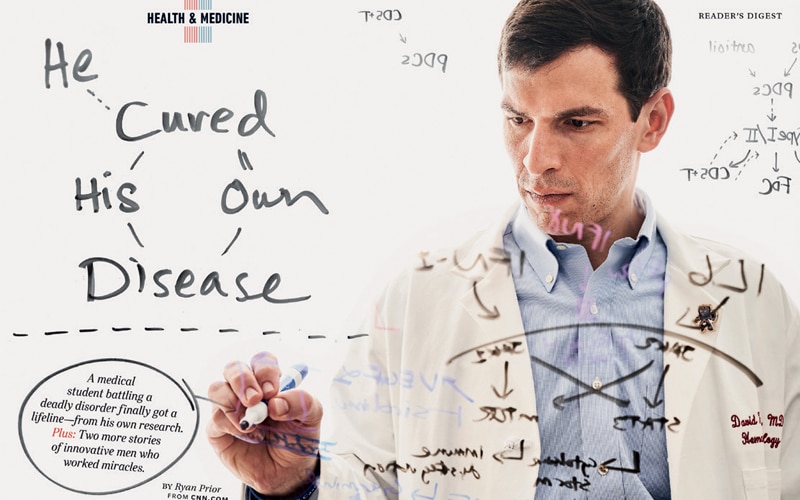 We shared Dr. Fajgenbaum’s miraculous story in the Indian editon of Reader’s Digest dated April 2021. Photo: Peter Murray
Dr. Fajgenbaum went on to become a professor at the University of Pennsylvania, and he began seeking out other drugs with unknown uses. Existing research, he realized, was full of overlooked clues about potential links between drugs and the diseases they could treat, he says. “If they’re just in the published literature, shouldn’t someone be looking for these all day, every day?”
His lab had some early successes, including finding that a novel cancer drug helped another Castleman disease patient. But the process was laborious, requiring his team to examine “one drug and one disease at a time,” he says. Dr. Fajgenbaum decided he needed to speed up the project. In 2022, he and two colleagues established a non-profit called Every Cure, aimed at using machine learning to compare thousands of drugs and diseases all at once.
Work similar to Every Cure’s is taking place at Penn State and Stanford universities, and in labs around the world, including in Japan and China.
In Birmingham, Alabama, an AI model suggested a 19-year-old patient debilitated by chronic vomiting try isopropyl alcohol, inhaled through the nose.
“Essentially, we ran a query that said ‘Show us every proposed treatment there has ever been in the history of medicine for nausea,’ ” explains Matt Might, PhD, a professor at the University of Alabama at Birmingham who leads the institute that developed the model.
The alcohol “popped to the top of our list,” Might says, and “it worked instantly.”
The model developed by Might’s institute has successfully predicted other treatments too: Amphetamines typically used to treat ADHD relieved periodic paralysis in children with a rare genetic disorder. A Parkinson’s drug helped patients with a neurological condition move and speak. A common blood pressure medicine called guanfacine drastically improved motor and vocal tics in a paediatric patient with Tourette syndrome.
Many drugs do more than one thing, Might says. Their additional features sometimes get characterized as side effects. “If you comb through enough drugs, you eventually find the side effect you’re looking for,” he says, “and then that becomes the main effect.”
In Philadelphia, Dr. Fajgenbaum’s platform compares the roughly 4,000 FDA-approved drugs against the world’s approximately 18,500 diseases. For each disease, pharmaceuticals get a score based on the likelihood of efficacy. Once the predictions are made, a team of researchers combs through them to find promising ideas, then performs lab tests or connects with doctors willing to try the drugs on patients.
Elsewhere, pharmaceutical companies are using AI to discover entirely new drugs, a pursuit that has the potential to streamline an enterprise already worth billions. But drug repurposing is not likely to prove lucrative for any one party. Many drug patents expire after two decades, which means there is little incentive for drug companies to seek out additional uses for them, says Aidan Hollis, PhD, a professor of economics at the University of Calgary with a research focus on medical commerce.
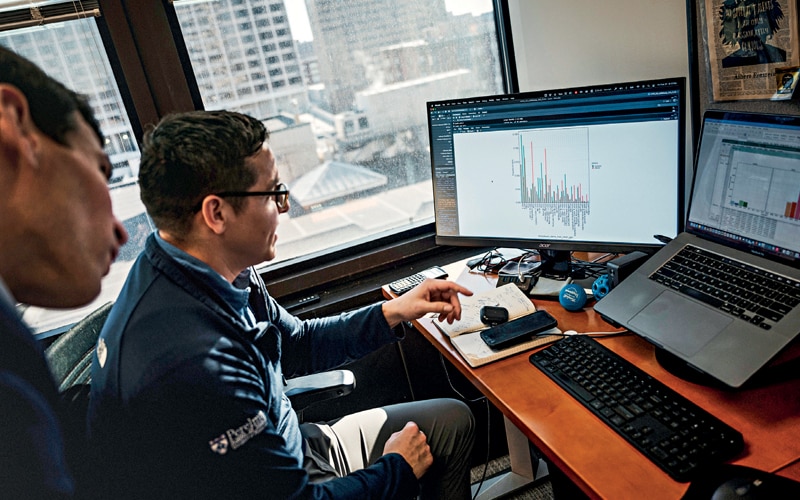 Drug repurposing isn’t new—but machine learning makes it much faster. Photo: Hannah Yoon/ The New York Times.
Once a drug becomes one of the thousands of generics approved by the Food and Drug Administration, it typically faces stiff competition, driving down the price.
“If you use AI to come up with a new drug, you can make lots and lots of money off that new drug. If you use AI to find a new use for an old, inexpensive drug, no one makes any money off of it,” Dr. Fajgenbaum says.
To fund the venture, Every Cure has received more than $100 million in commitments from TED’s Audacious Project and the Advanced Research Projects Agency for Health, an agency within the federal health department dedicated to supporting potential research breakthroughs. Dr. Fajgenbaum says that Every Cure will use the money, in part, to fund clinical trials of repurposed drugs.
“This is one example of AI that we don’t have to fear, that we can be really excited about,” says Grant W. Mitchell, MD, an Every Cure co-founder and a medical school classmate of Dr. Fajgenbaum. “This one’s going to help a lot of people.”
“Someone Had to Be the First to Try”
Luke Chen, MD, was sceptical when Dr. Fajgenbaum’s model suggested he treat a patient with Castleman disease using adalimumab, a medication typically used to treat arthritis, Crohn’s disease and ulcerative colitis.
“I didn’t think it would work, because it’s kind of a wimpy drug,” says Dr. Chen, a haematologist/oncologist and a professor at Dalhousie University and the University of British Columbia. But the patient had already undergone chemotherapy and a bone marrow transplant and had tried drugs including the one that saved Dr. Fajgenbaum’s life. Nothing had worked, and the patient was entering hospice.
“We had basically given up, but I put in a last call to David,” Dr. Chen says.
With no other options, Dr. Chen gave the patient the adalimumab. In a matter of weeks, the patient was in remission. The case was recently the subject of a paper in the New England Journal of Medicine.
Still, no model is infallible, Zitnik says. AI can sometimes make predictions “based on evidence that isn’t sufficiently strong.” Colvis says ranking potential treatments by likelihood of success can also prove difficult. Such issues make physician oversight crucial.
Sometimes, a doctor will determine that a treatment suggestion is too risky to try, she says. “But then there are instances where they will see something and say, ‘OK, this looks like it’s reasonable,’ ” she adds.
When Dr. Fajgenbaum first suggested that Wayne Gao, MD, a hematologist and oncologist in Washington state, try a novel treatment on one of his patients, Dr. Gao had doubts.
The patient was Joseph Coates, the Washington man headed for hospice, and the aggressive drug combination suggested by Dr. Fajgenbaum’s model seemed “a little bit crazy,” Dr. Gao says. In fact, he worried that the treatment might kill Coates faster.
But Coates was a young man, and there were no other treatments to consider. And so, Dr. Gao says, “Someone had to be the first to try.”
Just over a year after his brush with death, Coates and his girlfriend visited Dr. Fajgenbaum in Philadelphia to thank him for his help. A smiling Coates was the picture of health; he had put on muscle since the last time he met the doctor.
Coates had tweaked his ankle that morning while working out. But otherwise, he said, he felt “just fine.”
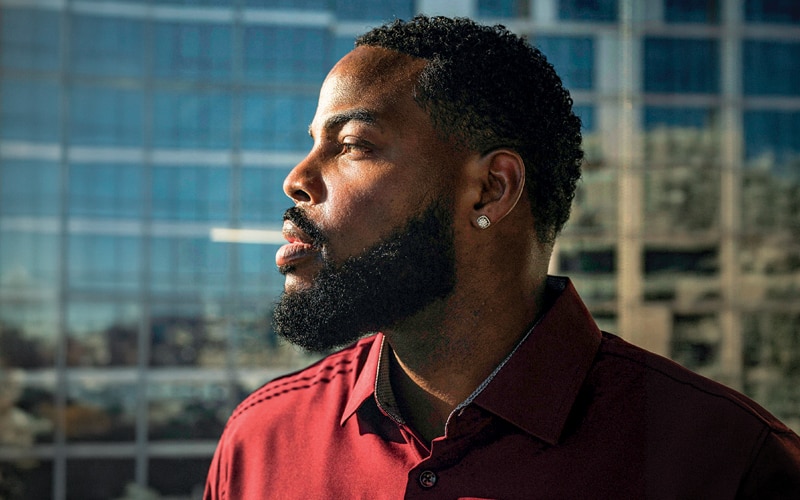 Thanks to the AI model’s plan, Coates is back to full health. Photo: Hannah Yoon/ The New York Times.
The New York Times (20 March 2025), Copyright © 2025 by The New York Times Company.
For more stories like these, click here