"Anyone Can Learn"-The Story of Sanjit 'Bunker' Roy and his 'Barefoot' Pioneers
When he founded Barefoot College in rural Rajasthan, Bunker Roy set out to prove that people often overlooked by conventional institutions could become agents of change. His experiment went on to inspire communities across the globe.
 Trained at Barefoot College, these rural women, based in remote Tilonia, Rajasthan, teach several others to become solar power technicians. all photos: Manish Rajput
Of all of humanity’s assumptions about humanity, there is perhaps little that surpasses the prejudices the well-heeled have about the poor. Even when most admit to social inequities as the reason why the poor remain disadvantaged, there is often a litany of stereotypes that follow. But Sanjit ‘Bunker’ Roy is different, and so is the social experiment he has engineered in remote Tilona, Rajasthan—the Barefoot College.
Set up in 1972, Barefoot College has been working to provide the only known cure for the issues that plague the poor: empowerment, especially of women. With practice as pedagogy, the Barefoot college “is in the process of exploding many myths by setting an example,” as Roy puts it.
This is perhaps best illustrated by its Solar Mamas programme, where rural women are trained to build, install and maintain solar panels and batteries. After three to six months of training, they head back to their communities and implement the technology, bringing a reliable source of energy to remote villages and earning themselves a decent income. Many go on to train others in their own, and in neighbouring, villages.
One such trainer is 57-year-old Leela Devi, who bends over her workstation while carefully soldering a circuit board during our interview. Having studied only till class 3, she never believed she could do this job. “The beginning was difficult. I told them that I am not going to be able to do this,” she says. But starting from learning colour codes assigned to different circuit components, she learnt the names of the various tools and instruments.
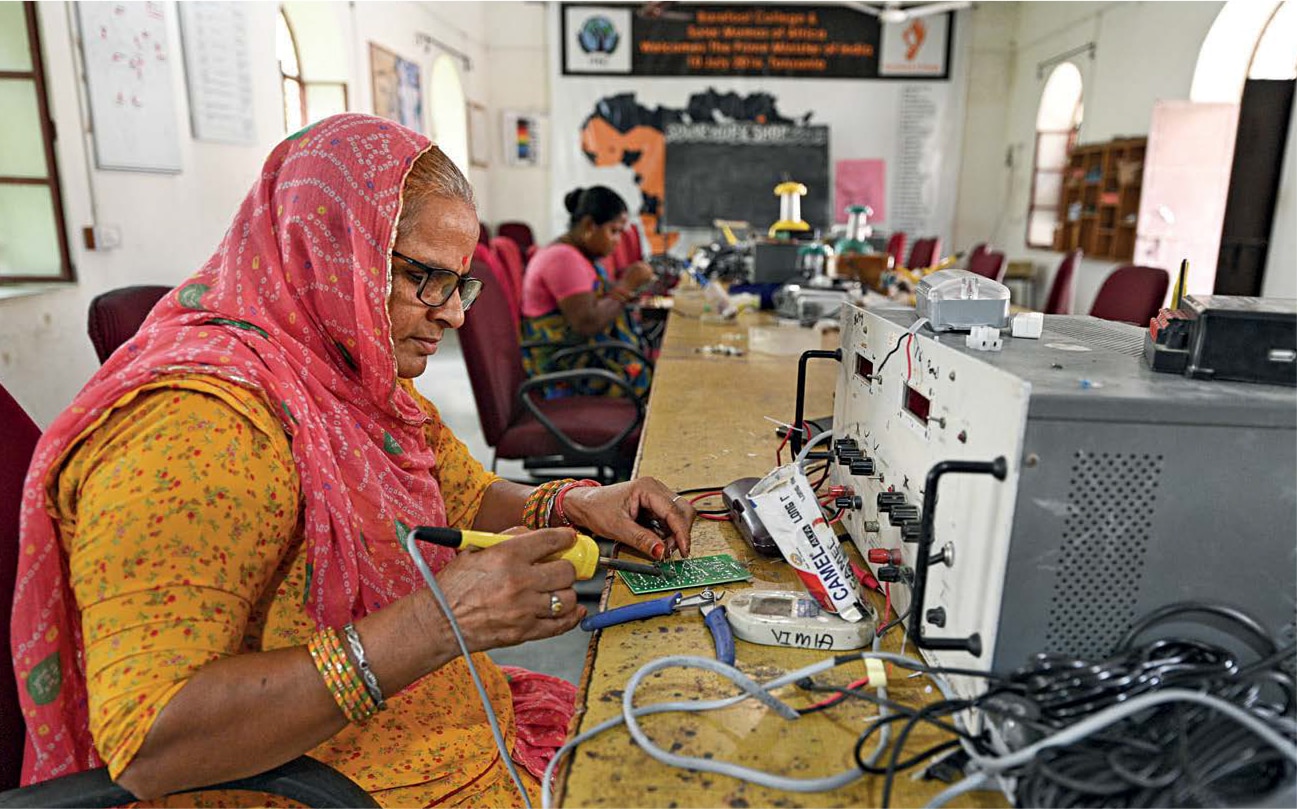 Leela Devi, a master trainer in the Solar Mamas programme, solders a circuit board.
“The first practical we did, was just about how to screw and unscrew things,” she recalls. Now, a master trainer at the Barefoot Solar Engineering Training Centre, where rural women from across the world come to study solar engineering, Leela has trained over 17,000 women over 20 years. The programme has created a global network of social entrepreneurs like her, and, in the process, upended societal hierarchies. Leela’s sense of confidence and self-worth too have come a long way. Having never stepped out of Tilonia in her life, her first trip out of home was straight to Zanzibar, as part of a five-member training team in 2009. Since then, she has been on solo trips to Germany and France as well.
Founded on the philosophy that ‘anyone can learn’, Barefoot College has chipped away at the social exclusion that is the lot of those who lack mainstream education. Putting technology skills in the hands of those who often rank lowest in literacy and education, as well as in the caste hierarchy, the college works to leverage existing indigenous knowledge, practical, ancestral wisdom and the inherent capacities of its students. Apart from solar engineers, students at Barefoot go on to become health workers, architects, designers, water engineers and teachers. Its two campuses are fully solar-electrified, with geodesic domes and rainwater harvesting structures, all built by Barefoot engineers. Funded by various foundations, donations and the Indian government, the college also runs a school, an artisan non-profit, study centres, heath campaigns, a water resources department, a nutrition programme called Super Five, a sanitary pad factory, and a waste management programme.
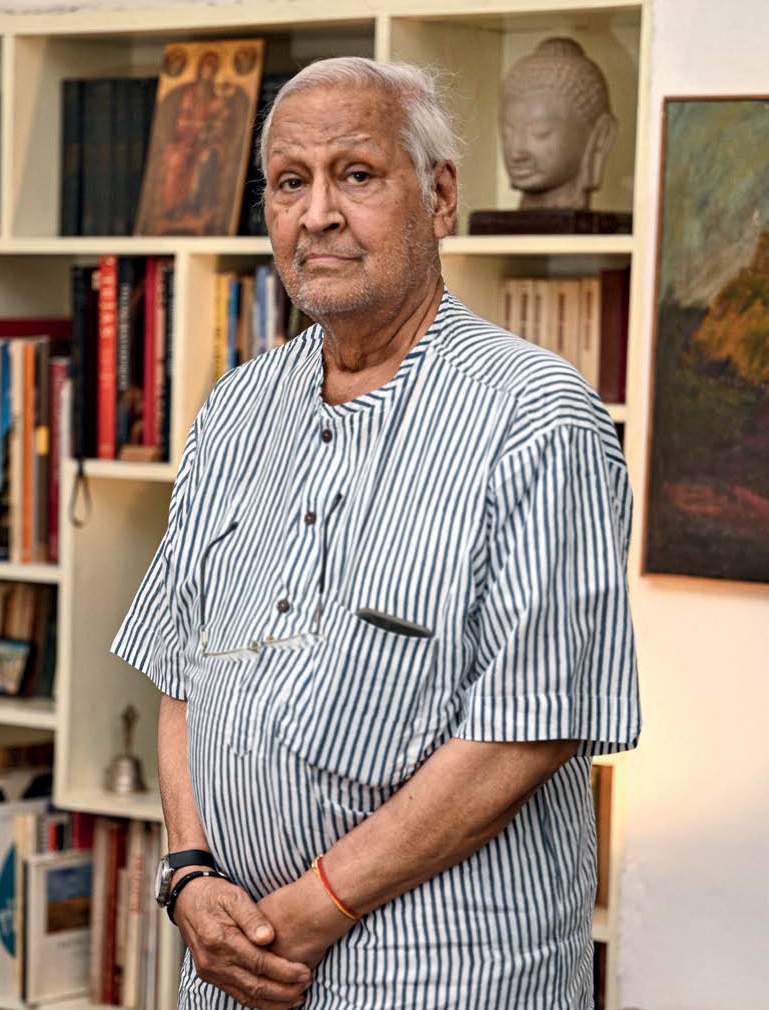 Sanjit ‘Bunker’ Roy, started Barefoot College in 1972
“There is a fundamental difference between hollow literacy and education with intelligence. And through the years, we have demonstrated at Tilonia that commitment and competence is not gauged by institutional degrees,” explains Roy. He can say this with some authority. Roy himself attended some very elite institutions—Doon school and then St. Stephens College—only to end up helping lakhs of Indians cock a snook at formal education.
After a life-changing trip to Bihar in 1965 when the state was battling a devastating famine, Roy knew that he wanted to live and work in rural India. Despite the family displeasure that followed, he got a job with Catholic Relief Services to dig 500 irrigation and drinking water wells in Ajmer, Rajasthan. “I was now exposed to the most extraordinary skills and knowledge that very poor people have. I started respecting water diviners, traditional bone-setters, midwives and well drillers. That was when the idea of the Barefoot College was born.”
Roy believes accepting education in all its expressions and the ability to intelligently identify effective, practical skills and traditional knowhow, is the future of rural India. The Barefoot approach of demystifying technology and nurturing the abilities of rural folk has produced a deep emancipatory impact on those associated with it.
30-year-old Phoolmanti came from Gaya as a part of a four-member team in 2013 to be trained as a solar engineer. After six months of training, when she went back, her life’s circumstances had altered. Her husband in jail, she and her four young children had nowhere to go. Turned away by family, she decided to head back to Tilonia. “I borrowed `1,000 on 10 per cent interest to make the trip here. I didn’t know how to get on a train, so I had to pay a man from the village his wage for the four days he would have to miss work to accompany me here.”
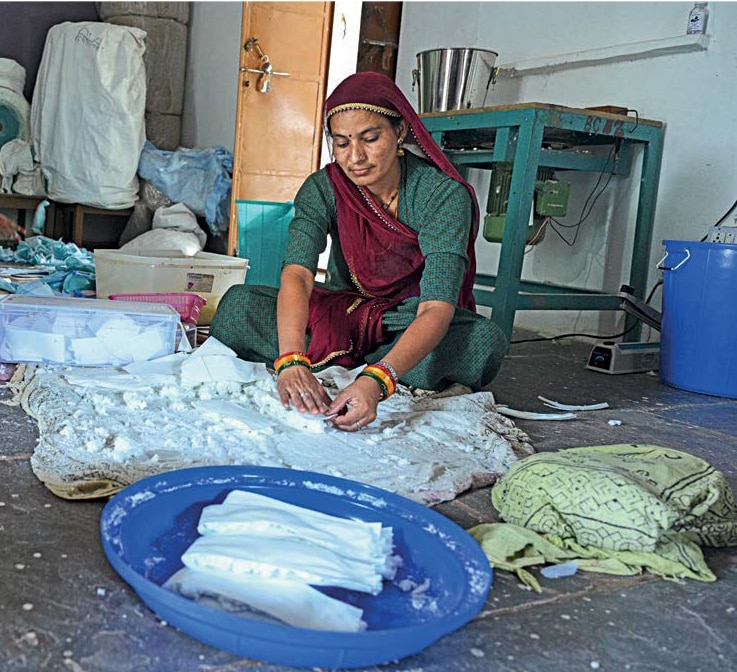 The sanitary pad unit works to provide menstrual-health products and awareness.
Now, a solar engineer and trainer, Phoolmati is able to send her kids to school and put food on the table. She says Roy saved her life, “I had never thought it possible that I would be doing something professional like this.”
Roy points out that this has been the abiding challenge in his life’s work: “To build confidence in the people who were providing technical services and to convince them that they were as competent as any paper-qualified graduate or engineer.” This self-doubt is understandable and perhaps all the more reason why the Barefoot College’s philosophy is a route to social inclusion. “They have been told all their lives that they are second-rate,” Roy explains. “So it is critically important that they understand the context and strength of their abilities. Over the years, it is amazing to see the transformation of a hesitant human being to a confident, skilled worker—a symbol of why degrees do not matter.”
Through the years, several social and policy changes have been afoot owing to the experiments in Tilonia. Its initiatives have led to governments replicating and expanding several of the bottom-up ideas that the Barefoot college pioneered. From night schools—designed to help children, who were expected to help out with household or farming work, continue their education—came the Rajasthan government’s Shiksha Karmi (Education Worker) project, which has facilitated the schooling of over 2,00,000 children. Barefoot was also behind a public interest litigation regarding minimum wages for famine relief workthat resulted in the 1983 Supreme Court judgement mandating that no site in Rajasthan pay less than the minimum wage. Barefoot’s solar programme, initiated in 1996—long before ‘going green’ and ‘sustainability’ became policy buzzwords—has expanded across 96 countries, with the Ministry of External Affairs funding the travel and training for women to become Solar Mamas.
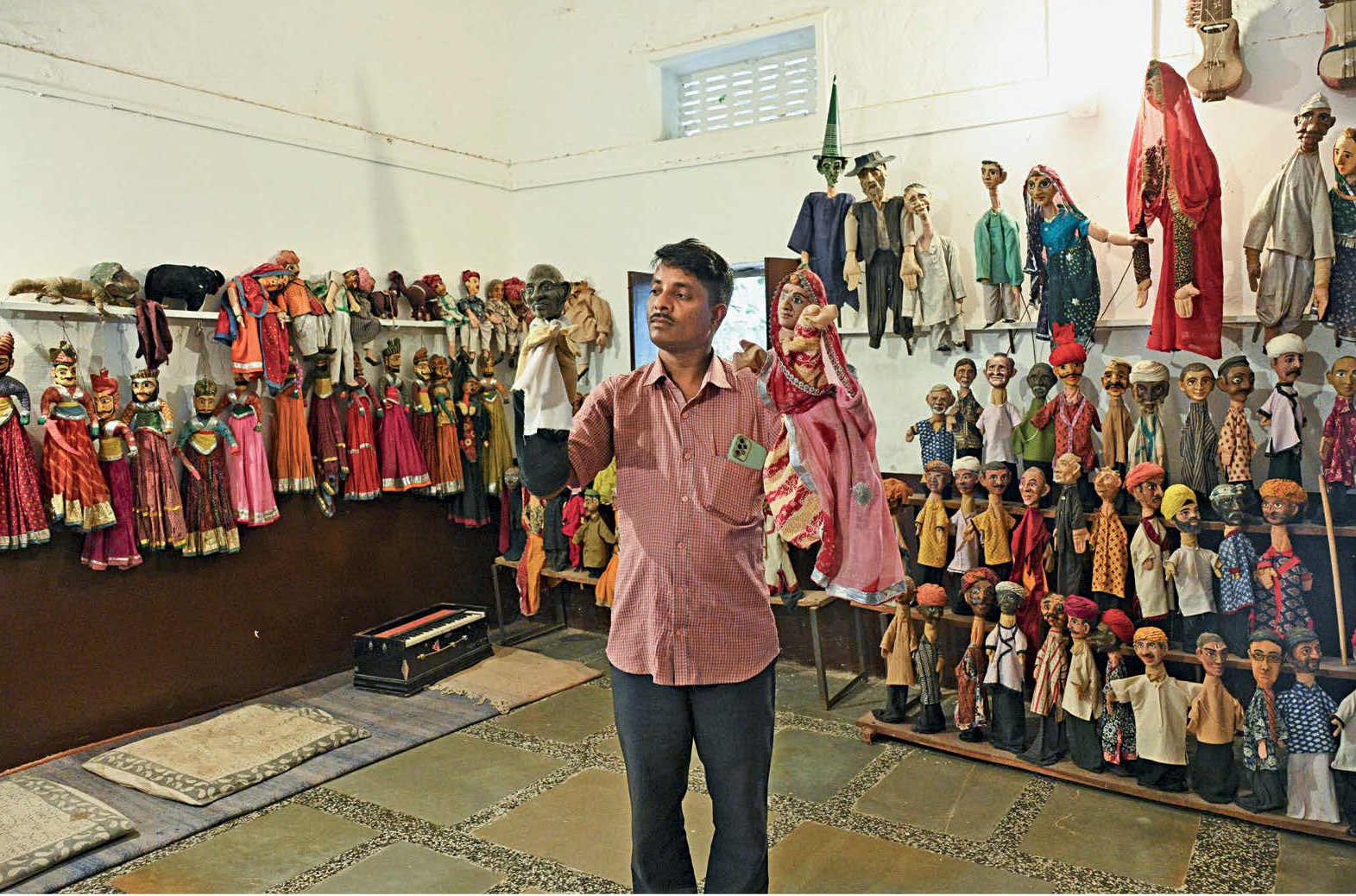 The College communications department employs the art of puppet theatre to bridge the gap between rural folk and development needs. These performers travel across the country and the world, establishing dialogue with communities.
Today, the 50-year-old Barefoot College is on the cusp of transition. In June this year, Roy, now 77 and ailing, handed over the reigns of the organization to Sowmya Kidambi, a social development specialist, who was instrumental in establishing India’s first independent society for social audit. She took on the role on the condition that the organization allow her to do so pro bono. “I am looking forward to the challenge of running an NGO”, she says, but adds that just four months into the job, it is clear that the field of social work has undergone a sea change. “The sector has shifted gears; it has corporatized. And this means that it often ends up missing the ‘social’ element of the work.” This disconnect, she observes, has hurt smaller, grassroots organizations that find themselves struggling to compete for funding.
In Roy’s life and legacy, Mahatma Gandhi looms large. Gandhian principles of self-reliance, austerity, of awarding dignity to labour and to those at the bottom of the caste hierarchy who often perform it, have all found home in the Barefoot approach. With our national imagination often focused on the aspirational middle class, the times we live in do seem anachronistic to these beliefs—as if India no longer lives in its villages.
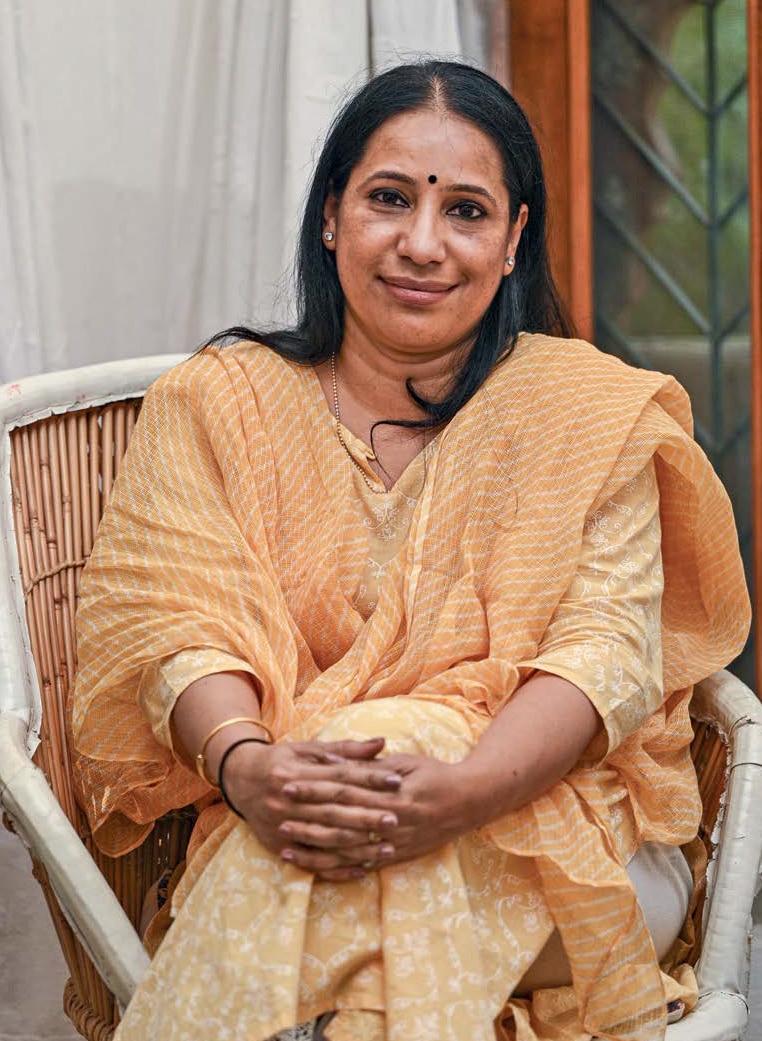 Sowmya Kidambi joined Barefoot College after her stint as Director of the Society for Social Audits, Accountability and Transpa- rency (SSAAT), Government of Telangana.
But, no matter how swift the winds of change, the pilot light that is Barefoot has spread across the country. Twenty-two organizations started by Barefoot alumni across 14 states have organized under the umbrella of SAMPDA (Society for Activating, Motivating, and Promoting Development Alternatives) to spread the Barefoot ideology and pedagogy through their work. After all, the Barefoot experiment offers lessons to anyone who is seeking answers on how to change the world.
To learn more about Barefoot college, visit barefootcollegetilonia.org