Lights! Camera! Campaign! When does a Blockbuster become a Platform?
A look at the enduring tradition of south Indian films that double as political theatre, where the box-office and the ballot-box often go hand in hand
 illustrations By Siddhant Jumde/AI
A lot of Tamil, Telugu and Kannada-language films make much pomp and show of introducing their leading man, often with name-cards that flash epithets like ‘Mega Power Star’ (Ram Charan), ‘Rocking Star’ (Yash) and so on. But during my Friday morning show of the Tamil-language Thalapathy Vijay film Jana Nayagan, I saw an introductory name-card unlike any other in recent memory: ‘Starring The Honourable Chief Minister of Tamil Nadu’. And believe me, the card drew plenty of loud cheers and whistles at PVR Select Citywalk, the response falling just short of a standing ovation.
That moment encapsulated something Indian cinema has practised for decades: films that function simultaneously as mass entertainment and political messaging, blurring the line between the box office and the ballot box.
Before it ran into trouble with the certification board, Jana Nayagan was supposed to release on the Pongal weekend in January, three months before the Tamil Nadu state assembly elections. As such, the film works as an extended, three-hour video manifesto for Vijay and his political party, the TVK (Tamilaga Vettri Kazhagam). The story follows Thalapathy Vettri Kondan—also known by his initials, TVK, conveniently tattooed on his arm—a former IPS officer who figures out that his adoptive daughter’s childhood trauma is linked to an ongoing conspiracy to interfere with state-and national-level elections.
Rather than subtle symbolism, Jana Nayagan repeatedly aligns its hero’s actions with the ideals and priorities of Vijay’s real-life political party. The film’s set pieces—from championing marginalized communities to invoking Ambedkar and Periyar—are less about narrative surprise than reinforcing a carefully constructed political persona. Two of the clearest examples are Vijay handing an assault victim a book bearing Ambedkar’s image and later declaring, “The wisdom of the voters is unquestioned.” Together they signal that the film is as interested in political communication as cinematic spectacle.

Jana Nayagan, then, is part of a distinctly Indian tradition, a genre that can be called ‘the ballot box-office’ to reflect its dual allegiances, its twin-purpose functionality. The ballot box-office is a space where the language of cinematic populism meets the demands of electoral populism, where voter and viewer coalesce into the same semantic category, where the performance of sincerity becomes key to the sincerity of the overall performance.
And Vijay is by no means the first actor-politician to participate in this genre. The legendary Tamil actor and former Tamil Nadu chief minister M. G. Ramachandran (1917–1987), better known as MGR, is something of a pioneer in this regard, and is referred to at several places in Jana Nayagan, including an AI-generated scene where MGR talks to Vijay fondly and gives him his blessings to take the bad guys down.
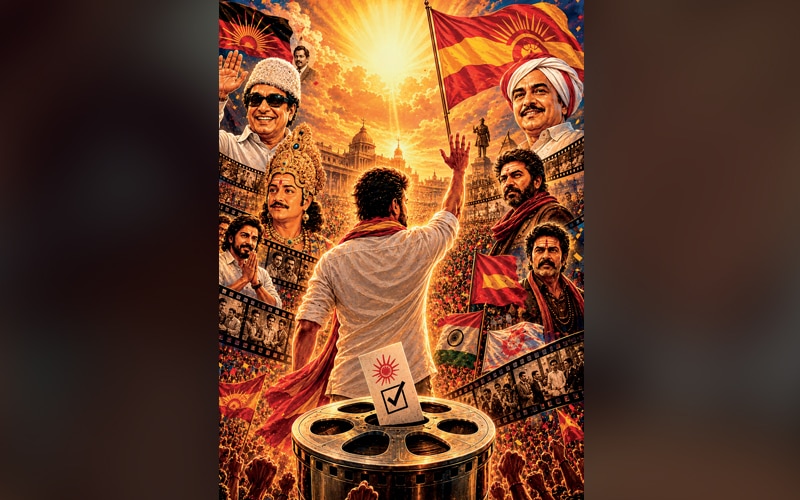
Another major proponent was the Telugu-industry icon and former chief minister of Andhra Pradesh N. T. Rama Rao (1923–1996), known as NTR (not to be confused with his grandson and current superstar NTR Jr. from films like RRR and War 2). Other actor-politicians like Pawan Kalyan and Nandamuri Balakrishna (son of NTR, uncle to NTR Jr.) have also used their films to push the talking points being pursued by their respective political parties.
How did the likes of MGR and NTR establish the foundations of this genre? Film scholar S. V. Srinivas argues that many of NTR’s early-1980s films cleverly balanced different audience expectations. Father-son double roles allowed one character to embody patriotism and moral authority while the other tackled local injustices and romance. In marketing terms, it was a four-quadrant strategy—but politically, it also broadened NTR’s appeal across demographic groups, subtly preparing audiences to imagine him as a future leader.
MGR, too, did something similar with films like Madhuraiyai Meetta Sundharapandiyan (1978), where he plays a brave Pandiya prince rescuing his people from a tyrant Chola ruler. Or Meenava Nanban (1977), where MGR rescues a clan of fishermen from a pair of cruel, malicious businessmen. Having already played a heroic fisherman in his classic Padagotti (1964), Meenava Nanban cemented MGR’s image as a champion of marginalized people across the state, especially coastal Tamil Nadu fishing communities.

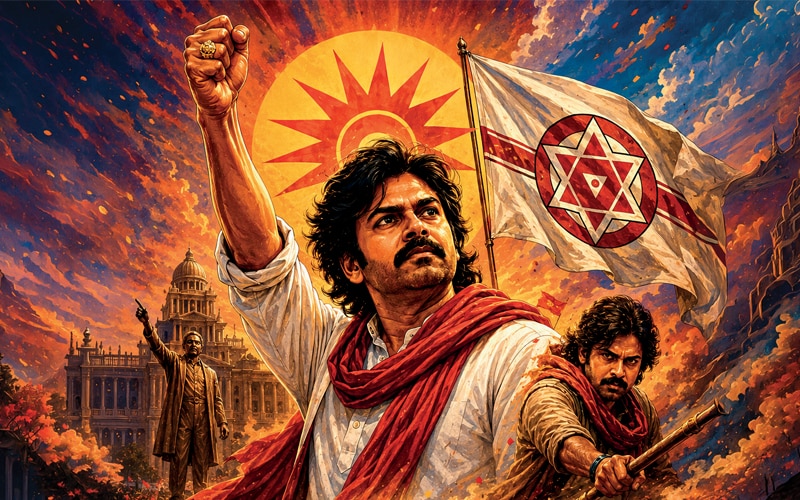
In recent times, we have also seen Telugu actor-politicians Pawan Kalyan and Nandamuri Balakrishna deploying the ways and methods of the ballot box-office. Kalyan’s Hari Hara Veera Mallu (2025) sees him playing a super-soldier tasked with recovering the Koh-i-noor from a marauding, sadistic band of Mughal soldiers serving the deranged emperor Aurangzeb (Bobby Deol once again, continuing his run as Indian cinema’s preferred larger-than-life antagonist). This dovetails nicely with Kalyan’s political speeches wherein he often talks about the need to change or rewrite history textbooks that involve the Mughals.
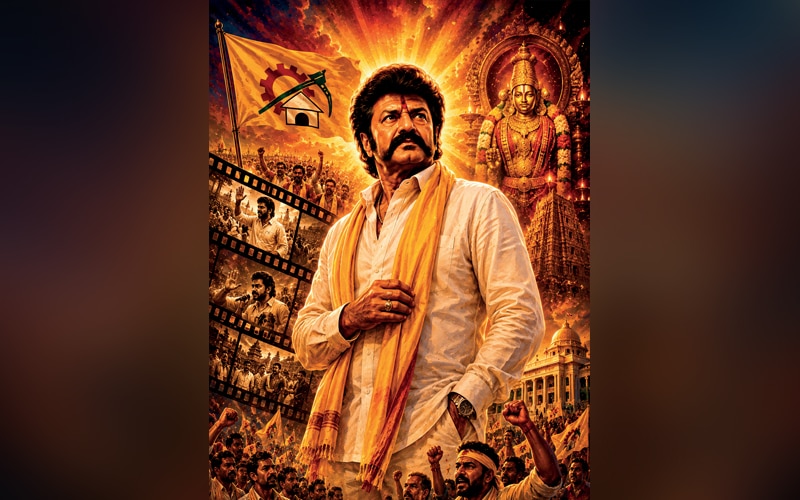
Similarly, Nandamuri Balakrishna’s films Akhanda and its sequel have plotlines pertaining to the protection, maintenance and day-to-day functioning of Hindu temples—which are also major talking points pushed by the TDP (Telugu Desam Party), which Balakrishna belongs to, and which was founded by his father NTR.
In fact, Jana Nayagan is an official remake (with some subplots changed) of Balakrishna’s 2023 film Bhagavanth Kesari. In the middle of a bloody combat scene in Jana Nayagan, Vijay stops and tells the goon, “Bro, I don’t care!”, a callback to Balakrishna doing the same thing in Bhagavanth Kesari. Clearly, Vijay wanted a tried and tested winning formula for his last film, and more importantly the film that’s tailor-made for his election campaign.
NTR, MGR and now Vijay—Indian voters and Indian audiences, particularly in south India, have repeatedly expressed their allegiance to the ballot box-office. Jana Nayagan may not be a cinematic masterpiece, but it remains true to its dual-purpose beginnings throughout the three-hour runtime.
We Indians watch films for all kinds of reasons, and for no particular reason at all. Why should elections be excluded from this conversation? Cinema in India has never merely reflected politics; it has repeatedly rehearsed it. Long before campaign videos became commonplace, the country’s biggest stars had already mastered the art of turning blockbusters into political theatre. Jana Nayagan is simply the latest—and perhaps the clearest—expression of that enduring tradition.