What a Naturalist Learnt about the Magic Around Us
A father’s shared walks with his daughter become a reminder that the natural world rewards those willing to slow down and truly look

When I step on to our home balcony early one morning, Diya, my daughter, is already there, eager to tell me about the birds she spotted before I joined her. Binoculars slung around our necks, we stand watching. After the night’s rain, the foliage is washed clean, the trees surrounding the cornfield below glow lush green, and mist rolls up from the valley. A cool breeze drifts across the balcony.
Diya’s summer vacation is soon ending and she will return to university in a few days. She silently bids farewell to one of our resident Eastern red-rumped swallows perched on its favourite overhead cable below the balcony. She says she’ll miss its soft chatter and hopes the birds will still be here when she returns in autumn.
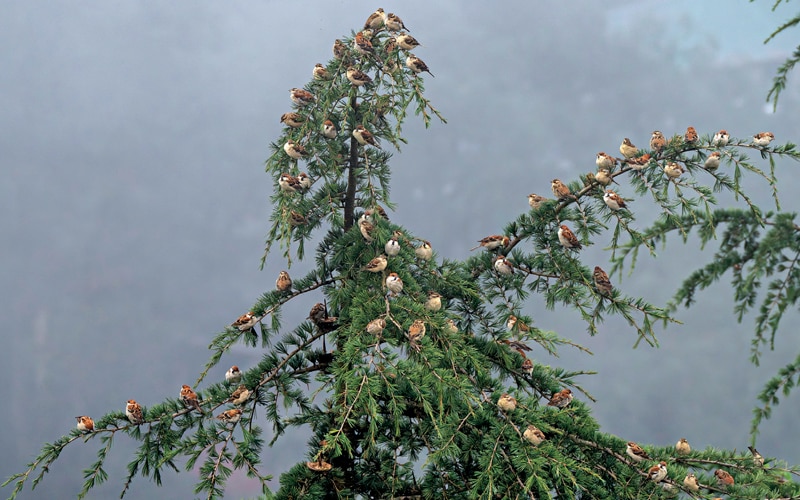 With woodlands nearly gone, a tree, alive with resting Russet sparrows, feels all the more precious.
The swallows are nesting in an unfinished hotel overlooking the valley. Just two years ago, before construction began, an untended green slope dotted with shrubs and wild pear trees stood there instead. Owlets brooded in the tree canopies, and every autumn, noisy flocks of parakeets descended to feast on the ripening fruit. All that is gone now. We see fewer birds near our home. So we stay mostly on the ‘good’ side of the balcony. Birding here has become a recent ritual, and before she leaves, we decide on one last hike together.
We choose a familiar trail carpeted with glistening oak and rhododendron leaves. We tread carefully over slippery, moss-covered stones, stopping to admire mushrooms we cannot identify. I point out a columbine flower and she reaches for her phone. We take small detours simply because something catches our eye. Neither of us wants to leave the damp woods and birdsong for the bustle of town.
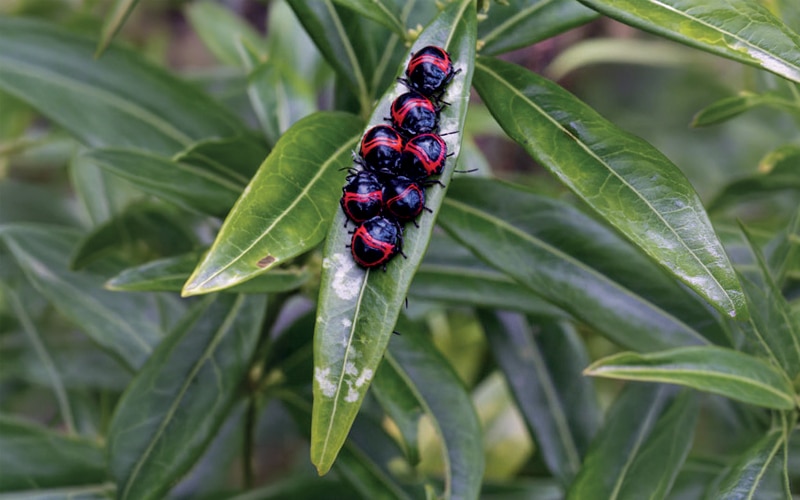 Clusters of brilliantly coloured bugs bring unexpected flashes to the foliage.
My daughter began accompanying me on these walks when she was nine. We climbed steep mountain paths as I searched for orchids and other flowering plants. Fellow walkers marvelled at how well she climbed; those who tried to encourage her usually received no reply—she simply kept going. Our walks were always rewarding. I returned with hundreds of photographs to sort and identify, and some of the ground orchids in my book were first discovered on those outings.
A day after she leaves for university, I find a cluster of Malaxis acuminata in flower on an unstable mountain slope. Like many of our wild orchids, it is easily overlooked. The first time I encountered it years ago, I failed to recognize it as an orchid at all. Only when I looked closely did I notice the tiny pink flowers emerging from the centre of its leaves. It taught me my first lesson in paying attention.
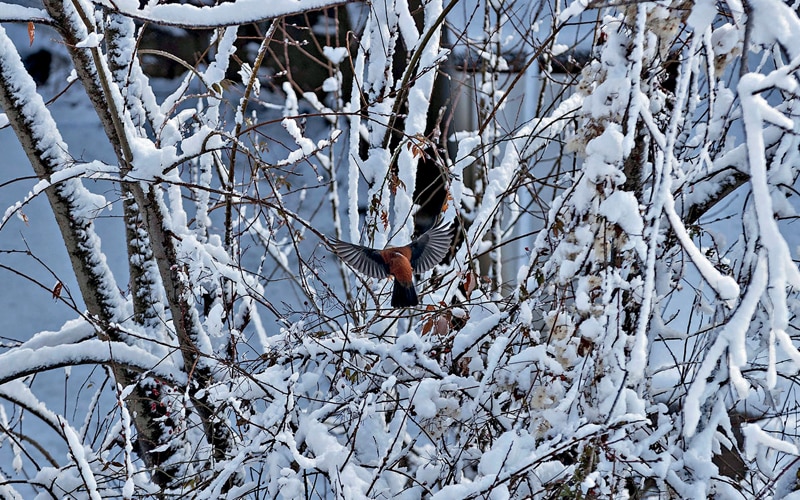 A chestnut thrush in flight
Most tree-growing orchids have finished flowering by the end of June and then begin setting seed. The pink foxtail orchids that brighten old mango trees in the lower town have faded, scarcely noticed by residents or visitors alike.I have long suspected that things truly exist for me only when I pay attention to them. So I have trained myself to slow down and look more closely. On a good day, I can spot a crab spider waiting in ambush inside a thistle flower or a jumping spider no bigger than a green pea perched on a fence across the road. Paying attention has become my way of respecting the natural world. The more deeply I engage with it, the quieter my mind becomes and the more forgiving I am—of myself and of others. The frantic pace of modern life overwhelms me less now, and I find I make better decisions.
I no longer walk blindly into spider webs stretched across a trail or startle as easily when a pheasant bursts into flight. Tiny gentians punctuate the trail with flecks of blue, iridescent bugs flash like living jewels, and camouflaged spiders slowly emerge from bark, leaf and shadow.
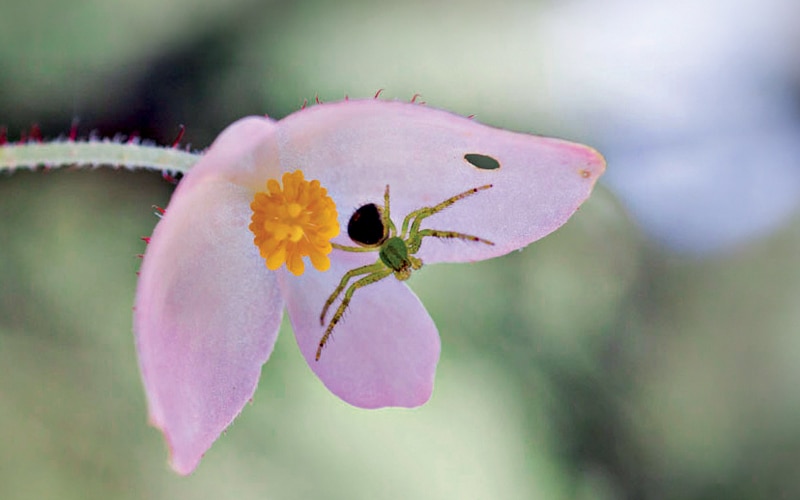 Perfectly hidden against a begonia flower, a crab spider waits patiently for unsuspecting prey.
But when I hurry or become lost in thought, I miss much of what surrounds me. Perhaps that is why so many people fail to notice spring blossoms or hear the birds outside their homes. Our busy lives demand our full attention, and our brains quietly filter out what seems unnecessary. I am no longer surprised when I meet people who have walked past a row of cherry trees in blossom without remembering seeing them.
And once you learn to look closely, you begin to notice not only what is there, but also what is no longer there. The land around me is changing with alarming speed. Many mornings I hear trucks labouring uphill long before I hear the blue whistling thrush. I mourn the wild pear trees I came to know so well, felled to make way for the hotel next door. Now my photographs must stand in for the living trees. The narrow trail I have walked for years on my way to and from work has become a strip of bleached grey concrete. For two springs now, I have missed the carpet of red rhododendron blossoms that once covered the path.
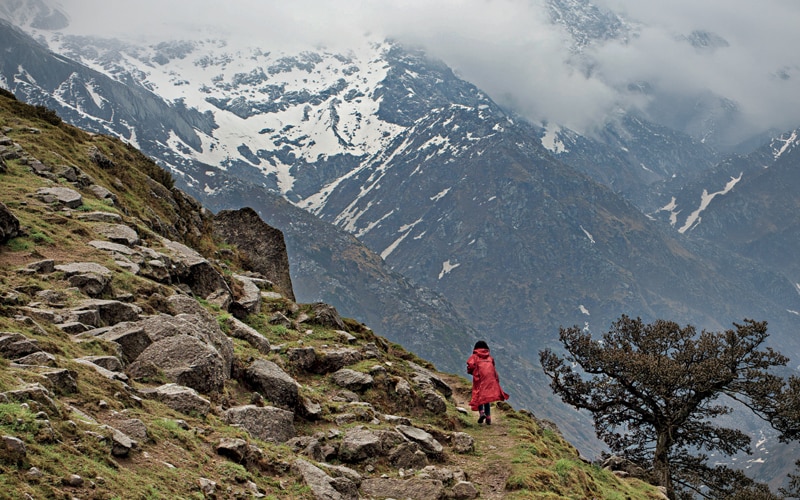 Diya, on one of our mountain walks.
It is not just the landscape that has changed but the soundscape too. Even deep in the mountains, I hear electric saws, concrete mixers and distant traffic where chirping crickets and birdsong should dominate. At what point did these sounds become so ordinary that we forgot what they replaced? If we continue to drift, almost absent-mindedly, away from the natural world, the consequences will be profound. We cannot protect what we have never learnt to see.
Then, just when the weight of these thoughts becomes difficult to carry, a small reminder arrives. I am cheered by a pencil sketch my daughter sent me last night. It is a rough drawing of a bird in flight, yet its strong beak and markings make it unmistakably a female koel. She has looked closely enough to capture the small details. Perhaps that is how attention endures—passed quietly from one generation to the next. As long as someone is still looking closely, there is reason to hope.
About the author: Ashwini Bhatia is a Dharamshala-based naturalist, Associated Press photographer and author of the book Orchids of Dharamshala. Visit orchids.themythe.org/ for more.