A Trail Of Spirits Through Japan
Exploring Japan’s Alpine wine regions reveal some hidden historical and cultural wonders
 Photo Credit: Shutterstock
Alcohol is intertwined with Japanese culture, and for centuries it’s been brewing sake, and more recently producing wine and whisky. A short distance by train from Tokyo, high in the Japanese Alps, Yamanashi and Nagano Prefectures are home to the country’s thriving alcohol producers. But this region is also rich in history and nature, so offers a true taste of Japan for visitors keen to get away from its super-modern cities. A journey through its wine-, sake- and whisky-making regions, starting in Kofu in Yamanashi Prefecture, then continuing to Nagano Prefecture, will explore both an intriguing spiritual past and thriving commercial future.
Kofu, Yamanashi Prefecture
Getting there: 1 hour and 44 minutes by train from Tokyo’s Shinjuku Station
Festivals: Shingen-ko Festival, every April, celebrates the city’s samurai past. Katsunuma Grape Festival, first Saturday of October, celebrates the region’s wine
Yamanashi’s capital city, Kofu, boasts excellent views of Mount Fuji and is rich in feudal history.
In the 1500s, Kofu was a samurai town and home to one of Japan’s great daimyo warlords, Takeda Shingen. Between 1546 and 1550 he conquered and ruled over Yamanashi and Nagano Prefectures. A 3.1-metre-high statue of him in full military armour is located at the front of Kofu Station. Takeda Shrine, built to honour the wartime and political achievements of his rule, remains a popular place for visitors. Erected in 1919, it sits on the site where Shingen’s descendants lived.
The Shingen-ko Festival, held every April, is a veritable celebration of his warrior greatness, and includes a parade of people dressed in samurai regalia accompanied by gunnery units, plus military re-enactments throughout the city.
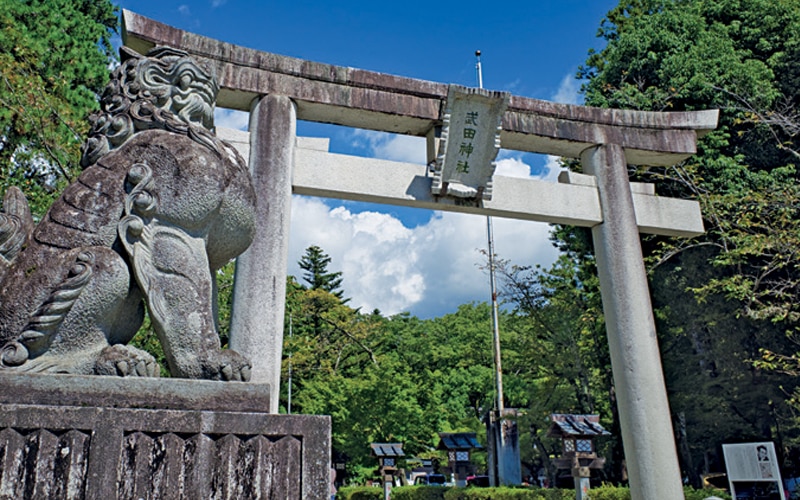 The Takeda Shrine pays tribute to the warlord Takeda Shingen. Photo Credit: Shutterstock
Kofu’s other great attraction is its wine. Celebrated as the birthplace of Japanese wine, today it is regarded as the country’s main wine-producing region, with roughly one-quarter of all Japanese wineries located here. Most are family owned. The city sits in a valley and, come summer, is one of the hottest places in Japan. The surrounding hillsides offer a Mediterranean-type climate and are fertile for grape growing. After rainfalls, water drains efficiently into the valley leaving behind perfectly moist soil for optimum grape production.
Yamanashi-produced wine is predominantly made from the Koshu grape, which is exclusive to the region. The Koshu grape gives the wine a subtle soft taste and is best suited to Japanese cuisine. “While Yamanashi wines can’t compare to European wines, the grapes they use make Yamanashi wine the best in Japan,” says Yui Inoue, a 26-year-old wine tourist visiting from a nearby prefecture.
To the east of Kofu is Katsunuma, Japan’s main wine-producing region. While locals are believed to have cultivated grapes in Katsunuma since the Nara Era (710-794 BCE), it was Masanari Takano and Ryuken Tsuchiya who, in 1877, founded the region’s wine producing industry after studying wine-making at Troyes, in the Champagne region of France. Sparkling, sweet, wet and dry wines are produced here today. Many of the wineries in Katsunuma, including Chateau Mercian, the first privately owned winery that was founded in 1887, have won global awards and export their wine internationally.
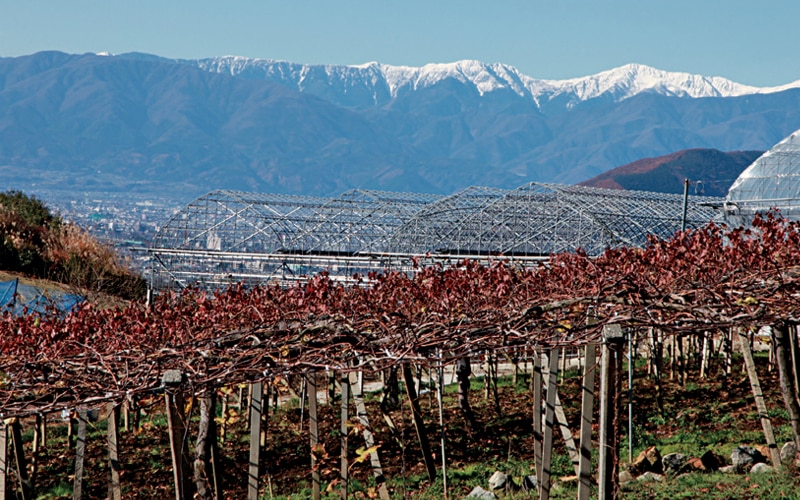 Katsunuma’s sprawling vineyards at the heart of Yamanashi. Photo Credit: Shutterstock
Some 100 wineries populate the valleys and hills around Katsunuma, with cellar doors offering tasting and sales of their latest vintages. Tsuchiya Ryuken and Tsuchiya Gaoka wineries both offer guided tours and workshops of their wine production. Tsuchiya Gaoka holds the honour of housing the oldest Japanese wine, dating back to 1879, which is exhibited every year from the end of September to the beginning of November. Visitors are also welcome to drop by the Grape Country Culture Centre and Miyakouen to learn about the history of the wine industry.
While those wineries are in the countryside, some are located in the city, such as the Sadoya Winery, which is one of Kofu’s major wineries and dates back to 1917.
From Kofu, travel northwest to the Yatsugatake area, home to renowned sake breweries, whisky distilleries and wineries.
Mount Yatsugatake, bordering Yamanashi and Nagano Prefectures
Getting there: 40 minutes by train from Kofu Station to Kobuchizawa Station
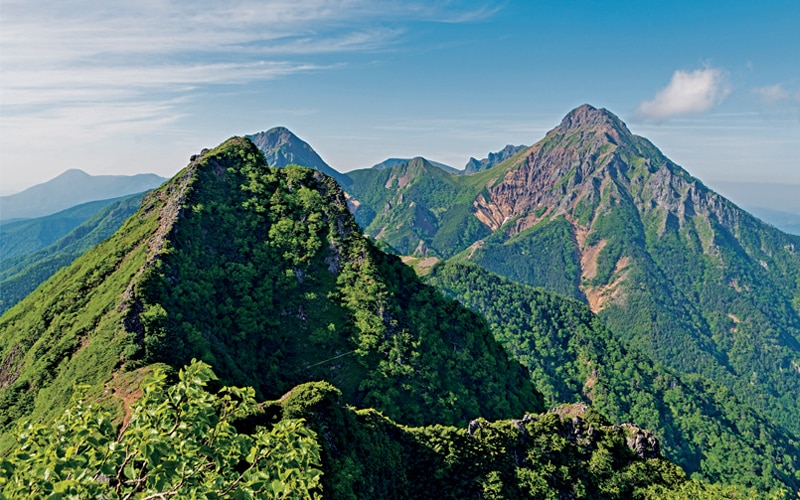 Mount Yatsugatake is a popular hiking area in the spring and summer. Photo Credit: Shutterstock
Mount Yatsugatake is Japan’s other famous mountain; its name means eight-peaked mountain. Local legend has it that the mountain was once higher than Mount Fuji. This made Fuji jealous so it struck Yatsugatake, the blow breaking it into eight shorter peaks. Fuji then claimed the position of the highest peak in Japan.
At the base of Mount Yatsugatake sit the towns of Kobuchizawa and Hakushu, where sake, wine and whisky are produced. Again, thanks to geography, these towns produce top quality spirits. Water runoff from high mountains combined with a great climate and rich soil make for high-quality rice and grape cultivation. Although this area has been producing sake for centuries using the subterranean water from the Yatsugatake Mountains, it’s a relative newcomer to western liquor production. While the Shichiken sake brewery, for example, was founded in 1750, the Château Charmant winery started in 1963 and the Suntory Hakushu distillery started operating in 1973. The Château Charmant winery has a gift shop where tourists can sample local wines and the Suntory Hakushu distillery has a tour where visitors can learn about the whisky making process.
Other than the vast selection of liquors of the area, the town offers many hiking trails and horse-riding trails as well as access to the many other high and famous peaks of the Southern Alps.
Like its various alcoholic beverages, the spirit of nature abounds in this region.
Suwa, Nagano Prefecture
Getting there: Suwa City Station to Kamisuwa Station
Festival: Annual Suwa Sake Festival in either September or October
Leaving Yamanashi Prefecture and heading into Nagano Prefecture, our next stop is the sake-producing region and ancient spiritual area of Suwa.This city is located on one of Japan’s most famous lakes, Lake Suwa, and is home to historically important Shinto shrines: Suwa Taisha (head shine); Kamisha (Honmiya Shrine and Maemiya Shrine): and Shimosha (Harumiya Shrine and Akimiya Shrine). The city has an ancient history with archaeological sites dating back to the Jomon Era (14,000–300 BCE). It is from this era that the Onbashira festival, one of Japan’s most uniquely thrilling (and death-defying) festivals, originates and which still occurs once every six years in early April. It’s thrilling because brave men ride giant logs down a mountain side while trying not to fall off; death-defying for obvious reasons.
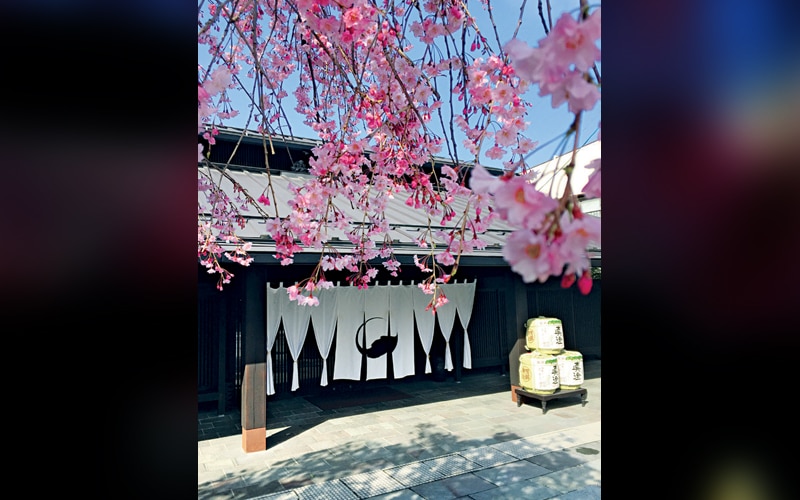 The historic Masumi Brewery. Photo Courtesy: Japanese Tourist Board
Sake is synonymous with Suwa culture and history, with a number of its nine breweries dating back as much as 400 years. Its geography plays an important role in this high quality as the water runoff from the nearby plateaus and hills contains low concentrations of calcium, which enhances the taste. Not too far from Suwa Station is a row of five sake breweries. The tourist information office sells cups to take to all these distilleries so visitors can taste and appreciate the different sakes. While all breweries offer tasting and have gift shops, there aren’t any tours of the production processes.
Nagano is home to over 80 sake breweries, but its most famous is the Masumi Brewery. The Miyasaka family started the company in 1662, and over the centuries it has gained wide acclaim. In 1946, the Japanese government registered the company’s seventh yeast and it became known as Yeast #7, which today is the essential yeast for making sake. While the family received no royalties, they have the honour of knowing that almost all sake produced in Japan uses Yeast #7. At the Masumi Brewery, tourists can explore the Japanese garden on the grounds and taste samples of its sake.
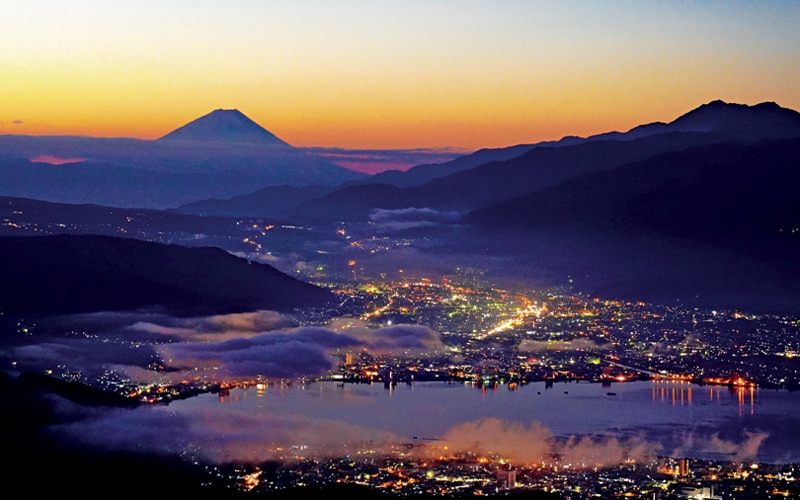 Lake Suwa. Photo Courtesy: Japanese Tourist Board
Shiojiri, Nagano Prefecture
Getting there: 45 minutes by train from Suwa Station to Shiojiri Station
Festivals: Shiojiri Wine Festival, every May
The final stop is the Shiojiri wine-producing region. Shiojiri is essentially a suburb of historical Matsumoto City, located only 22 kilometres south of the city. Matsumoto is home to Matsumoto Castle, which dates back to 1593, and is the oldest of the three Japanese castles still in their original form. Because of its authenticity, it is one of the few castles designated as a National Treasure. There are historical documents, artefacts and samurai armour on display. Outside in the moat, swans often swim and the castle has commanding views of the northern Japanese Alps. That alone is worth a visit, but Shiojiri also has prehistoric sites from the Jomon Era.
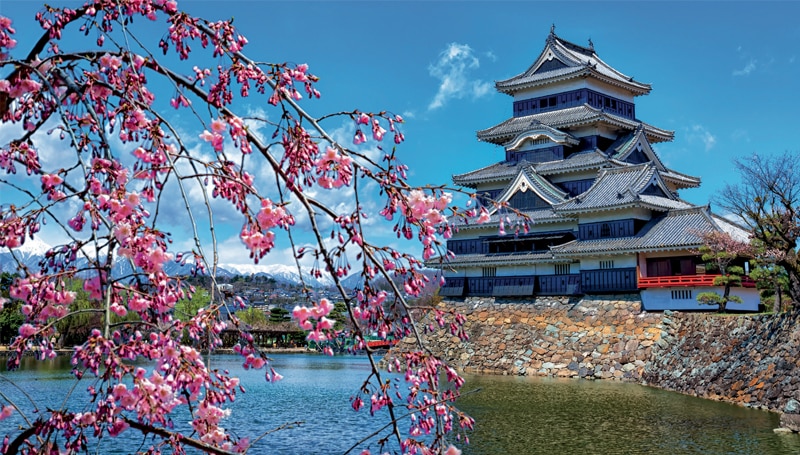 Matsumoto Castle is one of Japan’s most beautiful and best-preserved original castles. It is designated as a National Treasure. Photo Credit: Shutterstock
Today, Shiojiri has the second largest number of wineries after Kofu. Local wine growing started during the Meiji Era (1868–1912) and used mostly concord grapes. Unlike Kofu, which is at a low altitude, Shiojiri sits 700 metres above sea level and is the highest region for grape cultivation in Japan. Fertile soil combined with a humid climate and sunshine the majority of the year has blessed the area with a successful wine industry.
These wineries do not offer tours of the production process, but visitors are welcome to browse their gift shops and on-site wine tasting. Merlot and Chardonnay are among the many types of wines produced. Popular wineries include Alps Wine (considered to have the best quality), Shinano Wine (family owned for three generations), and Hayashi Winery (in production since 1919). A great way to end the journey is to attend the Shiojiri Wine festival that takes place every May where visitors can sample the wines from all the local wineries at the one time.
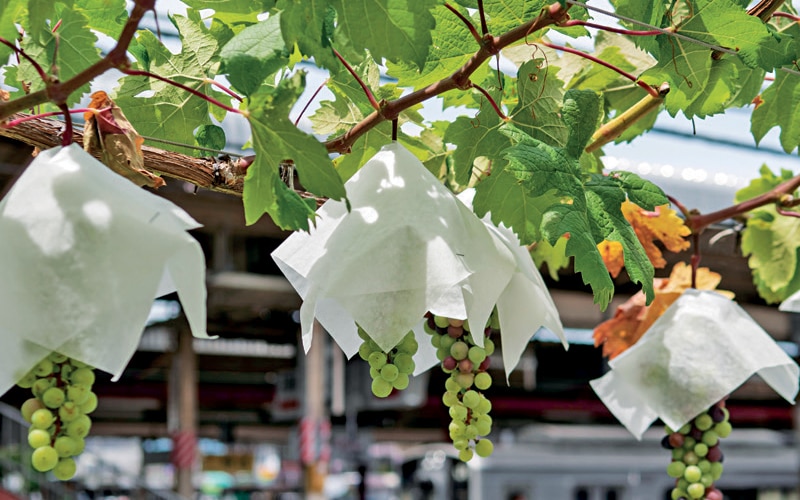 White grapes in the Shiojiri wine-producing region in Nagano Prefecture. Photo Credit: Shutterstock
The Japanese Alps offers impressive historical sites, spectacular natural beauty, and cultural traditions. Its sake-, wine-, and whisky-making history is very much part of this tradition. Once you have travelled this trail of spirits, you’ll not only feel the importance and beauty of the interior of Japan, but you will have sampled some of its greatest spirits. It will have been a journey worth taking. Now that’s something to toast about.
For more travel stories, click here.