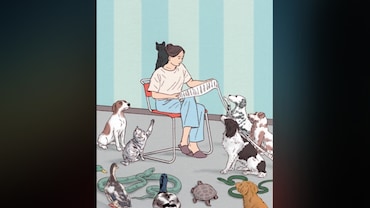
Unseen, Unpaid, Unsustainable: On the Burden of Invisible Labour on India's Women
For decades, our systems have ignored the invisible labour shouldered by women to sustain homes, families, and wealth producers of the nation. It’s time to stop taking this work for granted

The year my daughter was born was also the year the India Art Fair, an event I had built from scratch, began to be recognized as one of the most significant cultural platforms in the country. On the outside, it looked like a moment of triumph: awards, headlines, an ‘empowered woman founder’ at the peak of her professional journey. But behind the scenes, my real days and nights looked very different. I would shuttle between late-night construction reviews at the fairgrounds and a quiet nursing area where I breastfed my baby. I was also the primary caregiver for my mother, who lived with schizophrenia, and the emotional anchor for my younger brother.
In between all of this, I worked non-stop, travelled constantly and tried to meet everyone’s needs and expectations. But there was no time left for myself: not to rest; not to heal; not even to notice what this relentless pace was doing to my body and mind. Such was the lived experience that shaped my founder journey—first with Amaha, a mental-health care organization, and later with the NGO India Mental Health Alliance—and led to mental health becoming not just a professional mission but a deeply personal calling.
It took years for me to understand that the way I was living, and what I was living through, had a name: invisible labour.
Behind Every Economy
Caregiving and managing a home is undeniably the engine that keeps families, communities and economies functioning, but it is also the one form of labour that rarely receives any real recognition or relief. Moreover, studies show that this labour disproportionately falls to one half of the population over the other—women.
Women continue to shoulder the burden of cooking, cleaning, emotional caregiving, maintaining relationships, managing children’s schedules, caring for ageing parents, and holding the family together. They also carry the burden of managing money—often having to stretch limited financial resources across household needs, while placing their own health, rest, and well-being last.
Globally, women perform three times more unpaid care and domestic work than men according to a 2023 UN Women report. In India, the 2019 Time Use Survey showed women aged 15 to 59 spend more than seven hours each day on unpaid domestic and caregiving tasks. Unemployed men on the other hand contribute less than four hours a day, while employed men spend less than three.
This gap has a direct economic cost: when women are overburdened with unpaid labour, their participation in the paid workforce drops, productivity declines, and households absorb the fallout through chronic stress and mental-health strain.
The imbalance shows up in the numbers too. Unpaid work in India contributes approximately `22.7 lakh crore or about 7.5 per cent of the country’s GDP, according to a 2023 State Bank of India report. And yet this labour continues to be dismissed and undervalued in national accounting systems.
Rigging the Scales
This reality is not accidental. It is rooted in centuries of patriarchal values that place women at the emotional and domestic centre of the household. The foundation of such a system is lifelong conditioning: boys are raised to be ambitious and independent; girls are raised to be caring, forgiving and self-sacrificing. These hardwired early scripts determine who is expected to ‘show up’ and who is permitted to opt out—cementing a lifelong gendered imbalance that women spend their lives navigating.
But while patriarchy benefits men, it also restricts them—teaching them to withhold vulnerability, disengage emotionally, and distance themselves from human connection and interpersonal bonds. For true equality, men must also fight these cultural scripts, because an equitable home is impossible without shared emotional and domestic responsibility. And unless men actively participate in dismantling these expectations, women cannot achieve true equality inside or outside the home.
The Second Shift
Women today may be increasingly enabled and empowered to achieve independence and professional success, but the expectations and needs of the household remain unchanged. This creates the ‘second shift’ phenomenon, i.e., a full day or more of professional duties followed by an equally demanding shift at home.
Research shows that when women spend up to five additional hours a day on unpaid care-work, their chances of pursuing promotions, leadership roles or entrepreneurial opportunities drop sharply. Employers lose talent; households lose income; and the country loses potential GDP growth.
This burden is not only physical but also emotional. A woman may lead a team meeting at 6 p.m., manage vendor calls at 8 p.m., and return home to cook dinner, soothe a crying child, support a parent’s medication routine and plan the next day’s logistics, all the while appearing calm, accommodating and available.
Paying the Price
The mental-health toll of this invisible labour is severe—chronic exhaustion, burnout, deep mental fatigue. Long-term stress is linked to autoimmune disorders, diabetes, cardiac disease, anxiety and depression. In my own case, years of unprocessed trauma and prolonged over-functioning manifested as autoimmune issues and complex PTSD—conditions that worsen when women have no time to rest, seek treatment, recover or grieve.
By midlife, the burden intensifies. Women experience hormonal transitions during perimenopause and menopause—concerns that also remain shrouded in silence. Women manage mood shifts, hot flashes, sleep disruption and heightened worry alone, without social or structural support. If invisible labour remains unspoken and unsupported, women will continue paying for it with their bodies, their careers, and their emotional wellbeing—a cost no society can afford to ignore.
Taking a Stand
As more Indian women achieve financial independence, many are questioning traditional arrangements—delaying marriage, choosing to remain single, or opting out of motherhood entirely. Divorce rates in India are also on the rise.
Many describe their decisions as a way to ‘reclaim their life’. These choices are not threats to family values and structures—they are signals that women are refusing to keep carrying the full emotional, financial, and domestic load alone.
This is not just a personal revolution—it is an economic and societal one. When women withdraw from roles that exhaust them, it forces families, workplaces, and policymakers to confront the true cost of invisible labour. No nation can aspire to become ‘Viksit Bharat’ while half its population is silently carrying the emotional scaffolding of the country with no structural support in return. A future-ready India demands a fundamental revaluation of women’s time, their caregiving contributions, and their right to rest, autonomy, and dignity.
Neha Kirpal is the co-founder of Amaha and The India Mental Health Alliance. she is the co-author of Homecoming: Mental Health Journeys of Resilience, Healing and Wholeness (Westland, 2025)
For more stories like these, click here