My Heart Health Wake-Up Call
A medical journalist’s surprise heart attack reveals how much she didn’t know about the No. 1 killer of women—and men
 illustrations by Jeff Hinchee
(*not her real name)
I’m lying in a hospital bed, trying to process what happened. But all I can focus on are popular song titles:
Miley Cyrus and Mark Ronson’s ‘Nothing Breaks Like a Heart’ ...
Céline Dion’s ‘My Heart Will Go On’ ...
Blondie’s ‘Heart of Glass’ ...
The Bee Gees’ ‘How Can You Mend a Broken Heart’ ...
Sting’s ‘Be Still My Beating Heart’ ...
No! Not that last one! The last thing I want is for my heart to be still. Please, please, please keep beating.
It’s only been a few days since I was taking advantage of a gorgeous September Friday to play hooky. I’d decided to leave my home office to wander around New York City and then to make up the work time over the weekend. The day had been perfect.
I got a free facial offered by a cosmetics company in Herald Square. I ate a delicious chopped salad for lunch at one of my favourite restaurants. I used a gift card I’d carried around for months to get some new lingerie. Then, as I was feeling perfectly content, wondering what to do next, I felt a strange sensation in my chest.
It wasn’t painful. It was just weird. And somehow it also felt deeply, seriously wrong. It felt as if someone had taken an elastic bandage and wrapped it around my chest. A tightness, though not overly tight. And I was overcome with a feeling of almost existential dread, as if that elastic bandage, meant to heal, was going to kill me.
I walked to the train station and headed home. Once there, I drank some water, then sat on the couch, trying to breathe deeply and stay calm. Soon the strange feeling disappeared, and I tried to forget it had ever happened. But over the course of the weekend, it would return briefly, then disappear again. Each time the tightness returned, I panicked. And then when it disappeared, I felt relieved and tried to convince myself it was gone for good. But I knew it wasn’t.
So without a word to my husband, I drove myself to the local emergency room, half believing they’d tell me I was being ridiculous, and that all I was suffering from was indigestion. Or maybe gas. Anything but a heart attack. In fact, I was in such denial that I even thought about walking to the emergency room, which was over three kilometres away, just to get in my daily exercise. In the end, common sense won, and I drove.
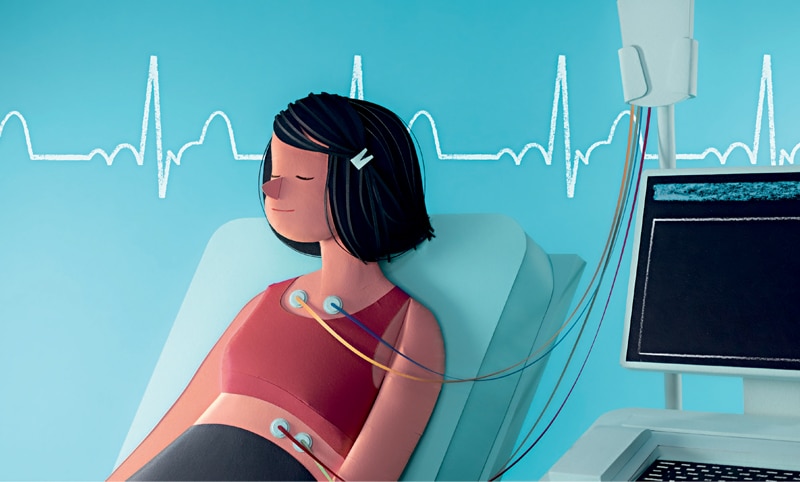
The ER reception desk staff didn’t assume I had indigestion. As soon as they heard me say “chest tightness,” they ushered me into an examining room and hooked me up to an electrocardiogram machine. Someone glanced at the results and then left me alone ... for a very long time.
Instead of being annoyed, I was relieved. I figured that if the ECG had found anything horrible, I wouldn’t have been left by myself. I peeked at the results in my file, which seemed to indicate a few minor irregularities, but nothing that screamed imminent danger. But the technician had also taken a blood test, and when those results came in, everything changed.
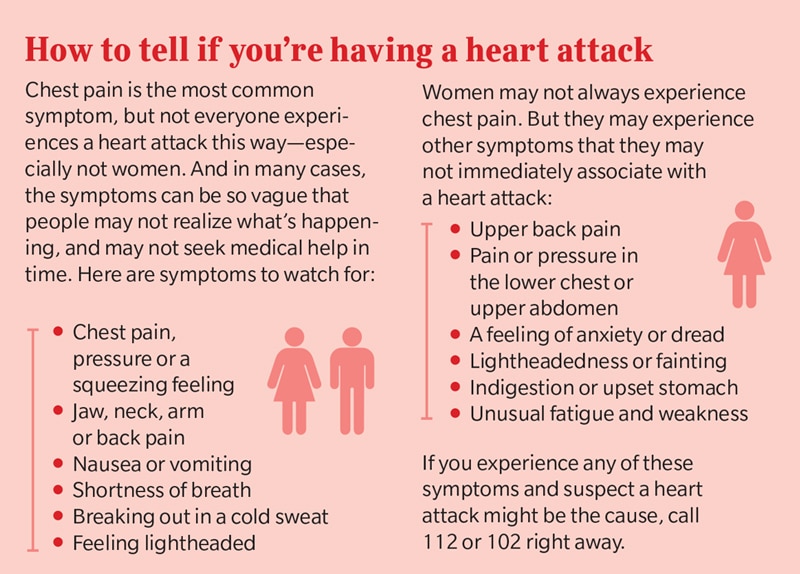
My blood contained an elevated level of troponin, a protein that the heart muscle releases when cells are injured. In other words, I was having—or had very recently had—a heart attack. Further testing showed that a number of my heart’s blood vessels were almost completely blocked, meaning my heart muscle couldn’t get enough blood and oxygen to function normally.
A doctor showed up to say I’d been scheduled for a procedure to put stents in place to keep the blood vessel walls open. It was a minimally invasive procedure in which a tube carrying the stents would be threaded through my groin into my heart, where the stents would be placed to keep the artery walls separate and open. That’s when I called my husband to let him know what was happening.
I woke up from the procedure only to find out that it hadn’t taken place. The blockages in my arteries were all at intersections of blood vessels, and the stents couldn’t be placed there. I would need to be transferred to another hospital for an emergency bypass procedure: open-heart surgery.
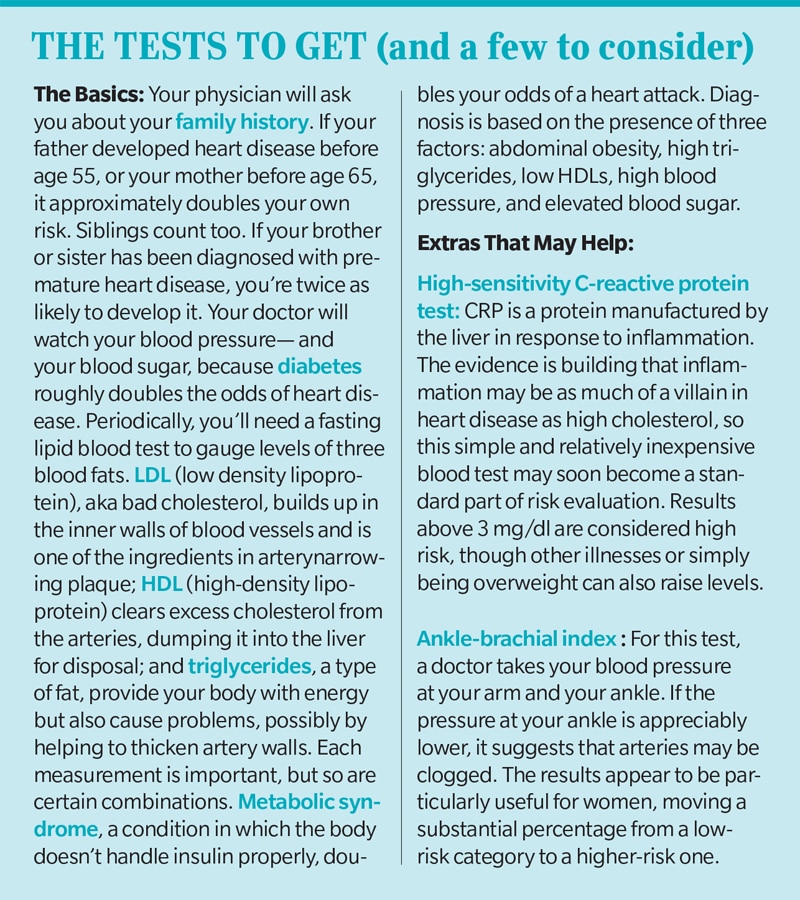
At this point I should mention that I’m a medical journalist. I’ve spent most of my career writing about health, often specifically about women’s health. I know very well that heart disease accounts for around a third of all deaths globally. I also know what the major risk factors are, so I erroneously believed I didn’t need to worry.
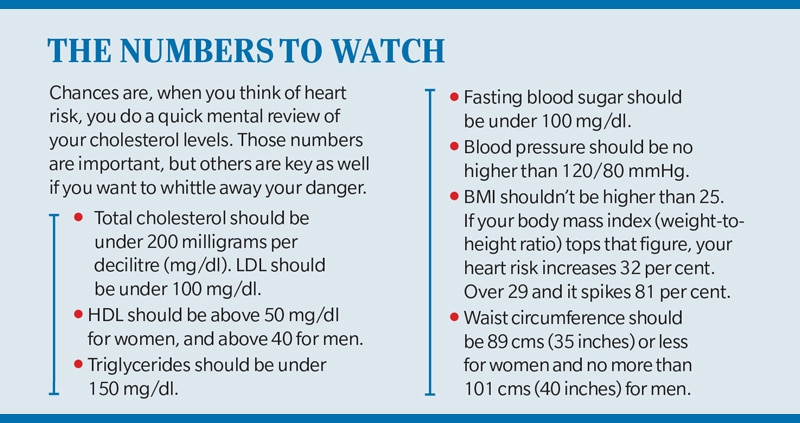
I don’t smoke. I didn’t have high cholesterol, high blood pressure or high blood sugar. I had even lost a fair amount of weight about a year and a half earlier and had been working out regularly. My diet wasn’t perfect, but it was pretty healthy. Since my numbers were good and I wasn’t aware of a bad family history, I didn’t think I was at high risk. My father did have a heart attack and bypass surgery, but that had happened when he was in his 70s. I was barely 60.
Honestly, heart disease just hadn’t been on my radar. Cancer was. Many, many members of my family over the generations had succumbed to cancer, often at very young ages. I was diligent about being tested for colon cancer, breast cancer, cervical cancer, ovarian cancer, skin cancer, etc. I thought I had everything under control. Ha.
I arrived at the larger hospital after a middle-of-the-night transfer by ambulance. Somehow my husband, son, parents and siblings were already there waiting for me. I briefly met the surgeon, who was about to put me on a heart–lung machine to keep me alive during the surgery. Through a sedative haze, I gazed at this man who would saw through my rib cage and hold my heart in his hands while sections of arteries from my left leg—removed just a few hours earlier—were sewn into my heart.
The next thing I remember was waking up in the recovery room. I looked up at the wall and muttered that the date on a bulletin board couldn’t possibly be right. And it wasn’t. The nurse in charge immediately notified someone that I was awake and “unusually alert.”
I was told to breathe into a plastic tube. “You have young lungs,” remarked the nurse. “And apparently an old heart,” I replied. But since my heart had just been “revascularized,” maybe it would now act younger too. I was inordinately pleased to be the first one out of surgery that morning to be released from the post-op recovery area to a hospital room. And that’s how I found myself lying in a hospital bed, making mental lists of song titles containing the word ‘heart’.
The next few days were uncomfortable, as I was constantly monitored and poked, and connected to a series of tubes that made getting out of bed to use the bathroom a major project.
I slept a lot and had incredibly vivid dreams that I still ponder. In one, I was attending a party, and the Olympic gymnast Mary Lou Retton was one of the guests. “Oh my gosh, I admire you so much; you’re so strong,” I gushed. “Oh, no, you’re the strong one!” she replied.
It doesn’t take a psychiatrist to figure out what that dream meant. In another, I was alone at night in a beautiful Italian plaza ringed by gorgeous white marble buildings. Projected on the buildings were repeating images from the famous Japanese woodblock The Great Wave, by the artist Hokusai. It was the most beautiful place I’d ever been, and I remember feeling as if I never wanted to leave. I’ve since wondered if that dream was the kind of near-death experience that people have spoken about, though as far as I know I was never near death while I was in the hospital.
A few days after surgery, all the tubes were removed, the doctors were assured my vital signs were good, and the in-house rehab specialist was satisfied that I was capable of walking on my own. I was released to go home.
My husband drove while I sat in the backseat as instructed, clutching a pillow over my chest for protection. After days of holding in my emotions and focusing on survival, I sobbed violently for the entire drive home.
I was tempted to take it easy for a while, but my husband had a different agenda. First on the list, a walk in the park. Though I’d always loved walking, I felt weak and unsteady. No matter, my husband suggested we make at least one circle of the park—just under one kilometre. The next day it was one and a half. Apparently, I was now signed up for his idea of a recovery plan. But I’m grateful to him for encouraging me. When the visiting nurse came to assess my post-surgery needs, she stated I would probably need a walker. I told her that wouldn’t be necessary. She asked if I’d show her how I went up and down the stairs. I sprinted up and down as fast as I could. No more walker talk!
As soon as I was eligible—just over a month past surgery—I began cardiac rehab at the local hospital. Once again, I realized my medical reporting had not really given me an accurate picture of heart disease patients and survivors. I thought that I, petite and not yet thinking of myself as old, would be exercising alongside much older and larger men. But the reality was quite different.
There was a tall, slim and very chic woman who had gone to her dentist complaining of a toothache and jaw pain. When he couldn’t find anything wrong, he told her to go to the emergency room immediately. Yep, she’d had a heart attack too.
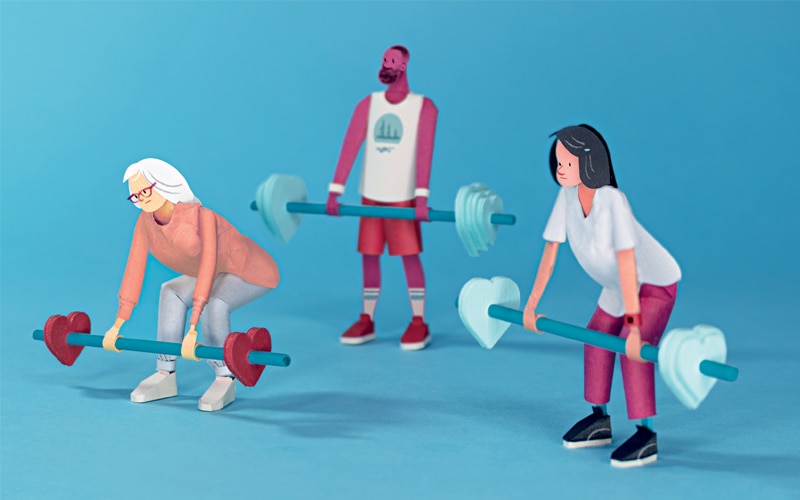
There was a young(ish) man who refused to let what happened change his image of himself as an outdoorsy, athletic, macho man. He always tried to lift the heaviest weights available. There was a tiny older lady who was always accompanied by her very attentive husband.
She struggled to lift even one kilogram weights and saw this as just one more medical problem to deal with, since she had so many. We became a rather eclectic and mutually supportive workout group.
We took turns on different exercise machines. But no one walking into the room would mistake it for a regular gym. For one thing, all of us had electrodes stuck to different parts of our chests. A wall of video screens transmitted the data to the nurses and rehab specialists who worked with us. Proud of my fast walking, I would speed up on the treadmill until one of the nurses would yell at me to slow down. I couldn’t convince her of how good it felt just to be able to move that way again. Each time someone in the group completed the programme, there was a small celebration, complete with a graduation certificate and healthy refreshments.
As my body healed, my mind struggled to come to terms with what had happened. How could I trust my body again? Without someone monitoring my heart, would I ever be able to exercise or walk without worrying it would happen again? The physical part of cardiac rehab was great, but why wasn’t there a psychological component? After the elation of surviving, I felt the aftermath of having to come to terms with what was a changed—and not diminished—self.
I’m very fortunate that the surgery and rehab went well, that there was little to no damage to my heart muscle, and that I’m now considered healthy.
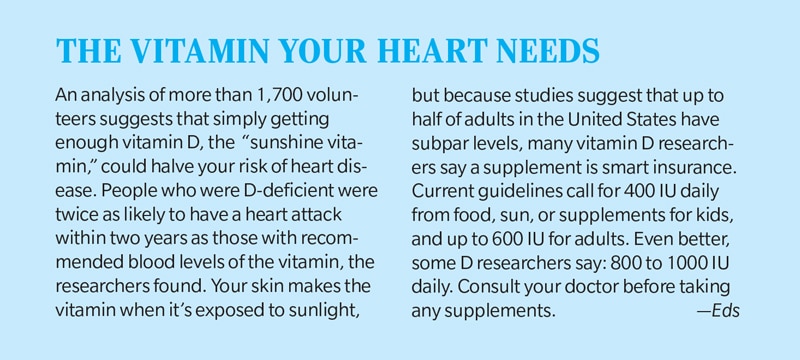
I take all my medications diligently (I was a Girl Scout), including a statin (to keep my cholesterol low), a beta-blocker (to keep my blood pressure low) and a low-dose aspirin (to help prevent blood clots). I will probably have to take these medications for the rest of my life. I’ve also changed my diet to be even healthier (but still not perfect—carbs!). I shopped around until I found the right cardiologist for me, and I see her for a blood test and physical exam every six months. There are no restrictions on my activities.
Before I left the hospital, I had asked the doctor if I could start training for a marathon if I wanted to. When he replied yes, I said, “Well, I don’t really want to, but it’s good to know I could.”
I’ve tried to understand why it happened, but no one has been able to give me an answer except to posit that genetics were probably involved. And I have since learnt that there was more heart disease than I was aware of on my mother’s side. But there is no ‘fair’ in medicine. Plenty of people practise healthy lifestyles and still wind up with chronic illnesses. Others eat bacon cheeseburgers and slather butter on bread, and don’t find themselves in the hospital. I know far too many people who died far too young without having done anything that would explain what happened to them. I know that in spite of having had a heart attack, I am lucky.
But one overwhelming feeling I have is that I was an idiot. Knowing what I knew, as a medical journalist, why did I assume that I wasn’t at risk of the biggest killer of women? What made me think I was an exception? That’s really why I’m writing this essay: to try to convince everyone, everywhere, not to neglect their heart health, and not to assume that because they eat well and exercise, they’re never going to have a problem. Everyone should be aware of their cardiac risk factors (including family history) and see their physician for an annual exam that includes an assessment of cardiovascular health.
It’s been more than six years since that ‘perfect’ day in New York City turned into one of the worst days of my life. I think almost daily about what happened. It’s not because of the way I feel; I feel absolutely fine and healthy. It’s that I am reminded every morning and evening when I take my medicines, and every time I eat out with friends and have to turn down the foods I know I shouldn’t eat.
I’m reminded, too, when I shower and dress in the morning and note the eight-inch scar—barely visible anymore—down the middle of my chest. But these things are also daily reminders of how good I feel, how lucky I was to get good medical care and how much I appreciate my wonderful husband and son, my fabulous parents and siblings, and my incredible friends, who all helped me navigate the months after the surgery. I’m also grateful for how much I learnt from an experience I desperately wish hadn’t happened.
Most of all, I feel privileged that, as a journalist, I can use my experience to get this message out to as many people as possible, and, I hope, prevent the same thing from happening to others. As for me, I’m determined that my heart will go on—for a long time to come.