- HOME
- /
- Features
- /
- Cover Story
- /
The Tigress Who Ruled the Lakes, and Every Heart That Watched Her
The man who spent years tracking, observing and documenting India’s wildlife shares the powerful, personal story of Ranthambhore’s unforgettable tigress.
 T-84, also known as Arrowhead relaxes in her territory in Ranthambore National Park. Photo by Sachin Rai
There are some creatures that pass through the wild without a sound, and others who leave their mark forever—etched not just in the landscape they inhabit, but in the hearts of those who have seen them. For me, Arrowhead was one such being.
I’ve been photographing wildlife for over 25 years now. Growing up in India, with its astonishing diversity of landscapes and life forms, I found myself drawn to the natural world early on—first to birds, then frogs, and eventually to the most enigmatic of them all: the tiger. It’s almost inevitable, I think, for an Indian wildlife photographer to fall under their spell. There’s something about their beauty, strength, and mystery that pulls you in completely.
I still remember the first time I held a camera on one of those early wildlife education tours by WWF India, back in 2000. That trip changed something in me. From a stable corporate career to travelling across India’s wild heartlands with a film camera in hand, it sparked the beginning of a lifelong pursuit. Back then, I would spend nights examining photo negatives under a tubelight, hoping to catch that one shot that told a story. This obsession with story, with watching and documenting life unfolding in front of me, has never left.
Over the years, my work has taken me to many of India’s tiger reserves, but Bandhavgarh and Ranthambhore have a special place in my heart. And Ranthambhore—dry, rugged, and starkly beautiful—is unlike any other. It’s a world of golden grasslands, scattered rocks, and twisted trees, where over 40 species of mammals and 300 species of birds thrive. But it’s the tiger who reigns supreme.
This land has seen its share of legends. None loomed larger than Machli, the fierce and graceful matriarch who ruled these parts for almost 20 years. Her legacy runs deep—woven into the forest itself through her descendants, one of whom would come to captivate me like no other: Arrowhead.
Known to the forest department as T84, Arrowhead was the daughter of tigress T19—Krishna—and the granddaughter of Machli. She was born alongside two siblings: a brother, Pacman, and a sister, Lightning. Each cub had distinctive markings that earned them their names—Arrowhead had two elegant arrow-shaped stripes above her eyes, Lightning wore a bold zigzag like a thunderbolt, and Pacman’s face bore the unmistakable curve of the video-game icon.
I first saw her in November 2014. We had just entered the park and came upon the carcass of a freshly killed sambar deer. Moments later, Krishna walked in with her three cubs trailing behind her. For two days, they feasted. I remember Lightning stuffing herself so deep into the carcass that only her hind legs stuck out. Arrowhead, even then, seemed more watchful, patient. There was a quiet strength about her.
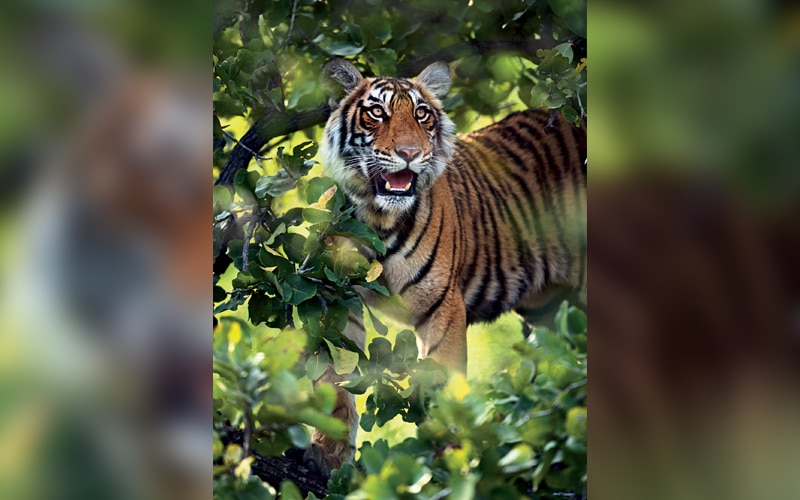 Arrowhead’s name came from the two arrow-shaped stripes above her eyes. Photo by Sachin Rai
Their bond, like that of most tiger siblings, was close through their early years. But inevitably, as they neared adulthood, a change crept in. Around the age of two, they began the solitary journey every tiger must take. Arrowhead and Lightning drifted from their mother, learning to fend for themselves. But while her sister eventually wandered, Arrowhead stayed. She had set her sights on something rare: the core territory where she was born.
This was no ordinary patch of forest. It encompassed three lakes and their surrounding terrain—prime tiger real estate. Many fierce felines had ruled these waters, including her mother and grandmother. But Arrowhead didn’t wait for her inheritance. She fought for it. Clashes between mother and daughter grew frequent. Eventually, Krishna relented and moved to a neighbouring area. And just like that, Arrowhead became the new Queen of the Lakes.
It suited her. The lakes brought in prey, and Arrowhead proved to be an exceptional hunter. Success in the wild is never guaranteed—tigers often fail in nine out of 10 attempts. But she had strength, skill, and presence. She hunted not just with her body, but with an acute understanding of the land she had claimed. She even climbed trees—a somewhat unusual practice for a tiger. I saw her leap on to branches with astonishing agility several times, unlike her siblings who stayed grounded.
With Krishna gone, other changes unfolded. Young males started entering the area, trying to stake their claim and woo Arrowhead. Her father, T28—the regal Star Male—was ageing. One of the challengers, a bold newcomer named T86, took over and eventually became Arrowhead’s mate. Their union produced two daughters: Riddhi and Siddhi.
One of the most unforgettable moments of her early reign came not during a hunt or a chase, but in stillness—amid the ruins of the old hunting palace in the middle of Rajbagh lake. It’s a striking structure, once used by royals who came to Ranthambhore to hunt the very animals we now fight to protect. On that particular day, I watched Arrowhead walk up the stone steps and nudge the male who waited there. She sat beside him, both bathed in the slanting light. Later, they mated on the steps of that same ruin. There was something symbolic, almost poetic, about seeing life being created in a place once known for death. It was a quiet, powerful reclamation of the past.
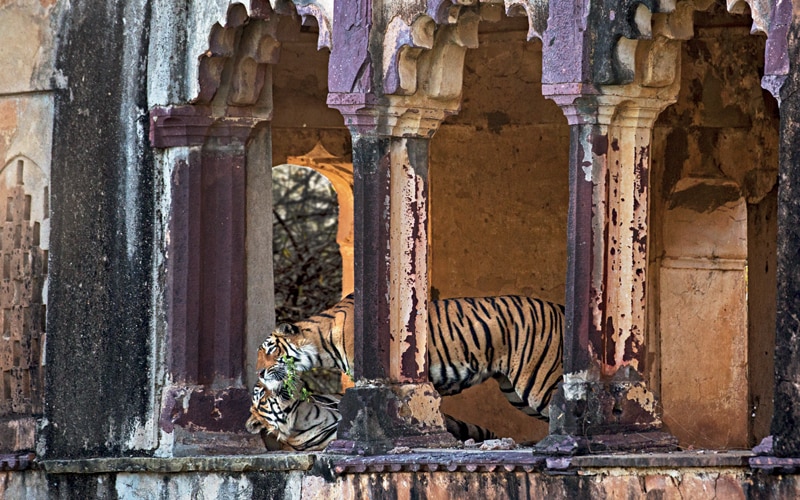 Arrowhead (upright) and a male tiger share an affectionate afternoon in the ruins of a colonial-era hunting palace. Photo by Sachin Rai
Arrowhead was a fiercely protective mother, raising her cubs with care and confidence. As the sisters grew, they mirrored their mother’s strength—and her stubbornness. They began to clash with each other, and soon, Riddhi turned her ambitions toward her mother’s domain. A confrontation between mother and daughter loomed. At the same time, something else began to trouble Arrowhead.
We started noticing a change. She began choosing unusual prey—crocodiles and turtles—perhaps because they were easier to catch. It was strange behaviour for a tigress still in her prime. Then she began avoiding Riddhi altogether, gradually withdrawing from her territory.
And then, just like that, the Queen stepped aside.
Riddhi claimed the lakes. Arrowhead moved to a smaller corner of her old home. No one knew for sure why. Around this time, another male entered the frame—T120, or Ganesh, the son of Arrowhead’s stepsister. He fought and defeated T86, taking over as the new dominant male.
At first, Arrowhead kept her distance. I remember one tense encounter clearly: she crouched low in the grass, tail twitching, ears flattened, snarling as T120 circled her, massive and silent. He didn’t engage, just walked around her once—shoulders high, asserting his dominance—and moved on. She didn’t confront him that day, but in time, accepted him. They mated, and she bore another litter—this time, of three cubs. But her body was failing her.
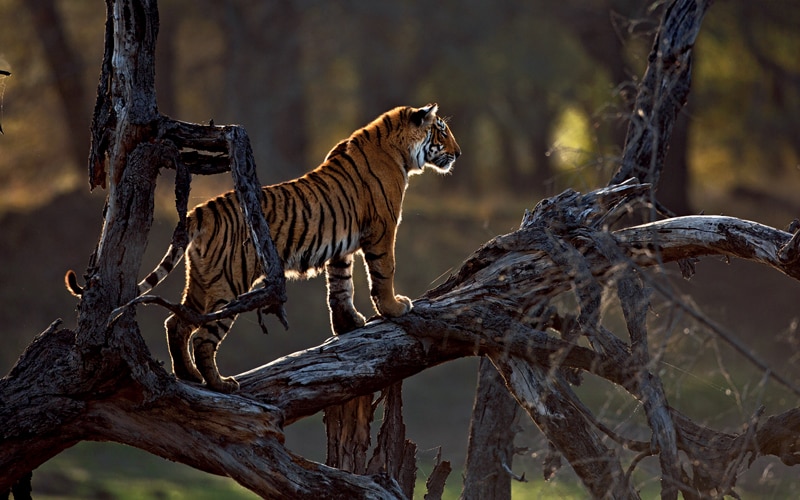 Arrow had a habit of climbing trees—a somewhat unusual practice for a tiger. Photo by Sachin Rai
A swelling appeared on her back. Her once powerful strides grew laboured. The forest department examined her and discovered a hip injury. She could no longer hunt the way she used to. To help her, they began leaving meat at a fixed location every two weeks—a move that requires a delicate balance between compassion and interference. Thanks to this, the cubs survived, and gradually began to hunt on their own.
Then came tragedy.
With the department eventually reducing food drops, two of Arrowhead’s second set of cubs—perhaps too young, too desperate—turned on humans. Three lives were lost in a single month. It was a crisis. The decision was made to relocate the cubs to other reserves, where they could live safely, away from people. They were old enough. It was time.
Arrowhead, meanwhile, was fading. With tensions rising in the forest, including the presence of T120 and Riddhi, the food drops stopped. The department stepped back. Nature would now decide her fate.
But the Queen was not done yet.
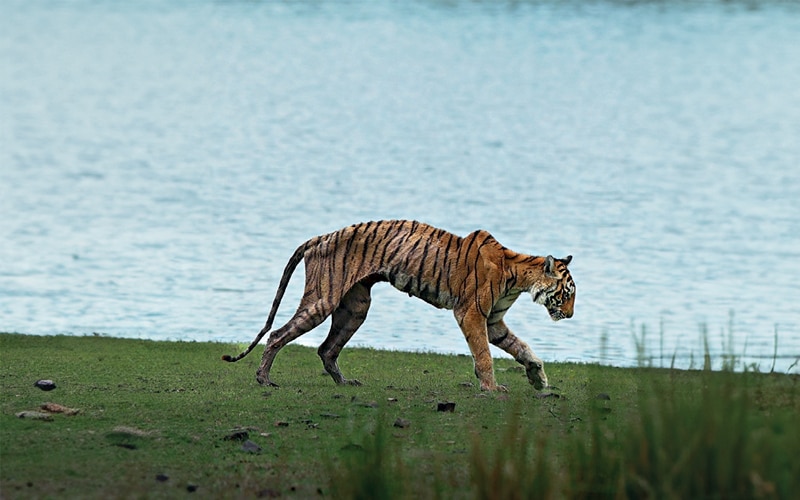 An ailing Arrowhead just a few days before her passing. Photo by Sachin Rai
In the final chapter of her life, Arrowhead returned to the lakes—her lakes. Frail, emaciated, and alone, she summoned the last of her strength to kill two full-grown crocodiles in a single week. It was an extraordinary feat, and a final statement from a tigress who had never accepted defeat easily. I saw her on what would be her final evening—barely able to walk, her frame skeletal, but her eyes still alight with something fierce. She took 10 shaky steps and collapsed under a tree. I knew then: this was goodbye. Five days later, she was gone.
Arrowhead wasn’t just a tigress I observed through a lens. She was a force, a daughter, a queen, a mother, a fighter. Her story moved me deeply—but not because she was the strongest or most dominant tigress I’d ever seen. In truth, she was none of those things. What made her unforgettable was her quiet resilience, her defiance in the face of struggle, and the sheer will to survive against odds that kept stacking up.
We grow attached to animals like Arrowhead because we see something of ourselves in them—their fragility, their tenacity, their grace under pressure. And yet, the wild is full of stories just like hers, unfolding every day beyond our gaze. That is the beauty of nature: it holds a mirror up to us, if only we choose to look.
And that is why it matters—to protect these places, to allow these stories to continue, and to remember that what we save is never just a species or a stretch of forest, but something far more magical and profound: a living world where awe, struggle and wonder still exist.