- HOME
- /
- Culturescape
- /
- Entertainment
- /
RD Recommends: Watch, Read, Listen in December 2025: Pluribus, Fallout Season 2 and More
Our top picks of series, books and podcasts for December 2025.

From long-awaited returns to buzzy new releases, the entertainment world is overflowing—in the best way. Your watchlist is growing, your TBR pile is teetering, and there’s more to choose from than ever. Consider this list your quick, curated guide to what’s worth your time right now.

Fallout Season 2
Now streaming on Amazon Prime Video
Created by: Graham Wagner and Geneva Robertson-Dworet
Starring: Ella Purnell, Aaron Moten, Kyle MacLachlan, Moisés Arias, Walton Goggins
Historically speaking, Hollywood has found it difficult to produce gripping, long-running video game adaptations, but Fallout (based on the RPG or role-playing game of the same name) is one of the exceptions. The story is set two centuries after “the Great War of 2077” between America and China, an event that led to a ‘resource war’ across the world and the development of widespread underground nuclear bunkers called ‘Vaults’ housing the survivors. The protagonist is a young Vault-dwelling woman named Lucy (Ella Purnell) who’s looking for her father; she suspects he’s been kidnapped by a gang of barbarians roaming the nuclear wasteland. As she roams the scorched surface of the earth, she meets legendary bounty hunter Cooper Howard (Walton Goggins) who has mutated to become a ghoul, roaming the earth to settle some mysterious unfinished business of his own.

Fallout’s primary strength is its cast, especially Purnell and Goggins who are both excellent. The versatile Goggins has featured in some of the most memorable TV series of the last 10-15 years, including Justified, Sons of Anarchy, The Righteous Gemstones and The White Lotus, stealing scenes with his strong screen presence and his trademark Southern drawl.
Pluribus
Now streaming on Apple TV
Created by: Vince Gilligan
Starring: Rhea Seehorn, Karolina Wydra, Carlos-Manuel Vesga
Vince Gilligan is the creator of two of the most popular and acclaimed TV shows of the last decade — Breaking Bad and Better Call Saul. The veteran screenwriter and director returns with Pluribus on Apple TV, a post-apocalyptic science fiction drama that’s arguably even more ambitious than his previous work. At the beginning of the story, we are shown how the whole world has become infected by an alien virus, and now they are all part of an alien ‘hivemind’, sharing thoughts, motives and memories. Well, all except one, Carol Sturka (Rhea Seehorn), a depressed writer of cheesy romance novels who appears to be immune to the virus and therefore retains her free will.

Would a depressed person deal with the end of the world better than ‘regular’ folks? Director Lars von Trier had previously asked this question in his film Melancholia. Gilligan begins with a similar query before branching out to other interesting dilemmas — Are you truly ‘good’ if you only behave well when eyes are on you? How much does morality depend upon the threat of accountability? Is a cheerful but naïve friend more dangerous than a blunt-speaking, pragmatic enemy?

Night Reign by Arooj Aftab, Verve Records. Streaming on YouTube

In 2022, the Pakistani-American singer, composer and producer Arooj Aftab became the first-ever artist of Pakistani origin to win a Grammy; her song ‘Mohabbat’ won Best Global Music Performance. A couple of years later, Aftab followed up the feat with her fourth solo studio album, Night Reign, a beguiling mixture of Urdu poetry and bebop jazz, the complex, aggressively improvisational subset of jazz pioneered by the likes of Charlie Parker and Miles Davis. Two songs on this album, ‘Naa Gul’ and ‘Saaqi’, are based on poems by Mah Laqa Bai Chanda, an 18th century Indian courtesan from Hyderabad who is now considered the first woman to publish a collection of Urdu poetry. Other tracks draw inspiration from the works of the Sufi mystic Rumi.

Called by the Hills by Anuradha Roy (Hachette India)
In Anuradha Roy’s second novel The Folded Earth (2011), there’s a line that goes “The mountains do not reveal themselves to people who come here merely to escape the heat of the plains.” The line made a clear distinction between vacationers and true mountain-dwellers. And her new memoir Called by the Hills is the story of how Roy and her partner Rukun moved from the former to the latter category, setting up their new lives in a small hut at Ranikhet, a hill station and former cantonment town in Uttarakhand’s Kumaon region. Along the way, the two also set up their own independent publishing house Permanent Black (2000-present day), working remotely at a time when this was unheard of, when Internet infrastructure wasn’t as widespread as it is today.

Roy, previously shortlisted for the Booker Prize for her novel Sleeping on Jupiter, is a fantastic writer, blending astute personal observations with an array of literary and artistic ‘anchors’, ranging from Arvind Krishna Mehrotra poems to Halldor Laxness novels to a memoir by the prolific Bengali children’s writer Leela Majumdar. More importantly, she never once depicts the Himalayan life with rose-tinted glasses. Indeed, one of the most admirable aspects of the book is Roy’s honesty about the daily challenges (financial, logistical, terrain-related) thrown up by life in the hills.
“That first night, a heaving tangle of scorpions made their displeasure at our intrusion clear. But we could no longer wait. In Himalayan villages far removed from the resources of the plains, even the transport of honest mud has a way of emptying your pockets. The details, including dissuading snakes and scorpions in their quest for rent-free accommodation, could be dealt with over time, we thought, partly because we had run out of money. We did not know that ‘over time’ meant the rest of our lives, and that the transformation would eventually have more to do with us than the cottage.”
As the passage above shows, Roy’s journey has seen its fair share of challenges, but it has also delivered on the promise that the author foresaw in the first place — the promise of transformation, of approaching an alternative way of living and gradually, learning to wear it like a second skin. Called by the Hills is the thoughtfully written account of a life well-lived.
Other Skies, Other Stories by Sara Rai, translated by Ira Pande and Sara Rai (Zubaan Books)

Sara Rai is a bilingual writer working in both Hindi and English; her translations of the Hindi writer Vinod Kumar Shukla’s work in particular are excellent. She also happens to be the grand-daughter of arguably the greatest Hindi writer of all time, Dhanpat Rai, better known as ‘Premchand’ (1880-1936). In her own Hindi stories, like the critically acclaimed ‘Ababeel Ki Udaan’ (‘The Swallow’s Flight’) Rai depicts the vagaries of life in small-town North India, with its laundry list of problems and its even longer lineup of languages, dialects, colloquialisms and popular sayings. Other Skies, Other Stories, this latest volume of her fiction-in-translation, has been co-translated by Ira Pande, perhaps best known for Diddi: My Mother’s Voice, the well-received memoir of her mother, the Hindi writer Gaura Pant aka ‘Shivani’ (1923-2003).
Ghost-Eye by Amitav Ghosh (HarperCollins India)

In Amitav Ghosh’s first novel since Gun Island (2019), we meet a young Marwari girl named Varsha Singh living in Calcutta in the 1960s with her strictly vegetarian family. One day, Varsha’s folks are thrown in a tizzy when she declares that she wants fish for lunch, recalling memories of catching and cooking fish at a different home, with a different mother. Dr Shoma Bose, a psychiatrist specializing in cases involving ‘past-life memories’, agrees to take up the case but what Varsha tells her forever changes her worldview as a woman of science. Half a century later, Shoma’s nephew Dinu gets drawn into his aunt’s history and Varsha’s account, triggering a chain of events that spells trouble for both families concerned.
Memes for Mummyji by Santosh Desai (HarperCollins India)
Santosh Desai, one of Indian advertising’s leading lights for over two decades, has also written popular newspaper columns in a range of Indian newspapers and magazines. He has a well-earned reputation for spotting cultural trends in Indian cities, as evidenced by his previous book Mother Pious Lady. In his latest book of essays, Memes for Mummyji, Desai turns his analytical eye towards India’s ongoing smartphone era, breaking down the small and big ways in which smartphones have changed our world, shrunk our attention spans and transformed the ways in which we consume and disseminate data.
Speaking of History by Romila Thapar, Namit Arora (Penguin Random House India)

Romila Thapar is one of India’s most accomplished historians, her work on ancient India being particularly well-received and a part of university curricula around the world. In this latest book, Thapar teams up with Namit Arora, the author of the excellent The Indians: A Brief History of a Civilization (2021). Through a series of conversations, the two of them tackle some fundamental questions surrounding the historian’s craft: why is it so important to chronicle the past honestly, without bias or ulterior motive? What are the ways in which a historian’s mandate can be corrupted? How do we fight back against those who wish to distort history in the service of short-term electoral arithmetic? Speaking of History attempts to answer questions like these with a combination of wit, wisdom and academic rigour.

Puliyabaazi: The Hindi Podcast, Spotify

Presented by Tech entrepreneur Saurabh Chandra, public policy scholar Pranay Kotasthane, and writer-cartoonist Khyati Pathak, Puliyabaazi is a Hindi-language podcast that operates at the intersection of technology, public policy and culture. Thanks to the hosts’ different domains of interest, they are able to discuss the headlines of the week with rigour and expertise. They rely on typically ‘Hindi heartland’ humour on occasion, and one of the things the hosts all agree on is that partisan politics ought to be kept out of the podcast as much as possible. Because of these reasons, Puliyabaazi has quietly built a faithful audience for itself. Recent episodes include a very informative discussion on why Argentina’s economy went on a rapid decline, and another one about the Emergency, with the historian Srinath Raghavan featured as guest speaker.
The Music Podcast with Tarsame Mittal, Spotify
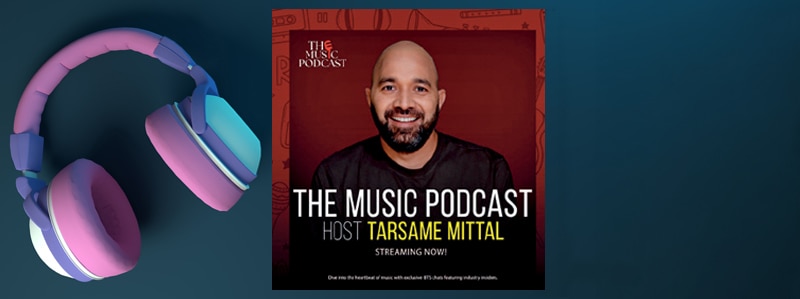
Tarsame Mittal, an entrepreneur and talent manager who has been a part of the Indian music scene for over 20 years now, hosts The Music Podcast, one of the most comprehensive podcasts about the industry. The strength of this podcast is the level of access Mittal gets to top names at every level of the industry—executives like Devraj Sanyal (Chairman and CEO, Universal Music India & South Asia), emerging talents like rappers Shah Rule and Dino James, as well as veteran artistes like the singer Rekha Bhardwaj, whose interview is one of the best episodes of them all. The comfort and ease with which Mittal conducts these interviews is palpable and helps the interview subjects let their hair down and be a little less guarded in their responses.
For more such recommendations, click here.