- HOME
- /
- Culturescape
- /
Once Upon a Drawing
What connects the carvings on a temple wall to today’s digital comics? A remarkable new exhibition uncovers the unbroken thread of India’s visual storytelling traditions across 1,500 years
 Covers of Amar Chitra Katha comics adorn a wall in A Moving Line exhibition at MAP. All photos: courtesy of Museum of Art and Photography, Bengaluru.
From painted scrolls to comic books and digital media, storytelling in India has continually evolved while remaining rooted in the power of sequential images. The Museum of Art & Photography (MAP) in Bengaluru explores this remarkable journey in A Moving Line: 1,500 Years of Indian Visual Storytelling, a major exhibition curated by graphic novelist Amruta Patil. Running until 15 November, the exhibition brings together more than 250 works that reveal how visual narratives have developed across 15 centuries.
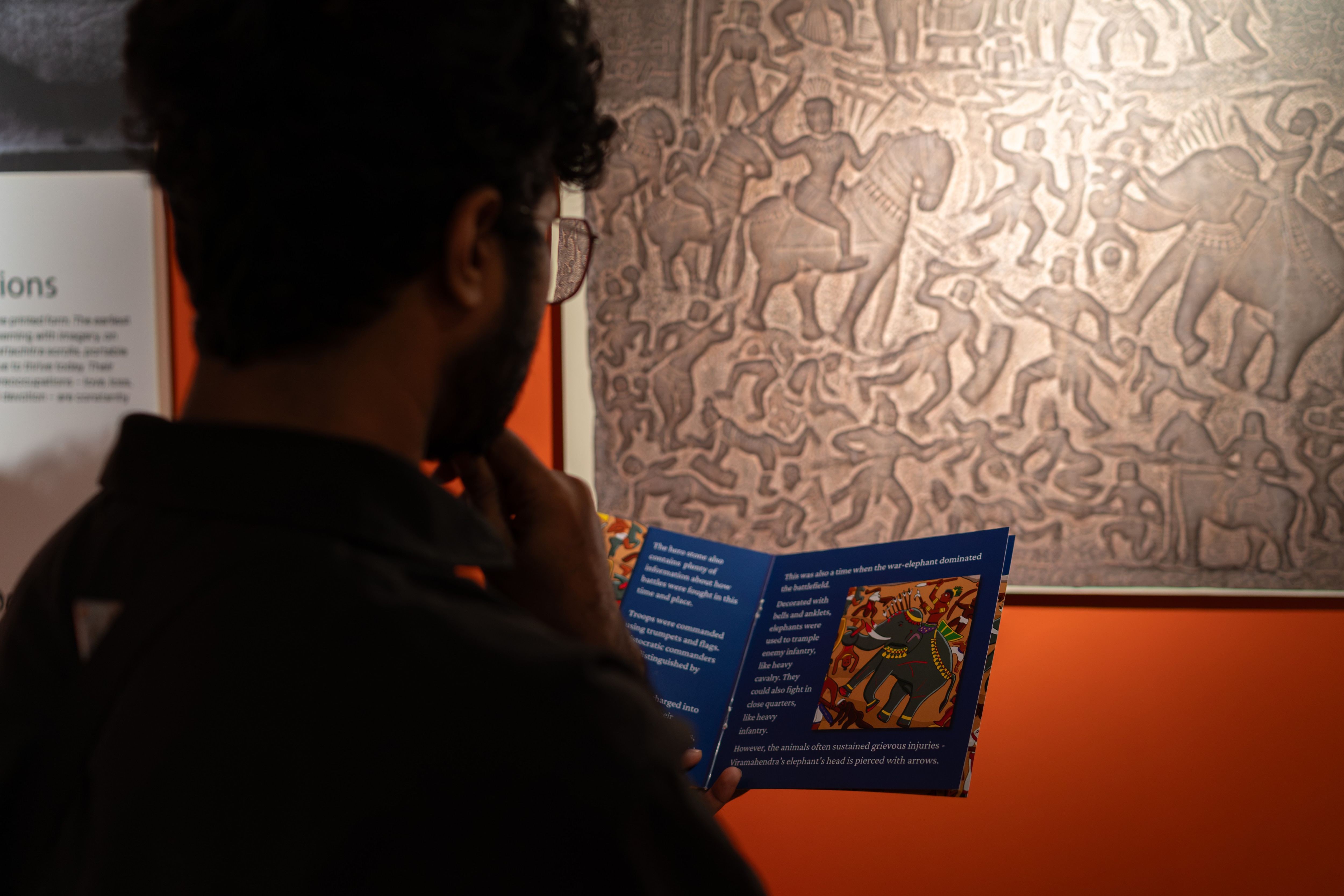
The exhibition begins close to home, with the Someshwara Temple in Halasuru, one of Bengaluru’s earliest surviving examples of storytelling carved into stone. These narrative reliefs become the starting point for an exhibition that follows a continuous line from ancient temple walls to today’s digital screens. Instead of presenting a strictly chronological history, Patil organizes the exhibition around ideas and recurring visual languages.
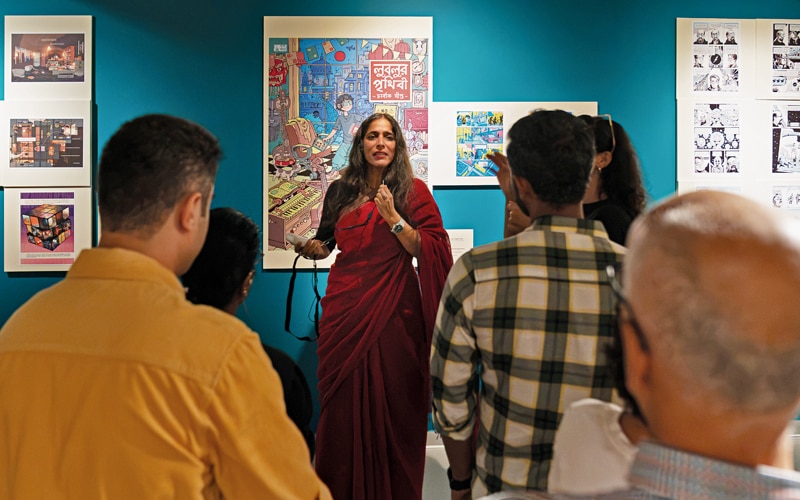 Graphic novelist and curator Amruta Patil at A Moving Line exhibition
“Comics and graphic novels emerged in the West, but the idea of sequential art, stories told through sequenced imagery, has existed in various forms in our culture,” she says. “Without overemphasizing ‘proto’ traditions, I wanted to suggest continuum, amplified by the name of the exhibition itself: A Moving Line.”
That sense of continuity is reflected throughout the exhibition. Historical forms such as the kaavad, portable wooden shrines with unfolding painted narratives, and pattachitra scrolls appear alongside beloved publications including Amar Chitra Katha and Tinkle. Familiar comic characters such as Chacha Chaudhary and the Phantom share space with contemporary graphic novels and web comics, revealing how India’s storytelling traditions have continually adapted to new audiences and technologies.
For Patil, these connections are more natural than they may first appear. She points to contemporary digital comics that borrow the visual grammar of miniature painting and graphic novels that draw upon the traditions of oral storytelling. “People are fixated on endless silos of ‘old and new’, ‘paper and screen’, ‘low art and high art’,” she says. “The primary driver in all of these works is the need to tell a tale alluringly and effectively, using drawn images and story track.”
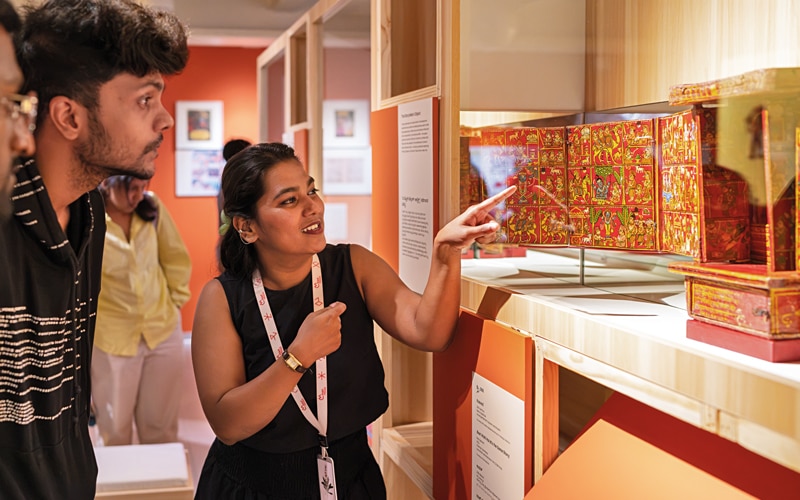 Pattachitra, an early example of India’s vast and ancient visual storytelling
The exhibition also reflects the challenges of researching India’s visual storytelling traditions. Many of the featured works have long been out of print, remain untranslated or have rarely been exhibited, limiting their accessibility even for artists and scholars.
“The very fact that such diverse, nuanced work was inaccessible to me was one of the main inspirations of this exhibition,” Patil explains. She hopes A Moving Line will encourage “greater scholarship, translation and reprints, institutional patronage, and archival attention towards India’s visual storytelling”. The exhibition, she says, is “just the beginning, a tasting menu.”
As visitors move through the galleries, they encounter changing social and cultural perspectives. Early Bengali comics reveal how artists used satire to comment on society, while later works reflect evolving ideas about identity and nationhood. Contemporary graphic novels address themes including gender, caste, ecology and political resistance. Patil notes that visual storytelling in India has always carried political weight, from pre-Independence comics and the cartoons of Shankar Pillai and R. K. Laxman to today’s graphic novels and Instagram comics.
Accessibility is central to the exhibition’s design. MAP has incorporated tactile and audio responses to selected Amar Chitra Katha stories, Indian Sign Language content, described audio, sensory objects and an audio guide to ensure a wider range of visitors can engage with the works. Gallery facilitators offer walkthroughs, while an interactive educational space invites visitors to create their own comic, reinforcing the exhibition’s emphasis on participation.
The exhibition concludes by looking towards the future of visual storytelling, including works that incorporate digital technologies and AI-assisted image-making. While Patil believes these tools are now an inevitable part of artistic practice, she argues that the more pressing questions concern how they are used. “The tech is here to stay, and its potential ranges from god-like to dystopian,” she says, adding that the challenge lies in creating fair systems of attribution and using AI to complement, rather than replace, human creativity.
Accompanied by a publication featuring an introduction by Patil and newly commissioned essays and graphic narratives, A Moving Line ultimately argues that India’s visual storytelling tradition has remained remarkably unbroken. Instead, it has always reinvented itself, revealing an interconnected history that shapes how stories are imagined, shared and remembered today.