- HOME
- /
- Cover Story
- /
A Call for Compassion
What does it mean to live with daya—kindness—as both duty and grace in today’s conflicted world?
 illustration by Siddhant Jumde
How might it feel to have a name like Daya? The Indian languages allow us that—to be the bearer of a virtue, to respond to someone calling us by that name, as if they were invoking the virtue itself. It is also possible that a name derived from virtues might, from being repeated over and over again, polish something in their owners, in the way footsteps, over centuries, shine the stone steps of pilgrimage sites. It might be a burden as well, the responsibility of having to live up to that name, say, in the way a word like ‘rain’ has to, as if it were ingrained in the instruction manual of the word itself.
What, then, of a name like Dayanand? The ‘da’ in ‘daya’, our etymologists tell us, means ‘gift’. ‘Anand’ is, of course ‘joy’. Is the recipient of this gift—of daya, kindness—also the recipient of joy? Or is it the giver of kindness, to whom joy comes from the act of being kind? I’m trying to understand why—if the giver of daya finds such ananda in giving it—should being kind be hard? Why don’t their English equivalents carry the joy, the expansive joy, that the act of being kind is supposed to bring the giver of kindness?
There’s Dayasagar—an ocean of kindness. Since an ocean implies inexhaustibility, is our capacity for kindness inexhaustible? Is the recipient of kindness smaller than an ocean—a river, a pond, a well? I am asking these questions to understand why the recipient of kindness is not as well-imagined as its giver.
Other names deriving from the same root only corroborate this: Dayal, the kind-hearted person; Dayanita, the kind-hearted woman; Dayamayi, the merciful woman. This, of course, owes to the character of the word daya itself—that it’s a gift, something that is activated only when it makes a centrifugal movement, that it has value only when it leaves its giver.
What, then, of the slogan of our times: ‘Be kind to yourself’? I have seen this in various locations, but my earliest memory of being struck by the syntax of such an utterance was finding it as a sticker in a hostel bathroom mirror (one really needs to be kind to oneself in front of one, of course). I’m told that we need to be as kind to ourselves as we often are to our neighbours in this world. All the verses about kindness in, say, The Bible—in Luke and Galatians and Ephesians—ask us to be kind to everyone, perhaps most of all to our enemies. When we want to be kind to ourselves, are we then trying to be kind to our enemy? (Our enemies might be easier to please than our own selves.)
In the Hindu scriptures, daya is often tied to daan, donation. In this, too, we find the same lineage of giving, to someone outside ourselves, someone unlike ourselves. The iconography of kindness—religious, ritualistic, corporatized, and intimate—is predicated on this outward-moving model.
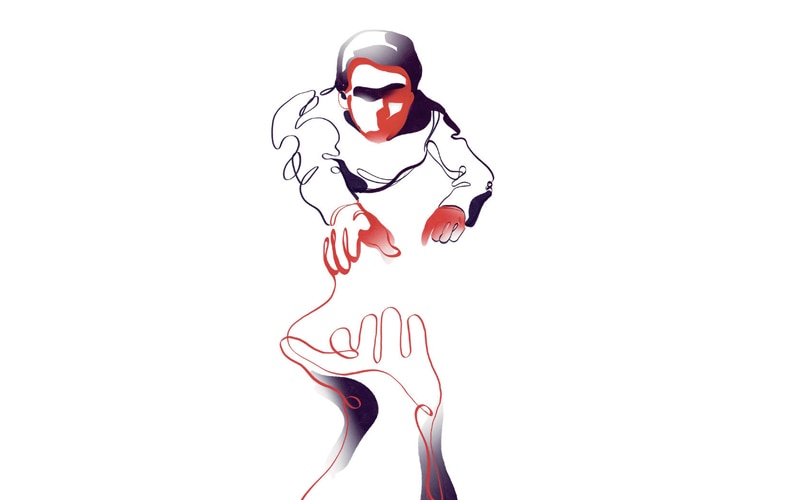 Illustration by Siddhant Jumde
Perhaps, it is our conditioning in this philosophy, this optics, that makes being kind to ourselves a difficult task. The outward-looking arrow would need to be substituted by a model that resembles something like a U-turn—being kind to our little selves seems to be as hard as pointing a finger at ourselves. Is that why the category of the receiver of kindness has been left amorphous?
Why does it feel so hard to be kind to oneself? Self-criticism comes faster than self-compassion, and misunderstanding the world doesn’t compare to the confusion created by misunderstanding oneself. The reaching out of the hand to give, to gift, is easier than soothing one's own skin and nerves and soul. Kindness—which I understand as the highest form of intelligence—doesn’t come easy when it is directed at oneself. To be its recipient, we seem to turn into the likeness of the backs of our bodies, which we know is there, parts of which we can touch but cannot see, unless a mirror or camera reveals it. The world is like the face—we are kind to those that fall in its way. To the rest, including ourselves, we have to strain, because we cannot see ourselves completely.
Perhaps that is why Bharatmuni, in his catalogue of the rasas, includes karuna but not daya. The equivalent of both these words would translate as ‘kindness’ in the English language, even though the first is an aesthetic emotion, an experience that derives from a response to art. I see one as the equivalent of lighting a lamp for the world to be able to see; see so that no one falls. I see the other as putting out a lamp so that one can create the darkness necessary for sleep.
Which one is harder?
As the news ticker keeps reporting about the incessant breach of the natural right to kindness that keeps the living together, one wonders about the timeliness of kindness. When has kindness ever been untimely? If we could think of the world as our kin, kindness—the words share a common origin—will become daya, a gift as much to oneself as to life itself.
To read more of our cover stories, click here.