- HOME
- /
- Conversations
- /
- In My Opinion
- /
The Case for Curiosity
Two trivia enthusiasts explore how wonder fades with age—and why asking questions might be the key to finding it again
 Photo Courtesy: Adobe Stock
It was an otherwise dull afternoon, when our three-year-old nephew, gazing into an aquarium, asked, “How much longer will the fish bathe? When will they come out?”
All the grown-ups in the room looked at one another, smiling at his innocence. But behind the amusement hid a lingering thought: When was the last time we adults asked such weirdly wonderful questions? The answer, felt rather than spoken, made us re-examine everything.
As children, we would stare up at the sky and imagine what it might be like to be astronauts. As adults, we barely notice the stars.
The sky is still there. The stars still twinkle. But instead of marvelling at their beauty and the mystery of the unknown, we ignore it, take it for granted. What turned us from endlessly curious children into impatient, unquestioning adults?
Five words: “That’s just how it is.”
Again and again, our persistent questions met with this universal reply. Slowly, we began to believe that the world exists in a fixed way for no reason other than that it must.
Why do fish live in water? That’s just how it is.
Why do birds fly? That’s just how it is.
Why don’t people fly? That’s just how it is.
It is a brilliantly convenient answer—one that fits every question, yet explains nothing.
R.I.P. curiosity.
In India, the best-selling ‘learning’ books are either colourful children’s encyclopaedias or general knowledge guides meant solely for competitive exams. As if curiosity belongs only to childhood—or to exam preparation. Formal education gradually replaces curiosity with rote learning.
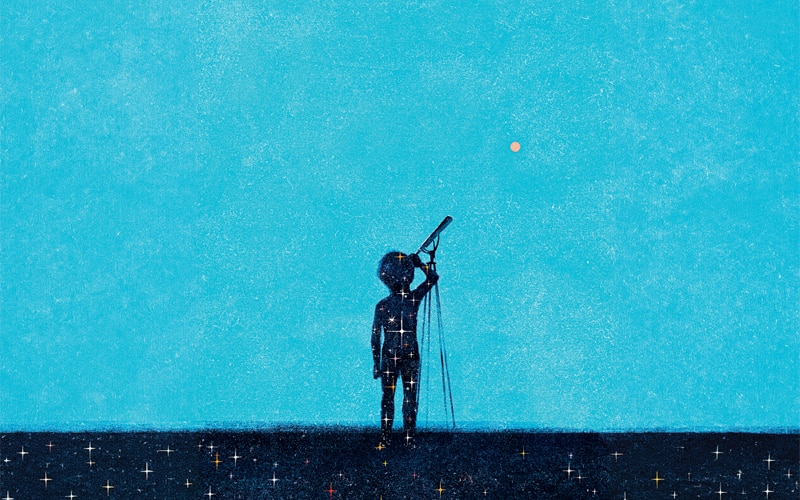 Photo Courtesy: Adobe Stock
So how do we undo the damage? By chasing seemingly useless knowledge. Such knowledge may never serve a practical purpose in daily life—that is why it appears useless. But the act of seeking it, purely for the joy of discovery, begins to repair what we lost.
These small nuggets are called trivia. They reveal hidden connections between unrelated things and spark that joyful ‘aha’ moment.
Beyond restoring curiosity, trivia creates a second-order effect: it deepens conversations—and relationships.
One evening, while watching a cricket match, we asked our father, “Who was the first cricketer to score a double century in a One Day International (ODI)?”
Without looking away from the screen, he replied casually, “Everyone knows—it was Tendulkar.”
But we were prepared. “Yes, he was the first male cricketer,” we said. “We asked about the first cricketer.”
He paused the match, turned toward us, and raised his eyebrows. We had his full attention.
We told him how Australian cricketer Belinda Clarke scored 229 not out against Denmark in 1997. He was impressed—but that wasn’t the point.
A few days later, at a family gathering filled with small talk and gossip, our father suddenly asked everyone this same question that had stumped him earlier. And just like that, the conversation shifted, instantly—to women’s cricket, and to how deeply we are conditioned to think of cricket as a men’s sport and on and on.
We are conditioned in other ways too. We learn to assume. Are assumptions always harmful? Not at all. Across evolution, assumptions helped humans survive. Believing a dark forest might hide predators kept our ancestors cautious—and alive. Assumptions are shortcuts for survival. But survival alone has never moved humanity forward. Curiosity has.
A quote often attributed to John A. Shedd reminds us: “A ship in harbour is safe, but that’s not what ships are for.” What is true for ships is true for us. Our purpose is not merely to stay safe, but to grow, discover and become something new. And that cannot happen by repeating what has always been done.
It begins with a question. Then another. And another.
Curiosity pushes us to look again at what seems obvious, to connect ideas that appear unrelated, and to imagine possibilities others overlook. What feels like a small question today can become tomorrow’s breakthrough.
After all, everything humanity knows is only a drop in a vast ocean of the unknown. The people who change the world are often those who remain with a question longer than everyone else.Which brings us back to the child’s wonder: “For how much longer will fish bathe? When will they come out?”
In a way, they already did—millions of years ago. Life began in water. One fish ventured on to land and, over time, evolved into us.
That first step was curiosity in motion. That same restless need to know more later pushed early humans to cross mountains, sail unknown seas and discover new lands. What more might change if we questioned our world with the same courage?
Nipun Jain and Mohit Mamoria are the co-founders of Arey Pata Hai, a digital platform for trivia, questions and stories, and the authors of the book What the What?!, published by Hachette India
For more stories like these, click here