- HOME
- /
- Better Living
- /
- Mind
- /
Why Your Brain Sees Faces Everywhere: The Science of Pareidolia
Why do some people see faces in random patterns? Learn more about pareidolia
 Photo: Shutterstock
So far this morning I have spotted faces in a crumpled piece of clothing and my neighbour’s front door, while my morning cereal was topped by a particularly grumpy-looking slice of banana. And while this might sound a little like I need some kind of intervention, it’s actually a completely normal phenomenon called pareidolia, where people see faces in inanimate objects. But why does it occur?
Frankly, why doesn’t it occur might be a better question. “Being able to spot faces is critical for our survival and our social life,” explains neuroscientist Professor David Alais from the University of Sydney.
“We need to quickly recognise friends, enemies, healthy people or unhealthy people and the best way to do this is for the brain to have a simple template, akin to two eyes, a nose and a mouth, for recognising them. Anything that conforms to the template triggers a response from the face processing network in your brain, which then decides if it’s real.”
Facial recognition happens within a few hundred milliseconds, but even when we realise that what we’re seeing isn’t actually another human, but say, two windows and a letterbox on a door, Professor Alais’s research found that our brain continues to dwell on the image. “Simply detecting a face isn’t enough for us, it seems we need to read the identity of the face and discern its expression—are they happy, sad, angry, pained—even if it’s not a person,” he explains.
How much conscious attention we pay to this process differs. Some people say they rarely see faces in inanimate objects, others can’t get through breakfast without seeing some fruit having a tantrum. Right now we don’t know why this is, but Professor Alais says the difference might simply be that “some people’s face recognition system is set with a lower threshold than others.”
 Spotting faces in objects is a common experience, but some people also attribute gender, emotions and age. Photo: Shutterstock
Our state as social beings might also play a role. Women are more likely to experience pareidolia than men but, Australian research has found that post-partum women are even more likely to spot faces, possibly because they have higher levels of the bonding hormone oxytocin in their system. In lab tests, people are also more likely to spot friendly, happy faces than sad or angry ones. “I definitely think pareidolia is related to our need for human connection,” says Dr Jessica Taubert who studies pareidolia at the University of Queensland. “Empathy, social connectivity and feeling lonely all seem to correlate strongly with someone’s susceptibility to pareidolia.”
Conversely, those diagnosed with autism are less likely to experience it. “People with autism don’t have the same drive to socialise as others, so they aren’t constantly searching for faces,” says cognitive neuroscientist Dr Mark Williams, author of The Connected Species (Rowman & Littlefield Publishers). “My own interest in face perception came about from studying autism.”
What also differs is what, or rather who, you see when spotting faces. Everything from your religious background, education and your news exposure might determine whether you decide a cloud looks like the Virgin Mary, Einstein or Donald Trump. “When we see a face we want to know who it is, and to determine this, your brain first fires up recognition cells that have recently activated to see if these can quickly find a match,” explains Dr Williams. “And if you’ve seen a lot of articles about Donald Trump, you’ll see him over someone you haven’t seen recently.” People with religious backgrounds tend to generally be more prone to pareidolia, which might also explain why there are so many noted sightings of the faces of Jesus or the Virgin Mary.
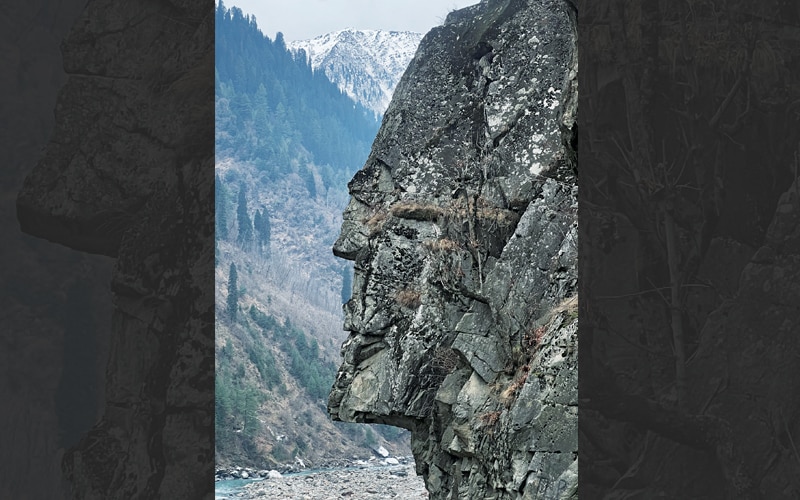 This rock ‘face’ is found on a mountain in Kashmir. Photo: Shutterstock
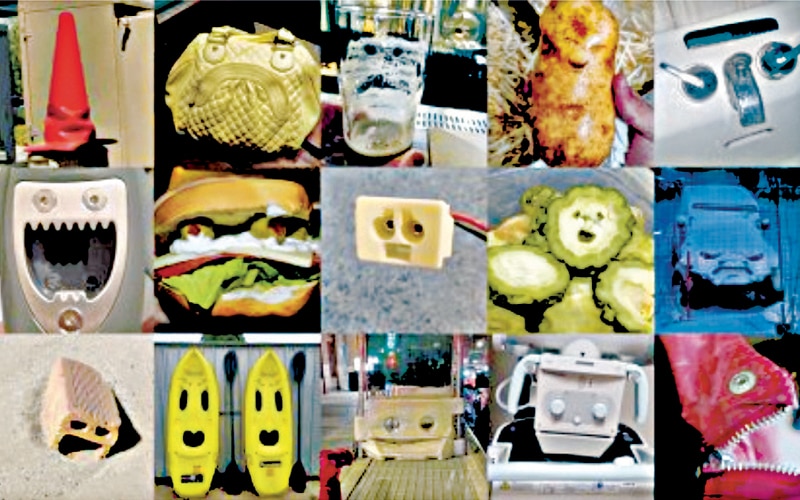 ‘Seeing faces in things’—a composite Image by Dr Jessica Taubert. Photo Courtesy: University Of Queensland, Australia. www.uq.edu.au
It’s also very common to see members of your family but as Dr Taubert points out, those sightings don’t get the same publicity as, say a vision of Mother Teresa in a cinnamon bun, as they are so individual and personal. “This is one of the things I find really interesting about the human experience of pareidolia,” she told us. “Animals also see faces in patterns, but they quickly reject images they realise aren’t right. Only humans spend time thinking about what they see and coming up with narratives like ‘that mop looks just like my mother when she’s angry’.”
Lastly, people who believe in the paranormal tend to be more prone to pareidolia. In fact, it might explain the whole phenomenon of seeing ghosts. But other than creating excellent Halloween stories are there any other uses for the ability? Well, it can be quite lucrative.
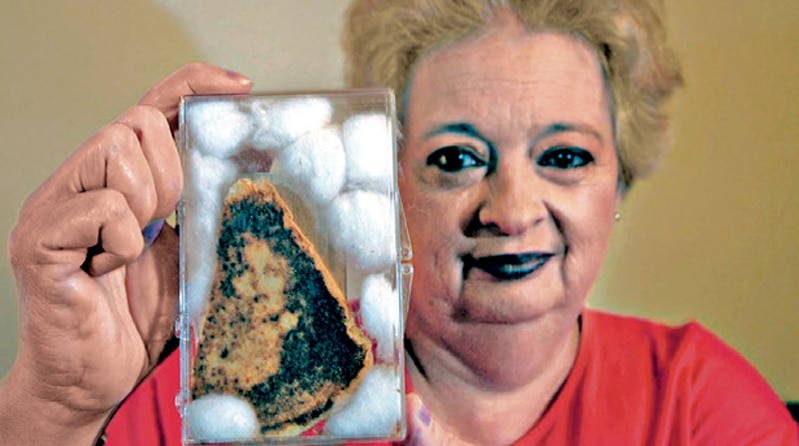 Diana Duyser shows a cheese sandwich with what she believes has an image of the Virgin Mary. In ten years, no mould had formed, she says. Photo: Joe Rimkus Jr. Miami Herald Staff
Florida resident Diana Duyser once sold a ten-year-old preserved toasted cheese sandwich that was imprinted with the face of the Virgin Mary for US$28,000.
Personally, I try and spot faces when exercising to liven up boring walks but there could be a more scientific use in the future. “We’re looking at whether we can use pareidolia to diagnose certain conditions, or spot early changes in mood,” says Professor Taubert. “If we can find patterns, it could become a very useful tool.”