- HOME
- /
- Better Living
- /
- Food
- /
How to Eat Fruits and Vegetables
Serve up some delicious, healthy produce now, while it’s fresh.
 Illustration by Kate Traynor
What if there was a kind of food that tasted delicious, came in thousands of varieties, could be eaten raw or cooked in an endless number of ways, and helped prevent most of the major diseases killing us? Well, this kind of food does exist—it’s fruits and vegetables!
Given these facts, the real question is why are only 1 in 10 of us eating the recommended daily amounts of these natural wonders?
Plenty of people have grown up never eating healthy foods, says Marion Nestle, PhD, author and Paulette Goddard professor emerita of nutrition, food studies and public health at New York University. Or they may not know how much to aim for. The U.S. Dietary Guidelines currently recommend at least two servings of fruit and three servings of vegetables each day, and give examples of what constitutes a serving size. A serving of fruit, for instance, could be a medium-size apple, banana, orange or pear. Or it could be ½ cup of chopped, cooked or canned fruit. A serving of vegetables could be one cup of raw leafy greens, or it could be ½ cup of other vegetables, cooked or raw. Last year, the Indian Council of Medical Research (ICMR) released 17 Dietary Guidelines for Indians, which recommends that not more than 45 per cent of calories should come from cereals and millets and up to 15 per cent of calories should come from pulses, beans and meat. The rest should be derived from nuts, vegetables, fruits and milk.
If this sounds like a lot, it’s because fruits and vegetables are considered among the ‘foundational foods’ (others include fat-free and low-fat dairy, and whole grains) that should be the basis of our diets, saying that these foods “are associated with improved health, such as reduced risk of cardiovascular disease, type 2 diabetes, certain types of cancers, and being overweight or obese.”
OK, you probably knew a lot of this already. But you still might be among the about 98 per cent of Indian adults who aren’t including enough fruits and vegetables in their daily diets, according to ICMR data. So we asked a few experts to address some of the reasons people cite for avoiding produce, and suggest ways to overcome them.
“They’re too expensive.”
“One barrier is the perishability of fruits and vegetables,” says Lauren M. Scott, president of The Foundation for Fresh Produce. “People think fruits and vegetables cost too much because they bought them but then the produce went bad and they had to throw them out. But the reality is that fruits and vegetables are not expensive relative to other foods. So it’s more the perception of cost versus absolute cost.”
If you find your schedule is too unpredictable and your vegetables are rotting before you get around to making that salad or steaming that broccoli, try one of two approaches. Either buy small amounts of produce more frequently—the way many Europeans do—or stock up on frozen fruits and veggies, which have all the nutrients of fresh but can stay in your freezer until you’re ready to eat them.
“They don’t taste good.”
“It’s not necessarily that you don’t like a specific fruit or vegetable. You just don’t know how you like it,” says Scott. “Think about beets—you can have cooked beets, candied beets, beets on a salad, beet hummus. If you don’t like something prepared one way, find a different way to prepare it.” It’s easy to find new recipes by doing a quick online search and choosing the form you like best, from a traditional printed recipe to a step-by-step video.
Or try some fruits and vegetables you’ve never tasted before. “People aren’t familiar with so many varieties of fruits and vegetables that are available,” says Robert Schueller, director of public relations for Melissa’s Produce, one of the largest distributors of specialty produce in the US. “Even the average foodie can probably only name about 30 different kinds. Melissa’s offers about 1,500 different produce options. But most people go to the store and keep buying the same things they bought last time.”
If the thought of trying something unfamiliar doesn’t sound appealing, think about what you ate the last time you went to a restaurant.
“Most people are open to new and different produce when they go out to eat,” says Schueller. “Do you know what kinds of vegetables you were eating the last time you had Chinese food? It could be bok choy, daikon, lemongrass. A lot of people love Chinese food, but they have no idea what they’re eating in that stir-fry. And they could be exploring that new produce at home.”
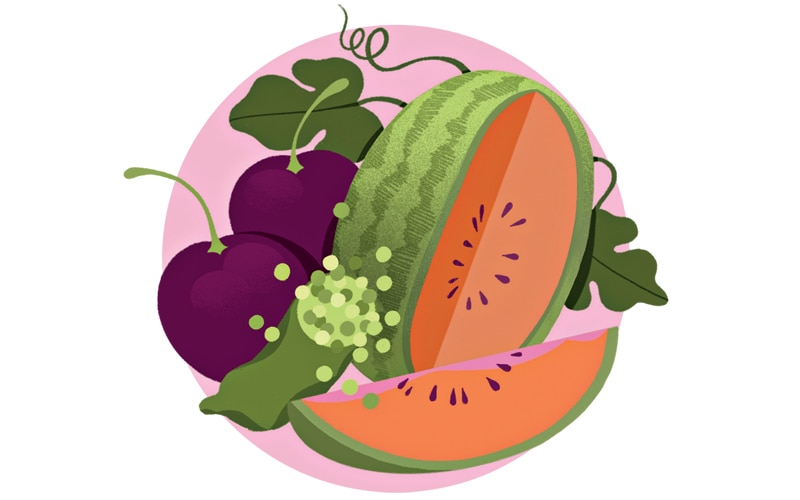 Illustration by Kate Traynor
“I don’t know how to prepare them.”
“It’s pretty well studied that one reason people avoid produce is because they don’t know what to do with it,” says Nestle. If you’ve been eating the same limp green beans, boring salads and tasteless tomatoes, it could be time to branch out. If you search ‘cucumber guy’ on Google, you’ll find Logan
Moffitt, a 24-year-old Canadian who makes videos about delicious ways to prepare cucumbers, which he loves. His creative cucumber salads, which he shakes in quart-size containers, have earned him over seven million followers. And the website for Melissa’s Produce—www.melissas.com—contains recipes for many of the 1,500 different produce products offered.
“It takes too much time to wash them, chop them, prepare them.”
This excuse may have once been valid, but not anymore. Not only can you buy canned or frozen vegetables that are already cut and washed, but you can buy fresh fruits and vegetables that way too. Most supermarkets now offer a large assortment of cleaned, cut and chopped produce. Chopped onions, for one, are a game changer. No more tears!
—With inputs by Ishani Nandi
To gain more insight into what you eat and drink, click here.