A Life on the Line: Slackliner and Adventure Athlete Samar Farooqui's Amazing Comeback
A near-fatal fall nearly ended Samar Farooqui’s story. But his comeback turned into his greatest adventure yet
 Samar Farooqui, performing his record-setting free solo highline walk in April 2019. Photo: Courtesy of Samar Farooqui
“I love you guys. I’ve had a good life, so don’t be sad.”
It was 16 August 2023, and 32-year-old Samar Farooqui had said his goodbyes. Moments earlier, the extreme-adventure athlete had leapt off a 530-metre cliff in Lauter-brunnen, Switzerland. He knew something was wrong the instant his parachute deployed: It opened with a violent 540-degree twist. Within seconds, he was sent smashing into the mountain face at roughly 70 kph.
Then—silence. He was no longer falling. He found himself hanging, his parachute wrapped around his body, around 200 metres from the top of the cliff. He had no idea what had stopped his fall, or what was holding him up.Then the pain hit—immediate and searing. His left hand was mangled. The right one could barely move. A sharp agony shot through him when he tried to shift his left leg—the thighbone had snapped. His other leg was caught in the parachute lines. When he tried to free it, whatever was keeping him in place gave way and he slid down a few inches. There was no way to tell how long it would hold.
For 40 long minutes, alone and helpless, Samar Farooqui hung between life and death.
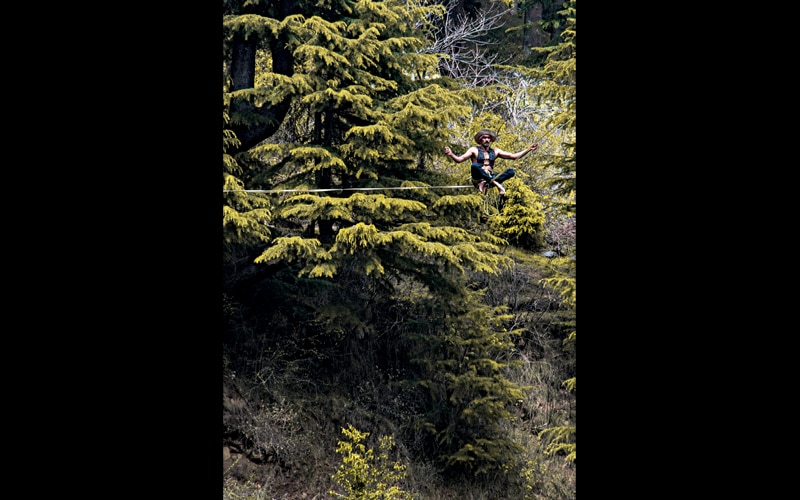 Highlining in Manali, India. Photo by Saurav Mahato
Walking the Line
Risk was never an abstract to Farooqui. He grew up exploring the outdoors with his mother, Afsar, a former National Cadet Corps officer. The Sahyadri hills, along the outskirts of Mumbai, became his playground. They hiked to hidden waterfalls, and slept under the open skies. Though studying mass media at the time, he had already sensed where his future lay.
Slacklining was Farooqui’s gateway into the world of adventure sports. Balancing on a thin polyester rope between anchor points around the city felt meditative, and offered a rare stillness amidst Mumbai’s chaos. Highlining—walking the rope at greater heights—followed, as did a deeper sense of himself and his life’s calling.
In 2010, he travelled to New Zealand to study adventure tourism. There, he explored rock climbing and began training to skydive. By the time he returned to India, he was certain: extreme sports would be his profession.The early days of practising what was then a largely unknown sport had its share of surprises in store. Farooqui was invited on television shows to showcase his skills. He was also marched to a police station in Mumbai for ‘distracting’ two bikers and causing an accident. In Dhauj, a popular adventure spot near New Delhi, cops asked him to pull down his highline, unsure of just what he and his mates were up to. But curiosity gradually turned into acceptance.
“Through these incidents, I drew attention towards slacklining. I soon found support in a few who recognized its beauty, how it was exercise and therapy, besides of course, a sport that was growing rapidly around the world,” Farooqui recalls.
His abilities soon took him places while also driving him to push his limits. In 2019, he pulled off the longest, free solo—without any safety tether—highline walk in India across a 33-metre expanse between two mountains in Lonavala. The feat demanded rigorous discipline and deep focus. It also reinforced something he already knew: he thrived at the edge. And his next frontier would push his talent to the limit.
Chasing the Void
A BASE jump lasts only seconds. The athlete steps into open air, accelerates to terminal velocity, and relies entirely on a parachute to break the fall. There is no backup system. No second chances.
“It’s a very nuanced practice,” Farooqui explains. “Meticulously packing the equipment. Studying the terrain, the season and conditions, choosing the right access point; even one’s body position determines how fast you fall and how the parachute opens.”'
Each jump offers vital experience. Lessons too: composure is just as crucial as daredevilry; fear is also a friend, because it begets vigilance; planning and reconnaissance can minimize risk—but never erase it. Little wonder then that there are fewer than a dozen practitioners of the sport in India—and according to the BASE Fatality List, 224 deaths over the last decade. “The danger is very real,” he says. “That’s what puts you in the mindframe where the jump is all that matters.”
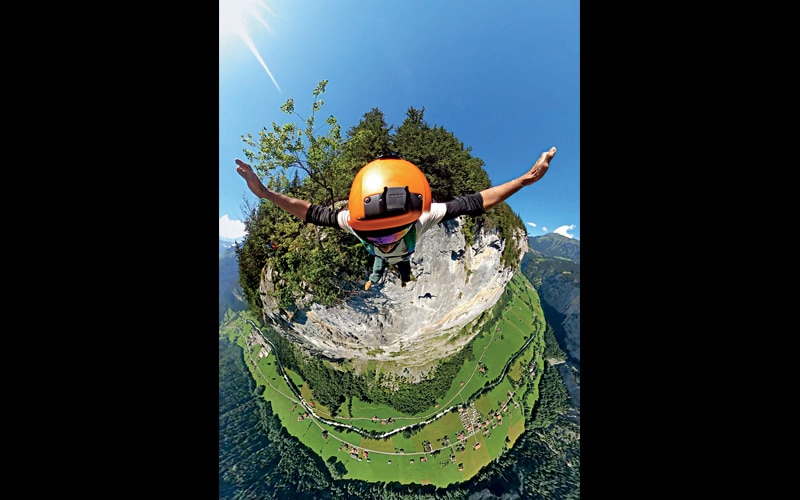 Farooqui’s jump from the Dumpster in Switzerland
By 2019, Farooqui had completed 120 skydives over eight weeks in Russia, earning him his skydiving certification. In 2022, he trained in France, Italy and Switzerland to pursue BASE jumping formally. Back home, he opened jump sites in Matheran and Malshej Ghat.
In 2023, an opportunity took him back to Switzerland. Over a week, he completed about 20 jumps. On the final day, he chose a slightly more difficult jump point known as the Dumpster—a site, he soon learnt, that lived up to its name.
The Impact
When the parachute twisted, Farooqui immediately switched to damage control mode. The textbook solution was to unwind the lines, but his novice skills betrayed him. He contemplated going feet first towards the mountain and pushing off and away to dislodge himself. “It all happened in a flash, but to me, time seemed to slow. There was a conscious train of thought where I tried to make pragmatic decisions,” he recalls. As shock from the trauma took over his body, his distressed cry for help echoed across the valley.
Later, he would learn from photographs that his parachute had snagged on a tree he had never noticed while studying the route. “In hindsight, I think complacency had set in after 58 jumps. I couldn’t anticipate the speed and force of the impact. I was also dealing with a personal crisis, using the sport as a kind of coping mechanism—perhaps my focus was off,” he says.
Up on the clifftop, Farooqui’s partner had called for help. A helicopter arrived, passed by, and then returned. Then it inexplicably circled and left a second time. Despair began to set in.
To stay conscious, he focused on his breathing. At one point, he began drifting into unconsciousness before a sudden sneeze reignited the pain and jolted him awake. His grip on life seemed to slip away. “I didn’t want to die, but I said my prayers. I made peace with it,” he says. He recorded a message for his loved ones on his GoPro, hoping it would be found. Finally, the helicopter returned a third time and the rescuers devised a long-line extraction. He was finally lowered into the valley and rushed to the hospital.
Farooqui had suffered multiple compound fractures including a left femur that was shattered into three pieces. That evening, surgeons operated—the first of nine procedures. A rod was inserted into his thigh, a screw fixed into his hip, and bone grafted into his hand.
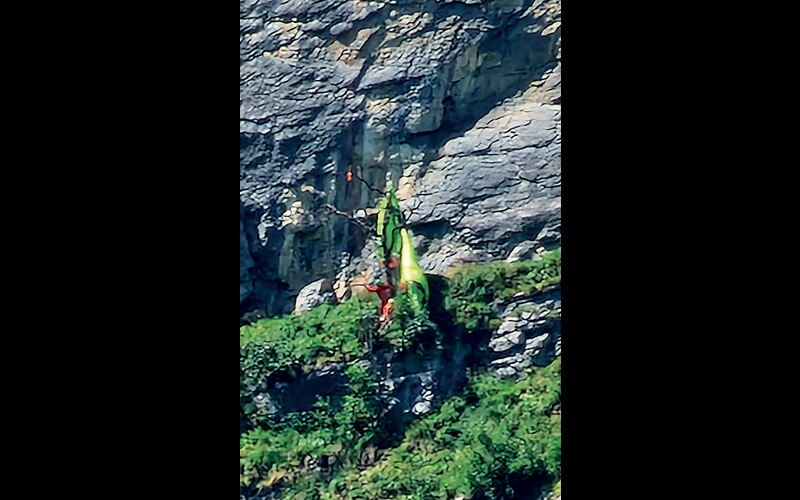 Farooqui was slammed into the mountainside when his parachute got caught in a tree. Photo: by 20 minuten
Rebuilding
As doctors in Switzerland and India reconstructed his body, Farooqui’s mind unravelled. Emotionally, he was wrecked, filled with anxiety and dread about the future. One doctor told him he would never again do a pull-up. The thought of having to give up the outdoors, and his passion, tore him apart. Medical bills mounted. The most basic tasks left him exhausted.
When he returned to Mumbai a month later, his mother had to assist him constantly. One night, he woke to find her resting at the foot of his bed. The moment broke him.
“I couldn’t bear to see her suffering because of me,” he says. “I blurted out that I wish I hadn’t survived. It was wrong to think like that, but I was so frustrated that my mother was having to look after me at an age when I should’ve been there for her,” he says.
Depression crept in quietly, and Farooqui realized he needed structure. “If I left my mind empty, I would go down a rabbit hole,” he says. “So I started looked for ways to be productive.”
He began by watching the accident footage. Frame by frame, he dissected the jump. The first few viewings were unbearable. But gradually, revisiting the trauma became therapeutic. Understanding replaced fear. Acceptance replaced avoidance.
When further surgeries required more immobility, he prepared mentally. If his body could not move, his mind would. He began writing, expressed gratitude and leaned on his support system—his family, his girlfriend, friends. “Your victories are never your own,” he says. “They belong to your support system. I’m not sure what would have happened if I had kept it all bottled up.”
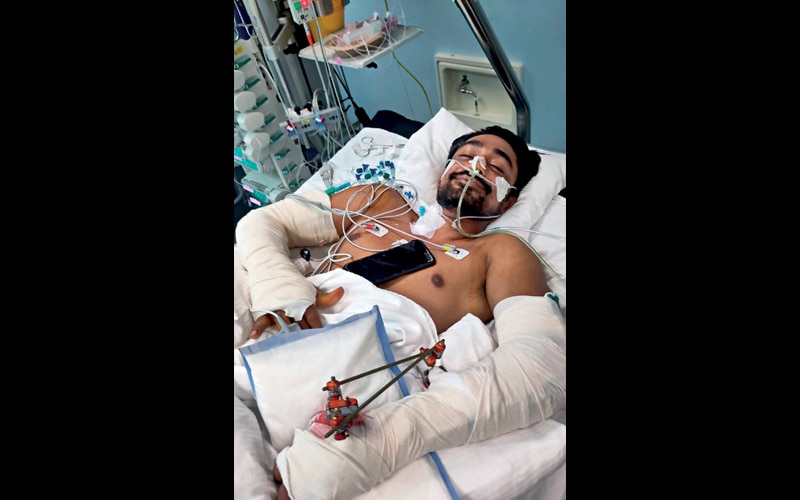 It took nine surgeries to correct and heal the multiple fractures he sustained. Photo courtesy of Samar Farooqui
Scars and Second Chances
By early last year, Farooqui was back on his feet. There were still some physical hurdles to cross, but he chose, at least for some time, to move forward. He returned to slacklining, rediscovering balance and relearning his body’s abilities, no longer taking them for granted. The scars that once unsettled him became testimonies of survival.
“I was close to dying, but I wouldn’t change a thing,” he says. He recognizes the statement may sound extreme. The experience was brutal, but the clarity it brought—the stripping away of illusion and arrogance—was transformative.Today, another goal stirs in him: setting the record for the highest slackline walk in the world, suspended between two hot-air balloons.
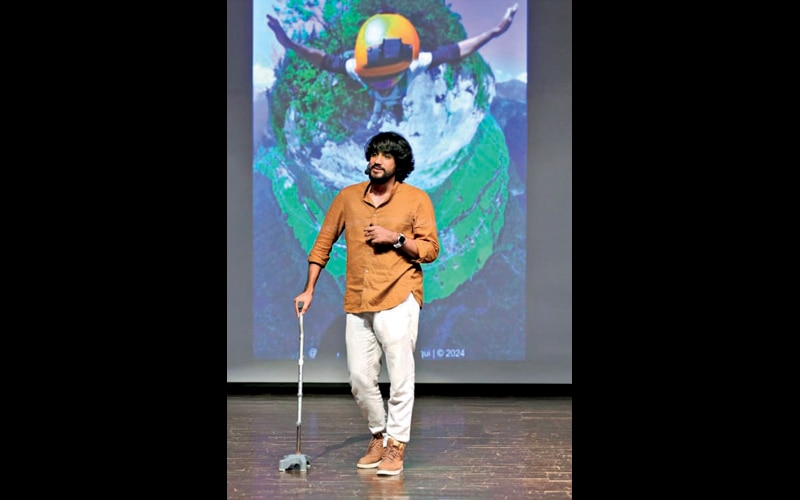 On stage at the AEE Asia-Pacific conference where he was invited to speak about his journey. Photo: AEE APAC
And there is unfinished business in Lauterbrunnen. He wants to return to the Dumpster—not to defy death or chase recklessness, but to complete a conversation interrupted mid-air. “I may not be BASE jumping all my life,” he says. “But I want to finish that jump—to prove a point to myself.”
There will be days he wins. Other days when he won’t. “And that’s absolutely fine,” Farooqui adds. “As long as I have the willingness to get up, go back and give it all another shot.”
Love this? For more thrilling tales of survival, click here.